Many state and local government IT teams are working to control costs while maintaining high-performing IT systems by simplifying their IT operations. For a small county IT team managing Windows, macOS, Linux, and mobile devices across multiple departments, the difference between one unified console and six or seven fragmented tools isn’t a matter of preference; it’s the difference between merely keeping systems running and having the capacity to take on meaningful strategic work.
The hidden burden of tool sprawl
Before you can simplify services for residents, you have to simplify the work of the IT teams running those systems. Fragmented tools mean inefficiency, duplicated effort, lost visibility, and higher costs.
Inefficiency
Many state and local IT shops manage as many as ten separate tools to monitor and manage endpoints, patch devices, remediate vulnerabilities, back up critical data, support remote users, and more. Each additional tool means a separate console, separate credentials, a separate patch cycle, and a separate audit trail. This leads to context switching that creates a bottleneck and slows the team’s ability to support their residents.
Duplicated efforts
In many agencies, the day-to-day work of patching, deploying software, onboarding and offboarding devices, remediating vulnerabilities, and more are still largely manual. And because IT is often managed department-by-department in counties and municipalities, the same problem may be solved in a dozen different ways across a dozen different teams. The result is duplicated effort at scale, slower service delivery, and a wider attack surface.
Lack of visibility
IT teams managing multiple tools housed on multiple platforms lack the deep visibility into all endpoints that helps ensure you can see and manage all endpoints on your network. When your IT team lacks visibility into all your endpoints, a significant portion of those endpoints go unmanaged, opening the door to cyber threats.
Three steps to simplified IT
Simplifying IT operations comes down to three steps: consolidation, automation, and end-user enablement.
Consolidation
It’s tempting to jump straight to automation. However, you can’t automate a fragmented stack effectively. So first, carefully evaluate your current IT operations tools. List every agent running on every endpoint and every console an IT staffer logs into in a given week. The redundancies become obvious quickly. From there, examine if or how you can integrate them into your platform. If that’s not possible, look for a vendor that offers a unified platform from which you can control it all – endpoint management, patching and vulnerability management, backup, remote support, ticketing, mobile device management, etc. The more tools that are housed in a single platform, the fewer integrations your team will need to maintain and the lower your attack surface will be.
Automation
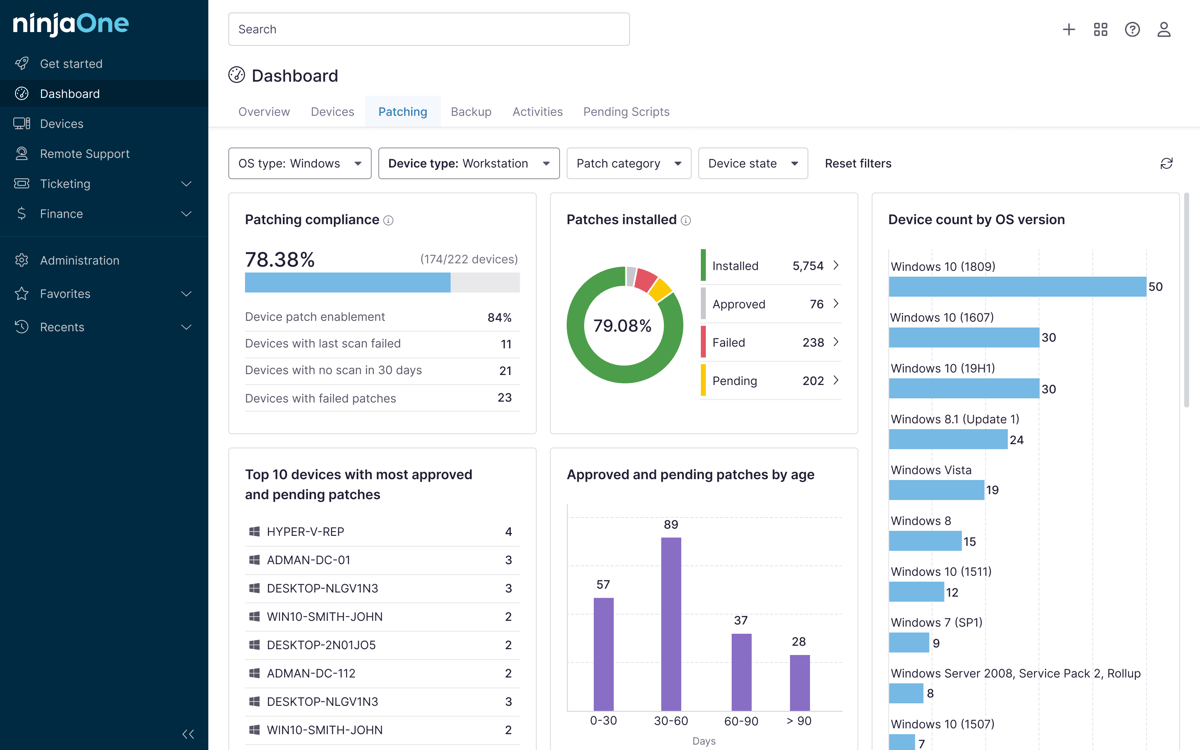
Patch deployment, configuration baselines, software installation, and device hardening are well-defined, routine tasks that make ideal candidates for automation. Target the highest-volume manual workflow (almost always patching) and automate it first. A 30-to-60-day pilot is sufficient. You don’t need a multi-year program to demonstrate meaningful value in weeks. Automating other routine tasks takes the manual effort out of day-to-day tasks and frees up your IT team for more strategic projects.
End-user enablement
Every password reset or routine software reinstall that doesn’t become a help desk ticket is time returned to your IT team. At scale, self-service capabilities are one of the most underrated force multipliers available to lean public sector IT shops.
But what about compliance?
One of the most common counterarguments to simplification in SLED is compliance. The concern is legitimate: agencies operate under NIST, HIPAA, PCI, CJIS, and a growing set of state-level frameworks.
But compliance and operational simplicity don’t have to move in opposite directions. When configuration baselines, patch SLAs, and endpoint controls are defined as policies inside a single platform, compliance becomes an output of normal operations. Procurement alignment, through authorizations like GovRAMP and FedRAMP®, eliminates another friction point before it stalls a project.
Measure progress
Simplification is only credible if it’s measurable. A few metrics that provide credibility include:
- Tools consolidated and licenses retired: If the tool count is staying the same or rising, simplification is not happening.
- Time-to-patch and patch coverage percentage: How fast can a critical patch reach every endpoint, and what percentage of devices actually receive it?
- Percentage of endpoints under active management: Your security posture and operational efficiency will improve the closer you can get to 100 percent of devices under active management.
- IT staff hours redirected to strategic work: Ultimately, simplification is about returning time. By automating routine tasks, IT teams can put those hours saved toward modernization, hardening security, and improving service delivery.
Simplification is doing more with less
The work of simplification in state and local IT isn’t about doing less. It’s about eliminating the work that shouldn’t exist in the first place: the duplicate tools, the manual patch cycles, the visibility gaps, the tickets that never should have been opened. When state and local government IT teams get those hours back, modernization actually happens. Citizen services actually get easier. And the people doing this work feel like they’re building something that matters.
That’s the opportunity in front of every state and local IT leader right now. The agencies seizing it aren’t waiting for the perfect conditions. They’re starting with what they can see and automating what they can reach.
Learn how the Unified NinjaOne IT Operations Platform™ helps you simplify IT for state and local government IT.