
Key Points
- What is the most effective MSP sales outreach strategy in 2026? A structured, multi-channel MSP sales outreach strategy improves response rates and builds trust by combining phone, email, and social media touches in a consistent cadence.
- How fast should MSPs respond to inbound leads? Inbound leads should be contacted within 5 minutes to be significantly more likely to qualify, making a faster 9-touch cadence over 10 days the recommended approach.
- How many touches should MSPs use for outbound sales outreach? Outbound MSP sales outreach performs best with 9 touches spread over 15 days, allowing MSPs to build credibility without overwhelming cold prospects.
- What are the best times to contact MSP sales leads? Midweek mornings (10:00 AM- 12:00 PM) continue to deliver the highest engagement rates for MSP sales emails and calls.
- Does multi-channel outreach improve MSP sales results? Yes. MSP sales cadences that use three or more channels consistently outperform single-channel outreach in both response and conversion rates.
In this guide, we cover different strategies to improve the response rates for your MSP sales outreach. We preview what the current data says about the best times to reach out, how many sales touches you should plan for, and how to create a high-converting sales cadence.
MSP sales outreach in 2026: What’s changed?
In 2026, MSP sales outreach is less about volume and more about precision. Buyers are more informed, more selective, and far more resistant to generic sales messaging. Business leaders are responding more favorably to tailored and genuine messaging. This means that decision makers now expect outreach to be both relevant and aligned with their buying stage, especially across email, phone, and professional social channels.
Previously, we covered 19 MSP Lead Generation Ideas That Don’t Require Being In-Person. Still, as much as we covered everything we wanted to (or could) in that article, generating leads won’t get you anywhere if you can’t find an effective way to get those leads to take the next step.
That’s where this article will be extremely useful. The “next step” in your multi-channel outreach strategy may not necessarily be asking a prospect to hop on the phone with you or scheduling an assessment. Some prospects may need warming up first or require several co-creating sessions before agreeing to any type of collaboration.
In practice, this means MSPs need clearer cadences, faster response times for inbound leads, and more patient, value-driven outreach for outbound prospects.
💡 Who this guide is for: MSP sales professionals, business owners, or marketers looking to implement consistent, measurable outreach strategies.
What is lead nurturing and a cadence?
Establishing meaningful connections with potential clients today requires a thoughtful, well-timed approach. Success depends on understanding who you’re reaching out to and making contact in a way that aligns with their priorities and timeline.
This is what lead nurturing is: It is the process of building a relationship with a prospective client with the goal of eventually securing a meeting and closing a sale. Contrary to popular belief, it is not “lying” to gain a sale or to practice some sort of slightly illegal tactic to get people to like you and your business. Rather, it focuses on the specific actions you can take to advance a relationship, such as phone calls, emails, or social media outreach (referred to as sales touches), to create a structured, repeatable sequence (the result of which is a sales cadence).
Why your MSP sales cadence matters
It’s important to remember that there are practically an infinite number of things that keep leads from becoming customers right away — fear of the unknown, existing contracts, loyalties, lack of information, etc. While you can’t control those factors, you can control the consistency and professionalism of your outreach.
By developing a clear and measurable MSP sales cadence, you ensure prospects receive timely, relevant communication across multiple channels. This approach keeps your business top-of-mind and positions you as a credible, trustworthy provider, ready to help when the timing is right.
Get actionable steps to improve the efficiency of your MSP sales process.
📥 Download NinjaOne’s MSP Sales Process Guide and Checklists.
MSP sales funnel: From lead to client
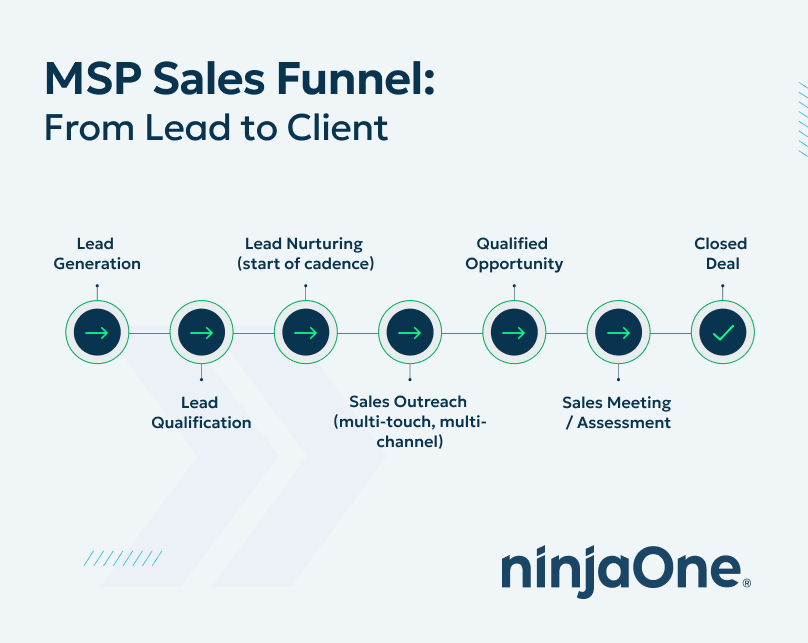
💡 Where this guide fits: This article focuses specifically on the lead nurturing and sales outreach phases of the MSP sales funnel—arguably the most make-or-break stages. If you’re looking for tips on how to generate leads in the first place or how to convert qualified opportunities into deals, check out our related resources on MSP Marketing Guide: Overview, Strategies, & Tips and MSP Sales Process Guide: Steps & Examples for 2026.
How often should MSPs contact sales leads?
Good sales leads are precious. You obviously don’t want to burn through them, but sitting on them and not making any outreach isn’t going to do you any good, either. Striking a good balance between being active and being annoying can be tricky (After all, you get sales calls and emails — you know how they can make you feel).
So, how much is too much?
It depends on the type of lead
The answer depends heavily on the nature of the lead and their prior engagement with your business.
Recent sales research continues to show significant variation in how many touches different prospects typically need before converting, especially between inbound and outbound leads.
| Lead type | Recommended touches |
| Inactive customer | ~1-3 |
| Warm inbound leads | ~5-12 |
| Cold outbound leads | ~20-50 |
Source: EmailToolTester – How Many Touchpoints Before a Sale (2026)
This variability is why it’s important to align your MSP sales cadence with the type of lead you’re working with. Warm leads may convert after just a few well-timed emails or calls, while cold prospects will require significantly more persistence.
How leads type shapes your MSP sales cadence
Inbound leads are those that have interacted with your brand already. That interaction could be downloading an ebook, subscribing to your email newsletter, attending a virtual event, or filling out a contact form on your website. They’re already at least vaguely familiar with you (your name might ring a bell), even if they aren’t completely aware of your offerings.
Outbound leads, on the other hand, are prospects that haven’t had any of those interactions. They may be from a list you purchased or an attendee roll at a recent digital conference. These leads are almost always cold. As such, they require more frequent outreach, a longer cadence, and a greater education on education and value-building to warm them up.
💡 Key takeaway:
Inbound = Fewer, faster touches
Outbound = More frequent, patient nurturing
Why multi-channel outreach boosts response rates
Whether you’re contacting inbound or outbound leads, the number of touches alone doesn’t tell the whole story. You also need to consider the variety of communication methods you use.
Research from saleshandy shows that sales sequences incorporating three or more channels can experience significantly higher response rates compared to single-channel outreach.
Key channels for MSP sales outreach
- Phone calls (plus voicemails): Provides a personal touch and immediate interaction.
- Email: Ideal for delivering detailed information and follow-ups.
- Social media outreach (e.g.LinkedIn InMails): Effective for establishing connections and sharing relevant content.
By integrating these channels into a cohesive sales cadence, MSPs can enhance their visibility and increase the likelihood of engaging potential clients.
Recommended cadence for inbound leads
Inbound leads should be treated with urgency. They’re warm and are often exploring their options at the moment, which makes timely outreach critical.
Multiple studies continue to show that responding to a warm lead within 5 minutes from the first point of contact can make you up to 21x more likely to qualify them compared to waiting 30 minutes or longer. For example, Gitnux’s 2026 study showed that rapid response times have a significant and continued impact on qualification scores.
| Response time | Impact on lead qualification |
| Within 5 minutes | 21x more likely to qualify |
| Within 30 minutes | Significantly higher qualification vs. delayed response |
| After 30 minutes | Sharp decline in qualification rates |
Take note that most inbound conversations either advance or stall within the first 10–14 days, which is why a concentrated early cadence remains effective. To capitalize on this momentum, you need a structured and timely outreach plan. Below is a sample 9-touch cadence over 10 days, aligned with modern engagement best practices and current CRM platform recommendations.
Example inbound lead cadence: 9 touches over 10 days
| Day | Action | Channel | Purpose |
| 1 | Call + Voicemail, followed by Email | Phone + Email | Respond quickly while interest is high |
| 2 | LinkedIn Connection Request | Social Media | Create a professional touchpoint |
| 3 | Follow-up Email with Case Study | Provide proof of value with a relevant success story | |
| 4 | Second Call Attempt + Voicemail | Phone | Show persistence, offer help |
| 5 | No outreach (pause to give space) | — | Avoid overwhelming the lead |
| 6 | LinkedIn Message or Post Engagement | Social Media | Maintain visibility through light interaction |
| 7 | Educational Email (e.g., helpful blog or tip) | Provide value without a hard sell | |
| 8 | Final Call Attempt + Voicemail | Phone | Reiterate the offer or invite to connect |
| 9 | Breakup Email | Respectfully signal the end of outreach, keep the door open | |
| 10 | LinkedIn Follow-up Message | Social Media | Final touchpoint to stay on the radar |
Recommended cadence for outbound leads
Because there is no existing relationship, cold outreach needs to be approached with greater patience, consistency, and tact. The goal is not to push for a sale right away, it’s to introduce your business (and product/service), demonstrate relevance, and earn trust over time.
A well-structured outbound sales cadence helps your MSP:
- Avoid being marked as spam or completely ignored (or both).
- Stay top of mind through professional persistence
- Create multiple opportunities for a lead to respond on their own terms.
💡 While inbound cadences can move faster, outbound outreach should be more spaced out and less intense per day—but still consistent.
Example outbound lead cadence: 9 touches over 15 days
| Day | Action | Channel | Purpose |
| 1 | Personalized Intro Email | Introduce your MSP with relevance to their business | |
| 2 | No outreach | — | Avoid overwhelming the lead |
| 3 | LinkedIn Connection Request | Social Media | Soft touch, low-friction brand visibility |
| 4 | Call Attempt + Voicemail | Phone | Personal follow-up referencing the initial email |
| 5 | No outreach | — | Avoid overwhelming the lead |
| 6 | Case Study or Social Proof Email | Social Media | Build credibility using a relevant success story |
| 7 | No outreach | — | Avoid overwhelming the lead |
| 8 | LinkedIn Like or Comment | Social Media | Keep presence alive through passive engagement |
| 9 | Second Call Attempt + Voicemail | Phone | Reiterate value and offer quick Q&A |
| 10 | No outreach | — | Avoid overwhelming the lead |
| 11 | LinkedIn Message | Social Media | Direct message with insight or a helpful prompt |
| 12 | No outreach | — | Avoid overwhelming the lead |
| 13 | Final Call Attempt or Breakup Email | Phone or Email | Close out politely, reaffirm value, keep door open |
| 14 | No outreach | — | Avoid overwhelming the lead |
| 15 | LinkedIn Content Share or Nurture Email | Social or Email | Passive value-add to leave a lasting impression |
Inbound vs. Outbound MSP sales cadence comparison
| Element | Inbound cadence | Outbound cadence |
| Lead type | Warm (has interacted) | Cold (no prior engagement) |
| Primary goal | Qualify quickly, strike while interest is high | Build awareness, establish trust |
| Tone | Direct, solution-focused | Educational, light, credibility-driven |
| Pacing | Faster (daily touches acceptable) | Slower (intentional gaps between touches) |
| Sales touches (recommended) | 9 touches over 10 days | 9 touches over 15 days |
Will you be annoying potential clients?
Unless you’ve been trained as a salesperson, it can feel awkward and embarrassing to reach out to people who are basically strangers and eventually ask them to part with their money.
That can especially be the case when reaching out to cold, outbound leads. Many MSPs and clients only know the outreach they’ve been subjected to — and a lot of it is annoying, not to mention ineffective.
But here’s the secret: Don’t do what you wouldn’t want to receive. Being overly “salesy” isn’t a requirement. What works best, especially in a crowded MSP market, is authenticity. Just be yourself. Speak to your prospects the same way you’d speak to a peer: with clarity, respect, and a genuine desire to be helpful.
This isn’t “woo-woo” advice either. As long as your message offers something of value (a useful insight, a relevant success story, a thoughtful question, most prospects won’t be annoyed. They’ll recognize that you’ve put a lot of effort into your outreach and approached them as a professional—not just as a “tick” in a box.
💡 Tip: The key is balance. Do your homework, personalize your message, and provide value—but don’t overthink it. Friendly, helpful, and human always wins over formulaic and forceful.
What to say in your MSP sales outreach messages?
For starters, the most important thing to keep in mind is that your goal isn’t to sell a lead in one go. That’s probably never going to happen. Instead, your first goal when reaching out is to make sure you’re reaching out to the right person — the actual decision maker or the gatekeeper who can put you in front of them.
That mindset shift can make a huge difference. You’re not trying to convince or “close”—you’re evaluating fit, learning about the prospect’s current situation, and offering helpful insight when appropriate.
Focus on relevance and curiosity
The best way to open a conversation is to connect your outreach to a problem you’ve solved for other clients, especially one that the decision-maker may personally be feeling.
Start by highlighting a challenge you help solve (e.g., managing remote workers, streamlining patching, or improving response times), and frame it as a question or insight:
“We’ve helped several businesses in your space reduce remote access issues by 40%—curious how you’re currently handling that.”
Then listen. Ask open-ended questions. Find out what they get animated or frustrated talking about.
Ask the right discovery questions
Use the opportunity to gently uncover their current setup:
- How are they managing endpoints across remote and in-office users?
- Do they have any challenges with response time or ticket volume?
- What’s their IT resource bandwidth internally?
You’re not trying to run a full assessment—you’re trying to confirm that their situation lines up with your expertise. If it does, that’s your opening for the next step.
Keep it light and respectful
Whether this takes place over one phone call or across several touches will depend on the prospect. Be prepared for both. Keep your tone confident but conversational, and make your value easy to understand without diving into technical detail.
Remember: You don’t need to get into the weeds, you just need to convey enough potential value to justify a next call. In short, keep it short.
Best time to contact MSP sales leads
Timing matters in sales—and for MSPs, catching a lead at the right moment can make the difference between a conversation and a cold shoulder.
Recent data shows that the time of day and day of the week significantly impact response rates for both emails and calls. While no time is perfect, there are clear trends worth incorporating into your outreach cadence.
Optimal times to send sales emails
Global B2B email engagement data indicates that the effectiveness of email campaigns varies based on the day of the week and time of day. Here are some general guidelines:
- Midweek (Tuesday to Friday): These periods often yield higher open and click-through rates, as professionals are settled into their workweek but not yet overwhelmed with tasks.
- Late Afternoon (Around 2 PM, 5 PM, 8 PM): Sending emails during this time can catch recipients as they wrap up their day, potentially leading to higher engagement.
- Avoid Mondays and Fridays: Mondays are typically busy with the start-of-week tasks, while Fridays are often associated with winding down, making them less optimal for email engagement.
Source: The best time to send an email (2026 research) – Omnisend
Optimal times to make sales calls
According to the latest data by HubSpot, the effectiveness of sales calls varies throughout the week:
- Tuesday: The most effective day for sales calls, with a 39% connection rate.
- Wednesday: Came in second, with a 27% success rate for daily callers and 21% for regular callers.
These trends suggest that midweek days are optimal for reaching out to prospects, as they are more settled into their work routines and receptive to discussions.
Best times of day to call
The same study highlights specific times during the day when sales calls are more likely to connect:
- 10:00 AM – 12:00 PM: Prospects are wrapping up morning tasks and are more available. In fact, 51% of regular cold callers found that calling at this time period was the most productive.
- 12:00 PM – 3:00 PM: This time slot was preferred by around 26% of salespeople because they said people are more energized to speak after their lunch period.
💡 Pro Tip: The ideal time to make calls is from 10:00 AM to 12:00 PM on a Tuesday or Wednesday. Calling at these “off” hours will help you to avoid “gatekeepers” such as secretaries, who usually work 9 – 5. If you can get around them, you have a better chance of getting in contact with the decision-makers who are more likely to be at work for longer hours.
Source: The best time to make a sales call – HubSpot
How to write a high-converting MSP sales email
Email remains one of the most effective tools in your MSP sales outreach strategy—but only if it’s done well. Most prospects receive dozens of generic cold emails each week, and it’s easy to get ignored if your message sounds templated, salesy, or irrelevant.
So, what does a strong sales email look like?
1. Keep it short and focused
According to HubSpot’s analysis of over 40 million emails, messages between 50 and 125 words achieve the highest response rates, hovering just above 50%. Emails extending to 200 words still perform well, but brevity often correlates with better engagement.
2. Personalize whenever possible
Generic emails are easily dismissed. Tailor your message by referencing the recipient’s name, company, or a recent event relevant to their industry. This demonstrates genuine interest and increases the likelihood of a response.
3. Ask a clear, simple question
Every email should prompt the recipient to take action. Instead of vague statements, ask specific questions like, “Are you currently facing challenges with remote workforce management?” This invites engagement and opens the door for further conversation.
4. Write a subject line that sparks curiosity
Your subject line is the first impression. Aim for 3-4 words that pique curiosity and convey value. Examples include:
- “Improving IT Efficiency”
- “Quick Question on Security”
Avoid clickbait; authenticity fosters trust.
Source: Hubspot 2025: 150+ Sales Email Subject Lines That Get Opened, Read, and Responded To
💡 Pro Tip: Before sending, ask yourself: Would I open this email? Would I respond to it? If the answer is no, revise accordingly.
What to do when an MSP sales cadence ends
After you’ve completed one cycle of outreach with a particular lead and they haven’t become a customer (which is okay!), it’s important to give them some time to process the resources you’ve provided.
Give the lead space, but stay visible
After you’ve completed a full outreach cycle (whether inbound or outbound), don’t immediately start over. Instead, shift into a slower, long-term nurture mode.
- Invite the lead to subscribe to your newsletter or email updates
- Share occasional helpful content (e.g., checklists, security trends, remote work strategies)
- Retarget with light LinkedIn engagement or marketing automation
This helps keep your MSP top of mind without overwhelming the prospect.
When to restart the cadence
If communication drops off—but you still believe the lead is a good fit—you can re-engage after a cooling-off period (typically 4–6 weeks). When you do, make sure to:
- Update your messaging (don’t repeat the same sequence)
- Reference a new resource, event, or insight
- Be respectful and transparent about why you’re reaching back out
💡 Pro Tip: Use a CRM to track who completed a cadence, when they were last contacted, and what messaging was used. This prevents accidental repetition and keeps outreach organized.
Get proven tips to selling MSP services and nurturing leads.
→ Read our blog on “How to sell managed services“.
Accelerate your MSP’s growth
Completing your sales cadence is just the beginning. To truly scale your MSP, it’s essential to have a comprehensive growth strategy in place. NinjaOne offers a wealth of resources tailored specifically for MSPs aiming to expand their operations, enhance client relationships, and boost profitability.
Some other resources we recommend:
- Overcoming Common Growth Pitfalls: A Guide for MSPs: Learn how to navigate common challenges in scaling your MSP, from delegating tasks to standardizing services.
- Selling Managed IT Services: Key Strategies for MSPs to Expand Their Businesses: Discover actionable strategies to acquire new customers, retain existing ones, and scale your services effectively.
- Driving MSP Growth in 2026: Stay ahead of industry trends and understand how to leverage emerging technologies for sustained growth.