
Key Points
- Define Aging Criteria and Risk Bands: Segment devices by age and assign color-coded risk levels to make lifecycle data clear and actionable.
- Capture Quarterly Inventory Snapshots: Export device data with deployment dates and roles every quarter to build a consistent baseline for analysis.
- Analyze Device Age with Formulas or Scripts: Use spreadsheet functions or PowerShell to calculate device age and flag assets nearing replacement.
- Visualize Data for Easier Reporting: Apply color-coded formatting and summary tables to make risks instantly visible to both technicians and clients.
- Present Findings During QBRs: Turn technical data into strategic recommendations that guide budgeting and refresh planning.
- Establish a Repeatable Quarterly Review Process: Maintain historical trend data to track changes over time, strengthen planning, and prevent hardware surprises.
Proactively managing hardware lifecycles is essential to maintain optimal performance and client satisfaction. Outdated hardware not only drives up support costs but also increases the risk of downtime and security incidents, yet most MSPs lack a clear process for tracking device age or warranty status.
In this article, we’ll present a repeatable, manual approach: export device inventory data each quarter, calculate age, flag high-risk devices, and use simple color-coded visualizations to surface actionable insights for client strategy meetings. The goal is straightforward planning and risk reduction, leveraging existing data rather than relying on expensive systems.
NinjaOne plays a key role by supplying deployment dates and inventory exports — turning raw reporting data into actionable insights for refresh planning and client strategy.
Prerequisites
- Access to a device inventory including deployment date, last check-in, and device type is required (these are usually available in RMM platforms like NinjaOne).
- Ability to export inventory data in CSV format from NinjaOne or a similar management portal is essential for review.
- A spreadsheet tool such as Excel or Google Sheets, with basic date formula support, is needed to analyze, sort, and flag hardware age during the quarterly review.
Define aging criteria & risk bands
Defining clear age criteria and visual risk bands is the most effective way to make device aging reviews actionable. Start by segmenting the entire hardware fleet by age, so each device quickly rolls up into a relevant risk category. This approach allows MSPs to align urgency and replacement recommendations with business priorities and budget planning.
Under 3 years: Green (Low Risk)
Devices in this range are typically under warranty and have reliable parts. They rarely present immediate performance or security risks.
3–5 years: Yellow (Medium Risk)
Devices are nearing end of warranty and may show increasing failure rates or diminished performance. Now is the time to plan for replacements or extended support.
Over 5 years: Red (High Risk)
Hardware is at increased risk for component failure and likely to fall short of security or support requirements. These systems should be prioritized for replacement or retirement.
Use color-coded conditional formatting in your spreadsheet to highlight these bands — green for healthy assets, yellow for aging, and red for urgent action. This enables at-a-glance identification of risk in both technical reviews and client presentations, supporting more strategic and effective lifecycle management.
Capture inventory snapshots quarterly for hardware lifecycle reporting
Performing quarterly inventory snapshots is the key to building a data-driven approach to device aging and lifecycle management. At the end of each quarter, export a full device inventory (including deployment date, last check-in, and device name/role) from NinjaOne or your RMM platform. Ensuring these critical fields are present in every export enables meaningful age calculations and role-based risk analysis across the environment.
Consistent naming conventions like “ClientA_Inventory_Q2_2025.csv” make future comparisons easy and prevent records from being lost or overwritten. Over time, this systematically archived set of snapshots allows MSPs to track trends, identify declining device populations, and proactively recommend asset refreshes. A quarterly cadence also provides the structure needed for client reporting, asset strategy discussions, and compliance reviews — without complex systems or manual guesswork.
Analyze device age using spreadsheet formulas
Analyzing device age with spreadsheet formulas brings instant structure and insight to the manual review process. Start by calculating the age of each device in years using:
=DATEDIF([Deployment Date], TODAY(), “y”)
Apply conditional formatting in Excel or Google Sheets to highlight risk bands visually:
- Green for devices under 3 years (low risk)
- Yellow for 3–5 years (medium risk)
- Red for over 5 years (high risk)
This color coding lets teams and clients see urgent priorities at a glance. Go further by summarizing devices in each age bracket, enabling easier reporting, benchmarking, and planning a hardware refresh. Here’s an example summary table:
| Age Bracket | Device Count | Notes |
| <3 yrs | 15 | Stable, under warranty |
| 3–5 yrs | 8 | Plan for upcoming hardware refresh |
| >5 yrs | 3 | Immediate replacements |
These simple spreadsheet formulas and summaries help MSPs turn exported data into actionable intelligence for quarterly client reviews—no expensive tools required.
Automate age calculations via script (Optional step)
To save time and eliminate input errors from manual spreadsheet formulas, MSPs can automate age calculations directly with a PowerShell script. Import your inventory CSV export, then run the following code:
Import-Csv inventory.csv |
Select DeviceName, @{Name=”AgeYears”;Expression={
[math]::Floor((Get-Date – [datetime]$_.’DeploymentDate’).Days / 365)
}} |
Export-Csv aged_inventory.csv -NoTypeInformation
This script processes each device record, calculates the age in integer years based on deployment date, and exports the results into a new CSV. The resulting age data can be directly imported into Excel or Google Sheets, letting teams focus on analysis, flagging, and client communications — not manual data entry or formula troubleshooting.
Automating this step makes quarterly reviews fast, accurate, and repeatable for every client engagement.
Present insights in QBRs with strategic recommendations
Presenting device age analysis in QBRs transforms raw technical data into strategic, client-focused guidance. Use the age report as a central narrative, spotlighting notable trends such as an increase in 3–5 year devices approaching replacement or a spike in high-risk hardware over 5 years old. Summarize findings in clear statements — like “three devices over 5 years should be budgeted for replacement next quarter” — to help clients forecast costs and minimize risk.
Reinforce urgency and impact with visual charts: bar graphs, pie charts, or color-coded tables that clearly illustrate the distribution and trend of device aging across the environment. These visuals make it easier for non-technical stakeholders to understand why replacement or refresh planning matters, empowering decision makers to act with confidence. This approach shifts quarterly review conversations toward proactive strategies, improving budget planning, reducing downtime, and building long-term trust with every client engagement.
Establish quarterly review cadence
Establishing a quarterly review cadence for device aging ensures MSPs and clients stay ahead of risk and replacement needs. Start every quarter by archiving the prior report to maintain historical trend data. Then, re-export inventory from NinjaOne or your chosen platform, updating key fields like deployment date, check-in time, and device role. Apply spreadsheet formulas to refresh age calculations and update color-coded risk bands.
Track how device age distributions shift over time to reveal patterns — such as a rising count of high-risk devices or a successful hardware refresh cycle. At each QBR, review findings with clients, jointly setting priorities and agreeing on specific actions for replacement, budget allocation, and warranty renewals.
This process turns a manual review into a strategic planning rhythm, leading to more predictable costs, less downtime, and improved trust in MSP guidance. Repeating the manual device age review process every quarter creates a reliable rhythm for proactive hardware management.
- Archive previous reports to preserve historical context, then re-export updated inventory from NinjaOne or your RMM tool.
- Refresh age calculations in your spreadsheet to maintain current risk categorization and spot trends in hardware aging.
- Tracking changes in age distribution and device status across quarters to quickly identify growing risk bands and adjust upgrade strategies.
- Review these insights with clients in QBRs, collaborating to prioritize device replacements and agree on budget planning in advance.
This cadence builds accountability, supports better decisions, and helps prevent surprise failures in legacy hardware.
Best practices summary table
Adopting these best practices helps MSPs transform quarterly device age reviews into a powerful (and repeatable) client engagement. Each component below serves a specific function in translating technical inventory data into collaborative, business-focused action plans:
| Component | Purpose & Value |
| Defined age bands | Prioritizes hardware refresh based on objective risk and lifecycle |
| Quarterly snapshot | Provides a consistent historical baseline for tracking device trends |
| Color-coded spreadsheet | Makes risk data easy to interpret and act upon during reviews |
| Optional scripting | Streamlines calculations, reducing manual effort and increasing accuracy |
| QBR integration | Ensures technical insights prompt budgeting and strategic action |
| Review repeat cadence | Builds long-term trust and encourages proactive asset management |
By combining these practices, MSPs can ensure every client is prepared for hardware changes — well before performance or security becomes an issue.
Automation touchpoint example
Quarterly device aging reviews are streamlined with basic automation and organized workflows. This example sequence ensures every client engagement delivers at-a-glance insights, actionable guidance, and a growth-oriented archive:
- Export device inventory, making sure deployment dates are captured for each asset.
- Use the spreadsheet’s DATEDIF formula to calculate each device’s current age in years, then apply color-coded conditional formatting to highlight status.
- Tabulate counts for each age band — low, medium, and high risk — for quick reporting and prioritization.
- Incorporate findings into QBR slide decks or use them as talking points during strategic client conversations.
- Repeat every quarter, archiving each snapshot so hardware lifecycle and risk trends can be monitored and discussed over time.
Integrating this workflow ensures quarterly reviews are data-driven, visually engaging, and consistently focused on proactive hardware lifecycle reporting and management.
NinjaOne integration ideas
Integrating NinjaOne with a device aging review process creates a seamless, reliable workflow for proactive lifecycle management:
- Use NinjaOne’s inventory export feature as the consistent source of truth for device data. This guarantees that deployment dates, device names, and roles are always current and accurate for each quarterly review.
- If available, regularly pull deployment dates and other inventory details via the NinjaOne API to automate and streamline data collection, minimizing manual entry and reducing errors.
- Enhance lifecycle tracking by adding tags or updating notes within NinjaOne for devices identified as high-risk or due for replacement. Custom tags like “Replacement_Y24Q2” make it easy to sync operational actions with inventory systems and communicate priorities to the team.
- Configure workflow alerts within NinjaOne to automatically notify stakeholders when devices cross important age thresholds (for example, reaching 3 or 5 years in service). These alerts keep critical devices top-of-mind, enabling timely action and more accurate budget forecasting.
By leveraging these integration ideas, MSPs can transform NinjaOne into not just a data repository, but an active engine for risk reduction and client value.
In summary
Manual device aging reviews offer MSPs a powerful way to influence technology strategy while staying operationally lean. With nothing more than exported inventory data, a handful of spreadsheet formulas, and consistent integration into QBRs, MSPs can spot risks early, recommend replacements proactively, and help clients budget for refreshes — no complex asset management platform required. This approach not only reduces the likelihood of hardware surprises and support emergencies but also strengthens client trust.
Key takeaways:
- Capture deployment date and last check-in information for every device.
- Use spreadsheet calculations to determine device age and visually flag risk.
- Present summary analysis as strategic guidance during QBRs.
- Repeat the review every quarter to maintain proactive lifecycle alignment and avoid costly surprises.
Quick-Start Guide
Device Aging Review Capabilities in NinjaOne
1. Warranty Tracking:
– NinjaOne offers a Warranty Tracking feature that allows MSPs to:
– View warranty start and end dates for devices
– Color-code warranty status (red for expired, yellow for expiring soon, green for valid)
– Automatically sync warranty information for Dell, Toshiba, HP, and Lenovo hardware
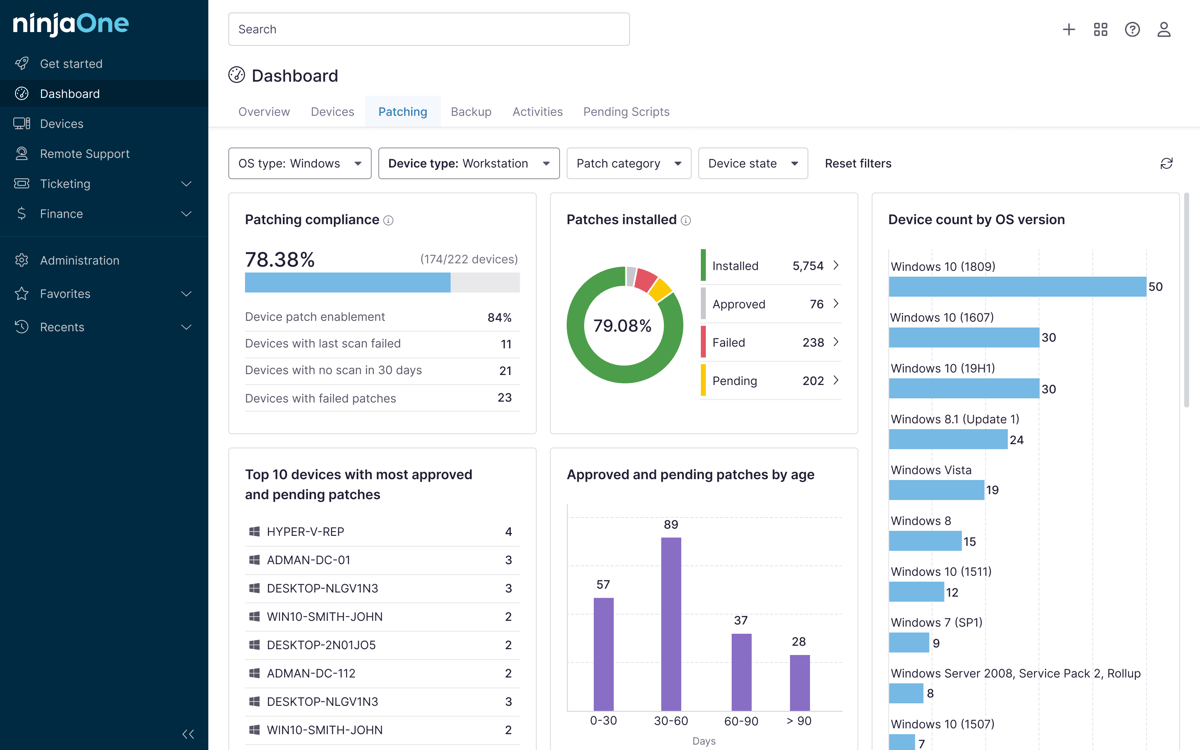
2. Patch Management Dashboard:
– Provides detailed insights into device health and aging, including:
– Device count by OS version
– Top 10 devices with most approved/pending patches
– Patch status by age and category
– Ability to filter devices by various criteria like OS type, device type, and patch status
3. Device Search Grid:
– MSPs can add and filter columns for warranty dates
– Export device information for quarterly reporting
– View detailed device health and status information
While NinjaOne doesn’t have a specific “device aging review” feature, these tools provide MSPs with comprehensive capabilities to conduct manual device aging reviews for quarterly reporting.