Key Points
- Define IT asset management reporting: ITAM reporting is the process of collecting, validating, and presenting lifecycle data for hardware, software, cloud, and SaaS assets.
- Provide real-time asset visibility: Effective ITAM reporting delivers accurate, up-to-date insight across on-prem, cloud, and remote environments.
- Reduce cost and waste: Usage and license reporting identifies unused assets, duplicate subscriptions, and renewal risks before budgets are impacted.
- Mitigate compliance and audit risk: Audit-ready ITAM reports document ownership, access, entitlements, and asset status to support regulatory requirements.
- Support data-driven decisions: Standardized metrics and dashboards align asset insights with business KPIs and strategic planning.
Effective ITAM reporting gives you accurate, real-time visibility into every asset across on-prem, cloud, and remote environments so you can control cost, reduce risk, and stay compliant. Without reliable data, you’re left guessing your spend, exposure, and where to prioritize action.
Strong ITAM reporting turns that visibility into impact. It helps you justify budgets, eliminate wasted licenses before renewal, close security gaps quickly, and align IT decisions with business goals.
In this article, you’ll learn what ITAM reporting is, the best practices that drive accuracy and value, how to align reports with your KPIs, and how to avoid the most common pitfalls.
Understanding IT asset management reporting
IT asset management reporting is the process of gathering, validating, and presenting data on all IT assets—hardware, software, cloud subscriptions, and SaaS licenses—throughout their lifecycle. You start with automated discovery tools that scan networks, endpoints, and cloud environments on a schedule. Then you normalize asset details such as model, make, purchase date, warranty status, and license counts.
This allows you to:
- Identify security gaps caused by unpatched operating systems or end-of-life devices.
- Track software usage to eliminate unnecessary license renewals.
- Monitor warranty and support contracts to plan hardware refresh cycles.
IT asset management reporting also mitigates compliance risk with audit-ready documentation. You’ll know who has access to which software and when license counts exceed entitlements. By surfacing hidden asset-related costs, like duplicate subscriptions or orphaned virtual machines, you keep budgets on track and show measurable ROI to department leads and executives.
Standards such as ISO/IEC 19770-1:2017, including its 2024 climate-action amendment, provide structure for mature ITAM programs, and the standard is now converging with FinOps terminology as more organizations run ITAM and FinOps as a single discipline (ISO; FinOps Foundation).
IT asset management reporting best practices
To get the full value from your IT asset management reporting, you need reliable data, a consistent framework, and clear visualizations that support confident decision-making. The following best practices will help you build reports that enhance efficiency, strengthen compliance, and improve cost control.
Automate data collection and validation
Manually collected data can quickly grow outdated and introduce costly errors. Automating discovery, normalization, and validation ensures your reports reflect the real environment and remain audit-ready. Modern ITAM platforms use agent-based discovery, network scanning, and API connectors to continuously pull data from SaaS, cloud, and on-premises systems.
- Use discovery tools that scan endpoints, routers, switches, hypervisors, and cloud instances on a scheduled basis.
- Validate details such as serial numbers, warranty status, and license counts against procurement records.
- Streamline updates across hybrid and cloud environments so you always have current data.
- Apply machine learning to your collected data to flag suspicious usage patterns and forecast license or hardware refresh needs.
By relying on automation, you reduce manual entry mistakes and free your team to focus on analysis instead of data gathering.
Standardize frameworks and metrics
Consistency makes reports comparable across locations and teams. Define standard KPIs for utilization, compliance, and cost optimization, then codify them in shared report templates. Align your approach with governance models like ITIL or COBIT so terminology and workflows match established practices (ISACA).
Where your organization runs ITAM and FinOps together, align report terminology with FinOps’ inform, optimize, and operate phases so both teams read the same numbers the same way. Set thresholds for asset age, performance, utilization, and license consumption so exceptions are obvious and action queues are clear.
With this foundation, every report speaks the same language to technical teams and executives, and new dashboards are faster to roll out as your environment evolves.
Visualize insights for impact
Dashboards should highlight what matters, not recreate a spreadsheet in chart form. Use trend views, thresholds, and anomaly indicators to surface your total cost of ownership (TCO), license utilization, and asset performance at a glance. Complement visuals with concise narrative summaries that clarify what changed, why it matters, and the recommended action.
When finance, operations, and security teams all see the same prioritized, contextualized view, decisions happen faster and require far less back-and-forth alignment.
ITAM reporting best practices
| Practice | What it does | Why it matters |
| Automate data collection | Uses agent-based discovery, scanning, API connectors, and ML-based anomaly flags | Keeps reports audit-ready and catches issues before renewal |
| Standardize frameworks | Aligns KPIs and templates to ITIL, COBIT, or FinOps phases | Makes reports comparable across teams and locations |
| Visualize insights | Uses trend views, thresholds, and anomaly indicators | Surfaces TCO, utilization, and performance at a glance |
Align ITAM reporting with business objectives and KPIs
IT asset management reporting brings the most value when it supports outcomes the business cares about. Build views that help teams act today and help leaders decide where to invest next.
Learn more about building a complete asset inventory without manual spreadsheet work.
Balance operational depth and executive clarity
Technical teams need granular inventory and change history, while leaders want a clear readout on risk, spend, and savings. Customize your reporting so each audience gets what they need without extra noise. For example, provide a living inventory report with full asset attributes for desktop support, and an executive overview that shows license compliance, cost avoidance, and risk reduction. Add drill-downs so leaders can move from summary charts to detailed views on demand, and schedule brief executive summaries that highlight only the top actions for the week.
Integrate financial and performance metrics
To demonstrate ROI, connect spend to outcomes like uptime and productivity. Combine purchase price, depreciation, and maintenance costs with service availability and mean time to resolution to calculate true cost per asset. Then use those insights to justify refresh cycles, negotiate vendor contracts, and time renewals when usage is low.
Additionally, highlight which SaaS subscriptions are underused or duplicated. Applying entitlement data to cloud and SaaS spend helps identify overlapping subscriptions and unused seats across platforms like Microsoft 365 or AWS before your next renewal.
This integrated view also helps you compare leasing vs. buying and decide when to extend warranties and when to replace devices.
Strengthen governance and compliance
Governance lives or dies on access controls, audit trails, and current documentation. Your ITAM reporting should automate those safeguards and reduce audit preparation work.
Key practices include:
- Enforcing role-based access controls (RBAC): Ensure that only authorized users can view, export, or modify sensitive asset data and reports.
- Maintaining audit-ready documentation: Align reporting outputs with SOX, GDPR, ISO 27001, DORA, CSRD, NIS2, and other standards and regulatory requirements so evidence is always current and complete.
- Scheduling automated compliance reporting: Generate and distribute weekly or monthly compliance summaries to keep stakeholders aligned and issues visible before audits begin.
Embedding governance in your reporting process can lower risk and shorten your audit cycles. For control mapping and asset inventories, NIST SP 800-53 CM-8 is a helpful reference (NIST).
Organizations in the EU, or serving EU customers, should also confirm whether DORA (financial services operational resilience) or CSRD (sustainability reporting) applies to their asset governance obligations.
Overcoming challenges in ITAM reporting
Even the best tools struggle if the underlying data is fragmented or if the dashboards are cluttered. Tackle these common blockers early to keep reports accurate and useful.
Address data silos and incomplete records
If asset data lives in multiple spreadsheets or point tools, you won’t get a trustworthy view. Consolidate fragmented data into a centralized repository that becomes your system of record.
Start by mapping where hardware, software, and cloud inventories are tracked across departments, then use integrations or APIs to synchronize into your ITAM platform on a regular cadence. Normalize records, enforce naming conventions, and remove duplicates so audits and capacity plans are based on clean data.
Simplify overly complex dashboards
Dashboards stuffed with every metric can overwhelm your teams. Focus on outcomes and limit each view to a few high-impact metrics like license compliance rate, cost avoidance, and risk exposure. Use color and threshold rules to flag items that need action, and retire or archive views that aren’t used.
Align stakeholders across IT, finance, and operations
If each department tracks different KPIs, you’ll struggle to present a unified view of asset health. Establish shared ownership of ITAM Reporting processes, cadence, and quality standards so everyone pulls in the same direction.
- Schedule regular reviews of asset reports across IT, finance, procurement, and operations.
- Assign clear ownership for data maintenance and report generation.
- Define common KPI targets and tie them to planning or budget allocations.
- Watch out for SaaS subscription sprawl (e.g., unused seats, duplicate tools, etc.)
With a joint governance model, teams work from the same data and aim for the same outcomes.
Quick-Start Guide
What is ITAM Reporting?
ITAM (IT Asset Management) is the practice of tracking and managing IT assets throughout their entire lifecycle—from procurement through decommissioning. It helps organizations maintain visibility and control over hardware and software inventory.
NinjaOne’s ITAM Capabilities
NinjaOne’s ITAM module enables you to:
Track Asset Lifecycle
– Monitor devices from purchase to decommissioning
– Track core asset information and custom fields
– Record asset-related activities (assignment changes, status updates, etc.)
– Automatically convert devices between unmanaged and managed states
Asset Data Management
– Import devices via CSV before they’re managed (track from order date)
– Create devices via the Public API
– Set and maintain core fields and custom asset fields
– Associate policies, owners, tags, notes, and related items with devices
Device Matching & Linking
– Automatically match provisioning devices to managed devices using:
– Link devices while preserving all historical information
Supported Device Types
– Currently supports agent-based devices (Windows, Mac, Linux)
– Future support planned for NMS, MDM, and other device types
Key Features
– Track devices before the RMM agent is installed
– Maintain asset information across the entire device lifecycle
– Generate reports on asset status and activities
– Manage device roles and classifications
This makes NinjaOne a solid choice for organizations needing comprehensive asset tracking and lifecycle management alongside their endpoint management operations.
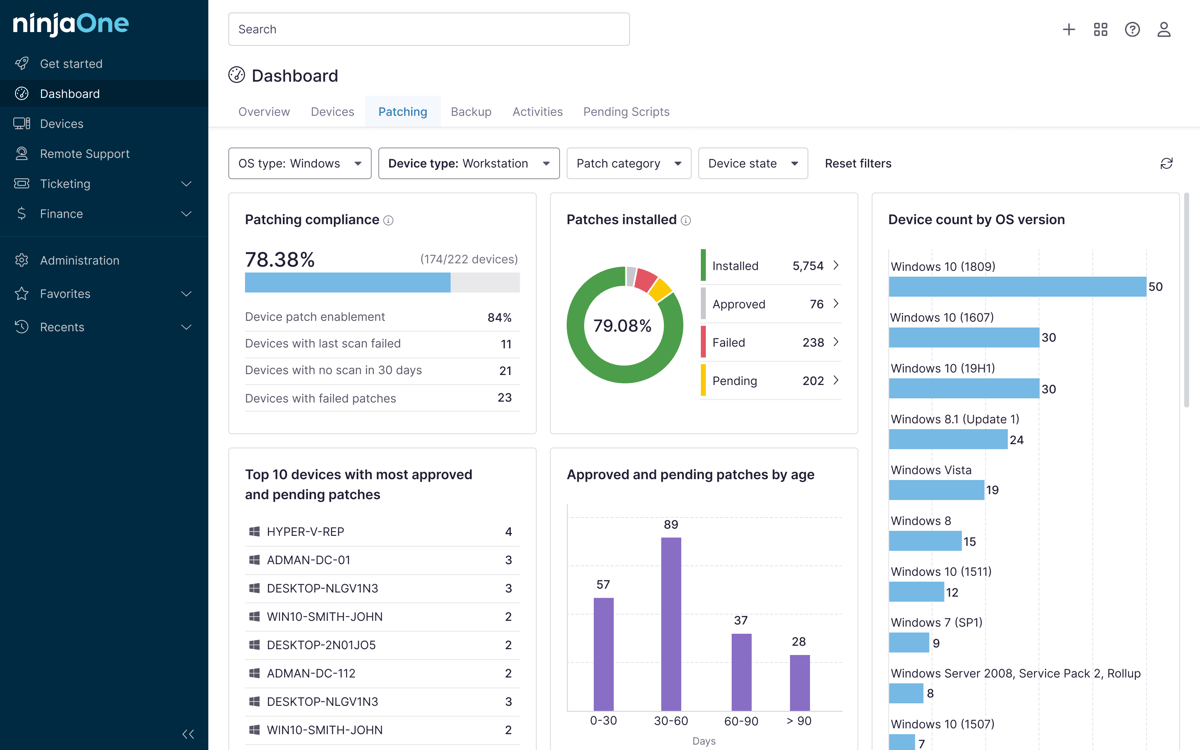
Bring inventory and reporting into one unified view with NinjaOne ITAM.
Take control of your ITAM reporting
NinjaOne unifies asset discovery, patch management, remote monitoring, and reporting in one platform. Try NinjaOne for free to see how integrated ITAM Reporting makes cost control, compliance, and efficiency easier to maintain.