
Key Points
- Patch approval and caching policies must be documented to strengthen client trust and reduce disputes.
- Clear documentation shows who approves patches, how they are tested, and when they are released, ensuring accountability.
- Caching policies save bandwidth, and explaining peer-to-peer or proxy caching helps clients understand efficiency gains.
- Templates make documentation scalable, so MSPs should use standardized formats to allow reuse and adapt policies across tenants.
- NinjaOne supports transparency through patch scheduling, caching integration, and reporting, ensuring accurate and accessible documentation.
Establishing patch approval policies with traceability in mind ensures accountability in how patches are reviewed and applied. Without an audit trail, you risk confusing clients or incurring compliance penalties. MSPs should thus aim to standardize policy approval for verifiable compliance.
This article explains how to efficiently track approved updates and answers frequently asked questions about patch caching for MSPs.
Track patch approval policies for auditability
To document patch approval, you need to set up transparent approval Standard Operating Procedures (SOPs) that align with client needs.
📌 Prerequisites:
- Established patch management policies for approval and testing
- Cache-aware distribution mechanism (Delivery Optimization, proxy caching, or WSUS)
- Documentation repository (NinjaOne documentation, Confluence, SharePoint, or client portal)
- Service Level Agreement (SLA) and Operational Level Agreement (OLA) definitions for patching timelines
Step 1: Define the patch approval workflow
Determining your patch compliance pipeline helps guarantee that important updates are applied consistently. It also improves transparency and maintains SLA compliance.
Design your patch approval policies around these tasks:
- Identify IT decision-makers: Assign ownership roles (e.g., MSP lead, compliance officer, etc.) for patch approval and transparency.
- Establish approval tiers: Prioritize critical patches over non-urgent issues for a robust review cycle.
- Clarify testing stages: Differentiate staging, pilot, and live deployments for clarity.
- Set timelines: Include SLA timeframes (e.g., critical patches must be deployed within 48 hours).
- Automate patch scheduling (optional).
Step 2: Document caching and distribution policies
Caching important updates helps reduce bandwidth consumption and speeds up deployments, while distribution varies client-to-client. Make a note of how they do both to stay on the same page during SLA-related patching discussions.
Include the following in your patch approval policy playbook:
- Cache type (e.g., P2P, proxy, cloud-based)
- Cache settings (e.g., size limits, refresh timelines)
- Bandwidth saving policies
- Diagrams visualizing distribution logic (e.g., source-to-endpoint flowchart to explain efficiency of rollouts)
Step 3: Standardize documentation templates
Standardized templates can simplify aspects of patch compliance to ensure consistency for clients.
Include the following in your patch approval workflow records:
- Approval process overview
- Caching policy summary
- SLA timelines and roles
- Client-friendly terminology
- Shared repository
Step 4: Align documentation with SLAs/OLAs
Make sure your records for patch approval policies include documentation-specific requirements outlined in your SLAs and OLAs. This ensures that your team is 100% compliant with roadmap standards, building trust.
Here’s how you can align your documentation efforts with client agreements:
- Include SLA patching guidelines (e.g., frequency, approval timelines).
- Base internal deadlines on OLAs (e.g., Task 2 should take only three days).
- Review SLA/OLA performance to refine workflows.
Step 5: Share and review patch approval policies with clients
Integrate patch approval policies into governance meetings and Quarterly Business Reviews (QBRs) to build trust, demonstrate compliance, and gather client feedback. To do this:
- Present your patch workflows
- Use comprehensive dashboards and data reports
- Acquire client acknowledgement to confirm understanding
- Use real-world patch deployment examples to drive the point home
How to verify if your patch approval documentation works
Forming patch approval policies helps foster trust while giving your team a healthy alibi during client disputes. To help build confidence in your MSP’s compliance, check if you have the following:
- Published policies in shared client portals and/or knowledge base.
- Signed client acknowledgements with added dates.
- Records of major updates being implemented as per caching/distribution standards or the SLA.
Important considerations for patch caching
IT teams must stay ahead of potential pitfalls surrounding patch approval policies to prevent disruptions and legal liability. Here are key points you should keep in mind while recording deployments:
Regulatory compliance
Align your documentation efforts with important industry regulations to lessen liability and improve auditability:
HIPAA
The Health Insurance Portability and Accountability Act (HIPAA) requires the safeguarding of electronic protected health information (or ePHI), and applies to healthcare providers, insurance companies, and business associates.
The US National Institute of Standards and Technology recommends proactive patch measures like risk analysis to emphasize cyber-resilience, especially for federal standards.
GLBA
Banks and investment firms firmly abide by the Gramm-Leach-Bliley Act, which requires documentation on how nonpublic personal information (NPI) is kept confidential.
Implement the following to comply with GLBA:
- Privacy notices.
- Opt-out mechanisms.
- Data sharing policies.
DORA
To regulate ICT risk management in important financial institutions within its region, the EU enforces the Digital Operational Resilience Act, a set of guidelines that focus on modern incident reporting, risk assessment, and third-party audits.
Make sure to include the following in your patch compliance reports for EU clientele:
- Subcontractor risk evaluations.
- Incident notification timelines.
- Internal standards for business-critical patching.
Multi-tenant MSPs
If you’re handling multiple clients on the same software service, it’s best to develop a core patch policy template with standard patch approval workflows and cache methods to simplify management. That said, you should also tailor your template to specific SLA needs.
Create a master template for general documentation, and include industry-specific regulations, device types, and SLA terms later.
Versioning
Keep things up-to-date with a documentation hub that tracks patch policies with built-in version control. This enables MSPs to easily prove their compliance with SLA-approved deployment strategies.
🥷🏻| Track dates, show authors, summarize updates, and see impacted systems in a single pane of glass.
Troubleshooting patch documentation
Here’s how to resolve the most common issues IT professionals face when documenting patch approval policies.
Clients don’t read documentation
It’s important to have client-facing reports for long-term transparency. To avoid overly technical reports, add executive summaries at the top of each audit trail and graph out your data.
Confusion about caching
How updates are packaged (or not) for efficient rollouts can vary, and too many details can muddle business-oriented conversations. Provide side-by-side comparisons on cloud-based vs. local server distribution to give clients as much clarity as they need.
Disputes over patch timing
Arguments can arise from deciding how soon future patches should be implemented. Streamline discussions with SLA definitions and maintenance windows to prioritize your roadmap and prevent scope sprawl.
How does NinjaOne simplify patch approval policies?
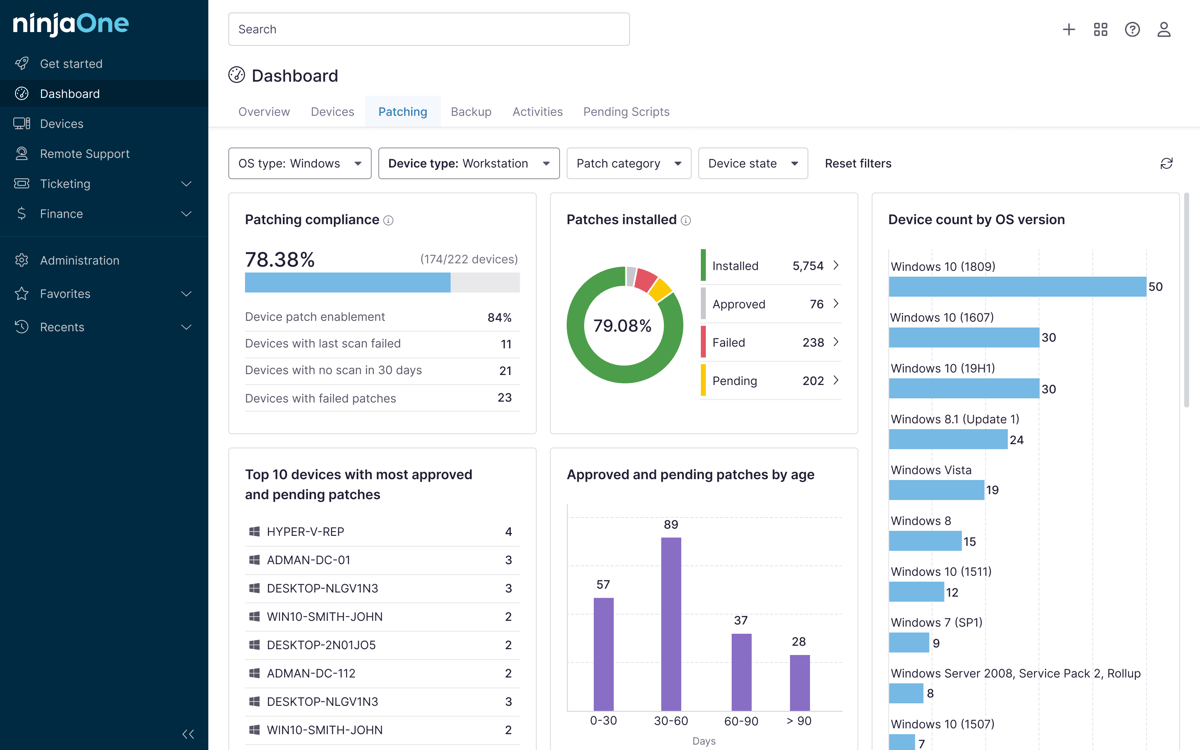
NinjaOne can simplify patch audits through automated deployment tracking and centralized dashboards that offer QBR-ready data visualizations. Here’s how NinjaOne integration speeds up patch compliance:
| Step | With NinjaOne |
| Define Patch Approval Workflow | Approval tiers assigned at role, SLA timelines integrated to improve patch compliance. |
| Document Caching & Distribution Policies | Manage cache servers by tenant or location, improving client understanding and bandwidth. |
| Standardize Documentation Templates | Customizable templates included on day 1; comes with a shareable KB via NinjaOne Docs for audit readiness. |
| Align Documentation with SLAs/OLAs | Automated performance reviews and embedded SLAs significantly improve visibility. |
| Share & Review Policies with Clients | Client portals provide business-oriented reports and integrate signed acknowledgements. |
Quick-Start Guide
NinjaOne does support document patch approval and caching policies for client transparency.
Patch Approval:
- NinjaOne provides granular control over patch approvals through policies
- You can approve/reject patches at multiple levels (device, policy, global)
- The system offers automated approvals with manual override options
- Patches can be approved/rejected by KB number or patch ID
Caching Policies:
- NinjaOne supports peer-to-peer patch caching across remote client sites
- Caches can be synchronized and managed through policies
- You can document caching policies for transparency and audits
- Cache retention and restart policies can be aligned with client requirements
Client Transparency:
- All patch activities are logged and can be reported on
- You can generate compliance reports showing patch approval statuses
- Cache usage metrics are available for review
- Policies and approval settings are visible in the NinjaOne interface
Documenting patch approval eliminates client disputes
A solid patch audit framework absolves your MSP of any contractual violations and puts SLA compliance front and center. Make sure to define your procedure, confirm agreed-upon methods on cache and distribution, standardize report templates, and get client acknowledgement whenever possible.
Integrating modern RMM tools helps you prioritize streamlined audits, giving you a steadfast way of vouching for compliant work while maintaining client confidence.
Related topics: