Key Points
- Distributed Network Management is designed for multi-location environments, where monitoring and control are distributed across sites, not handled from a single central point.
- Data collection is decentralized, allowing measurements to be gathered close to users and devices for more accurate visibility and faster detection of local issues.
- Traditional centralized models struggle to scale well, as single-point monitoring often overlooks site-specific conditions and contextual performance differences.
- Centralized visibility remains essential, with insights aggregated across the network to support analysis, coordination, and informed decision-making.
- The effectiveness of distributed network management depends on architectural design choices that determine visibility, response speed, and operational reliability.
Modern networks are no longer centralized, but many monitoring and management models still are. Distributed Network Management (DNM) addresses this gap by rethinking how visibility and control are applied across complex, geographically dispersed environments.
What Distributed Network Management means
Distributed Network Management (DNM) is best understood by the problem it solves.
The problem
Centralizing monitoring and control into a single system can seem efficient, but it introduces bottlenecks at scale. When multiple systems rely on one control point, response times slow down as issues compete for attention. If that central system becomes overloaded or unavailable, failures can cascade across the environment.
Distributed Network Management (DNM)
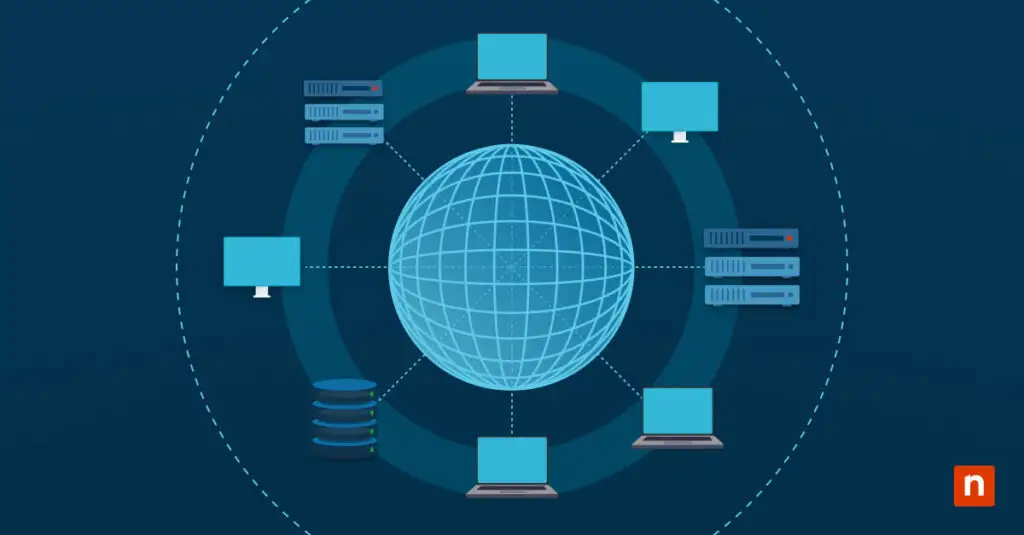
DNM addresses this issue through a distributed architecture. Monitoring and management responsibilities are spread across multiple systems, each with its own local control point. This allows systems to monitor conditions, make decisions, and respond locally. When failures occur, their impact is contained instead of affecting the entire network.
The idea behind DNM is to place monitoring and management components closer to where traffic is generated, processed, or consumed. This allows systems to observe their own conditions and respond to routine events locally, instead of waiting for the central point to decide and act.
What is the role of central management in DNM?
In DNM, a central system still exists, but its role changes. Instead of direct control, it provides visibility and coordination. Local components report summarized insights upward, allowing centralized oversight without creating dependencies for day-to-day operations.
Why centralized monitoring alone falls short
Apart from the problem mentioned above, centralized monitoring alone can also fall short in accurately understanding network health. Since centralized monitoring relies on aggregated data, it often misses localized edge issues that directly impact applications and end users.
Specifically, centralized monitoring models can:
- Miss localized congestion, latency spikes, or packet loss
- Mask performance degradation by averaging conditions across sites
- Fail to accurately represent the experience of remote or edge-based users
Distributed data collection closes these visibility gaps by observing performance closer to where activity actually occurs.
Distributed vs centralized management models
Keep in mind that distributed and centralized network management are designed for different operational needs, depending on the size, complexity, and structure of the network. Take a look at the table below for a clear comparison.
| Aspect | Distributed management | Centralized management |
| Design approach | Single control plane handling monitoring, configuration, and decisions | Management capabilities spread across multiple sites or network segments |
| Deployment complexity | Simpler to deploy and operate | More complex to design and coordinate |
| Best suited for | Single-site or tightly controlled networks | Multi-region, multi-cloud, or geographically distributed networks |
| Scale | Limited as the network size and distribution increase | Scales effectively across sites and regions |
| Troubleshooting context | Relies on aggregated or averaged data | Includes local and site-specific conditions |
| User experience representation | May not reflect remote or edge user conditions | More accurately reflects real user and application experience |
Most organizations adopt a hybrid approach that keeps central coordination in place while allowing data to be collected and decisions to be made locally. This helps teams stay consistent and in control without running into scale and visibility problems of fully centralized monitoring.
Core characteristics of distributed management
Effective Distributed Network Management depends less on specific tools and more on how the system is designed to provide clear visibility, meaningful context, and coordinated action across different locations. Common characteristics include:
- Local probes, agents, or collectors deployed near endpoints
- Site-aware metrics and alerts
- Local autonomy for detection and response
- Correlation of data across multiple locations
- Policy-aligned coordination across domains
Together, these characteristics help distributed management systems maintain accurate visibility, prevent issues from spreading, and operate reliably as the network scales.
Modern use cases for distributed management
Distributed Network Management fits the way modern networks actually work. As systems spread across different locations and platforms, performance and reliability are increasingly affected by what happens outside a central network core. Distributed management is especially important for:
- Organizations with many branch locations
- Remote and hybrid workforce environments
- Hybrid, cloud-connected, and edge-heavy architectures
- MSPs and service providers supporting diverse client sites
In these environments, you can’t understand network health by looking only at centralized systems. Real visibility comes from observing conditions where traffic starts, ends, and is actually experienced, not just where data is aggregated.
Architectural design considerations
How well Distributed Network Management works depends largely on how it’s designed. Simply spreading out monitoring or control components isn’t enough; what matters is how those components work together and are managed, which determines whether the model delivers operational benefits.
Key architectural considerations include:
- Placement of local monitoring and management components
- Consistency of configuration across sites
- Data aggregation and visualization strategy
- Alerting tuned to site-level conditions
An effective architecture strikes a balance between local accuracy and centralized coordination. Local systems handle timely insights and responses, while centralized systems keep policies aligned and provide a complete view of the network.
Additional considerations for Distributed Network Management
As distributed network management scales, it brings more benefits, but also more operational complexity. Here are a few things to keep in mind.
Deployment and maintenance complexity increase with scale
Every new site adds agents, collectors, and dependencies that need ongoing maintenance.
Data volume grows as more sites are monitored
Metrics, logs, and telemetry increase fast, so data needs to be filtered and summarized efficiently.
Configuration consistency is critical
When policies drift across sites, reporting becomes inconsistent and enforcement uneven.
Visualization and correlation tools improve usability
Correlating local and centralized data is essential for interpreting distributed behavior accurately.
Common issues to evaluate
Below are some common issues you may encounter with Distributed Network Management, along with practical ways to address them.
Inconsistent performance reports
This happens when data collection isn’t consistent or when local collectors aren’t working correctly. Check the placement, configuration, and health of local collectors to make sure metrics are being generated correctly.
Blind spots at branch locations
Some sites may not have enough monitoring coverage. Adding site-level probes or lightweight agents can help capture local performance and availability data.
Conflicting metrics
This often occurs when metrics are viewed in isolation. Correlating local data with centralized views helps align interpretations and makes root cause analysis more accurate.
Delayed detection
Centralized alerting thresholds may not reflect site-specific conditions. Adjusting alert thresholds at the site level enables faster, more context-aware detection.
NinjaOne integration
NinjaOne supports distributed environments by giving teams a central view of the network while still allowing them to apply site-specific context when interpreting data and responding to issues.
| NinjaOne capability | How it helps |
| Centralized visibility across endpoints and network behavior | Gives teams a single view of endpoints and network activity across all locations, without needing to manage each site separately. |
| Context-aware monitoring and response | Helps teams interpret data based on local site conditions and respond appropriately, instead of applying the same actions everywhere. |
Distributed Network Management as a foundation for scalable network operations
Distributed network management reflects how modern, geographically dispersed networks actually operate. Data is collected close to users and devices while centralized visibility is maintained, giving organizations clearer insight, faster problem diagnosis, and more reliable operations across complex environments.
Related topics: