
Key Points
How to Help Clients Prepare for a Cyber Insurance Renewal
- Plot a renewal timeline: Begin cyber insurance renewal preparation at least 90 days before policy expiration.
- Build a cyber insurance readiness checklist: Create a standardized cyber insurance checklist for validating core security controls.
- Gather evidence through snapshots and scripts: Place compliance evidence (such as logs, scripts, and policy documentation) into a centralized folder.
- Do a lightweight risk assessment: A lightweight risk/maturity assessment can show YoY security progress.
- Craft a renewal summary: Deliver a security readiness brief to streamline broker and insurer discussions.
Cyber insurance renewals have become tougher than ever. Nowadays, insurers don’t just want verbal confirmation from organizations; they want extensive proof that they have necessary protections in place and are proactively improving them.
This shift in demand can be daunting for stakeholders, but MSPs can make a big difference. By helping clients prepare for their renewal 60-90 days ahead of their deadlines, you can increase their approval odds, reduce the cost of premiums, and showcase the real value of your managed services.
This guide discusses how you can help clients prepare for cyber insurance renewals through structured reviews and clear documentation.
For a quick visual overview, watch our video guide on How to Help Clients Prepare for a Cyber Insurance Renewal
How to help clients navigate cyber insurance renewals
Step 1: Create a renewal readiness timeline
Start by creating a structured readiness plan at least 90 days before the renewal deadline. Creating a preparation timeline can help prevent last-minute scrambling and ensure a smooth renewal process.
A. Day 90-80: Review existing policy
- Analyze the current policy language, exclusions, and control obligations.
- Identify any outdated clauses or coverage gaps.
- Note any areas for renegotiation or clarification.
B. Day 75-60: Update business and risk profile
- Reconfirm the contact details for IT, legal, compliance, and broker teams.
- Document recent changes in operations, infrastructure, or staffing (such as mergers, cloud adoption, and new services).
- Update threat exposure profile based on recent incidents or emerging trends.
C. Day 60-30: Refresh documentation and collect evidence
- Review and document the existing security policies and procedures to ensure that evidence is current and properly referenced for renewal.
- Collect technical evidence of security controls, such as logs, screenshots, and reports. Ensure each item is clearly dated and linked to a designated responsible party for accountability.
- Gather proof confirming that security controls, such as Multi-Factor Authentication (MFA), backups, and patching, are in place and are working as expected.
D. Day 30-15: Finalize and share summary brief
- Prepare a concise summary document.
- Share documentation updates with the broker or insurer.
- Schedule renewal meetings or respond to insurer questionnaires.
💡 Tip: Use calendar invites or similar task management tools to keep the process moving.
Step 2: Build a cyber insurance readiness checklist
Collaborate with your clients and build a cyber insurance readiness checklist for This line may not fit here, since verifying MFA, backups, and patching is part of regular security operations and not something done specifically for the insurance renewal. It could be removed to keep the section focused on evidence collection.validating key security controls. It should include the following:
- Multi-Factor Authentication (MFA): Ensure MFA is enabled across all critical systems and export reports for evidence.
- Backup and Recovery Procedures: Verify current backup procedures, retention, and recent recovery drills.
- Incident Response Plan: Prepare a documented and tested incident response plan.
- Endpoint Detection and Response (EDR)/antivirus (AV) Coverage: Document endpoint detection, antivirus deployment, and centralized monitoring status.
- Patching and Vulnerability Management: Prepare cadence documentation and logs showing timely updates.
- End-user Security Awareness Training: Track completion logs of employee training.
- Logging and Access Controls: Capture reviews of privileged access and centralized log management.
- Policy Documentation: Maintain updated documentation of acceptable use, breach notification, and data retention policies.
Use Excel or Notion to make the checklist collaborative for mutual accountability.
Step 3: Gather evidence through snapshots and scripts
Next, you must help your client gather evidence proving their control maturity. You can use automation and other built-in tools to simplify this process.
Automation examples
(A) MFA Status (Azure AD)
Install-Module Microsoft.Graph -Scope CurrentUser -Force
Connect-MgGraph -Scopes "User.Read.All","UserAuthenticationMethod.Read.All"
Get-MgUser -All |
ForEach-Object {
$m = Get-MgUserAuthenticationMethod -UserId $_.Id
if ($m.Count -gt 0) {
[pscustomobject]@{
UserPrincipalName = $_.UserPrincipalName
DisplayName = $_.DisplayName
}
}
} | Export-Csv "MFA_Enabled_Users.csv" -NoTypeInformation
(B) Group Policy Security Snapshot
Get-GPOReport -Name "Default Domain Policy" -ReportType XML -Path .\GPOReport_Q2.xml
⚠️ Important: You must run this script on PowerShell 5.1 for it to work.
You should also collect the following documentation:
- Backup success logs
- Security awareness training records
- Restore drill screenshots
Store all the evidence in a dedicated folder titled CyberInsuranceRenewal_[Year] and ensure each file has a timestamp for easy reference.
Step 4: Perform a lightweight risk assessment
Small-scale risk assessments can also increase your client’s odds of approval, as they demonstrate proactive governance.
Steps:
- Choose a framework to use as a benchmark. You can use the CIS Controls or the NIST Cybersecurity Framework (CSF).
- Score maturity: Rate each domain (such as access controls, backup, and patching) on a 1-5 scale.
- Highlight improvements: Note all improvements implemented since last year’s insurance renewal.
- Identify gaps: Summarize identified gaps and mitigation plans.
Doing this step demonstrates to insurers that your clients are dedicated to continuously improving their security posture.
Step 5: Craft a renewal summary brief
Finally, create a renewal summary brief. This document should outline your client’s current cyber insurance posture in a clear, concise format. The two-page summary should include:
- Coverage Snapshot
- Current coverage and any recommended changes.
- Major Security Improvements
- New technologies or processes that have been implemented since the last policy cycle.
- Readiness Evidence Summary
- Results from maturity assessments or the status of the cyber insurance readiness checklist.
- Security Roadmap
- Planned upgrades, like SIEM deployment in Q4.
- Artifact Index
- List of attached evidence files.
A summary brief can help preempt lengthy questions from brokers and streamline conversations with insurers.
Preparing for cyber insurance renewals with NinjaOne
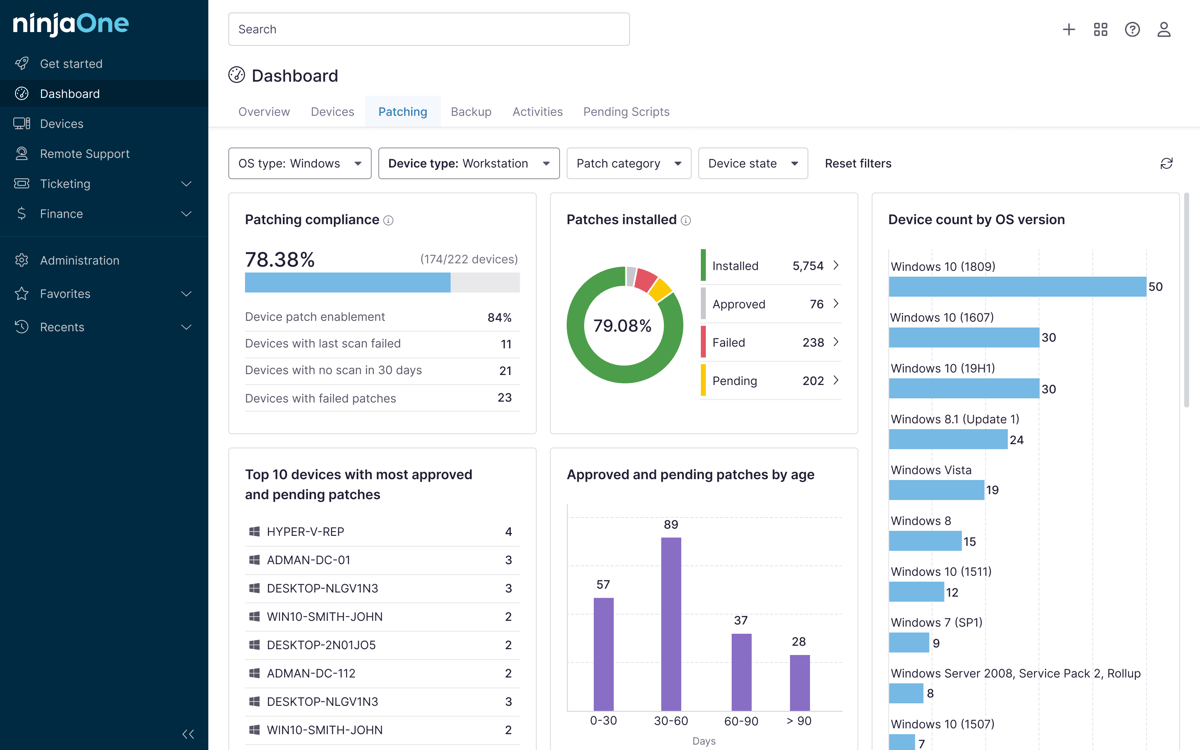
NinjaOne simplifies data and evidence collection through:
| NinjaOne Service | What it is | How it helps |
| Automation Scripts | Exports comprehensive compliance data on device patching, encryption, and AV compliance | Takes the manual work out of gathering timestamped evidence of security controls |
| Policy Checks | Scans and documents critical security controls, such as EDR presence, disk encryption status, and backup agent deployment | Allows you to build an inventory of existing security measures and makes identifying coverage gaps easier. |
| Asset Documentation | Stores and organizes critical security documentation per client | Provides you with a centralized repository for compliance-related documentation and ensures quick access during renewals |
| Compliance Tagging | Applies standardized tags such as SEC-MFA and INS-Verified to assets with compliant controls | Enables quick filtering and reporting of compliant assets |
| Ticket Metrics | Leverages NinjaOne’s ticketing features to track and report incident response | Helps demonstrate proactive security management to insurers and brokers |
Quick-Start Guide
Here are some key points to consider:
– Documentation and evidence: Ensure clients have all necessary documentation ready, including incident response plans, security policies, and evidence of compliance with industry standards. This helps demonstrate their commitment to cybersecurity.
– Risk assessment: Conduct a thorough risk assessment to identify vulnerabilities and areas for improvement. This can include penetration testing, vulnerability scans, and reviews of security controls.
– Training and awareness: Ensure that clients’ staff are trained on cybersecurity best practices and aware of potential threats. Regular training sessions and phishing simulations can be beneficial.
– Incident response plan: Review and update the client’s incident response plan to ensure it is comprehensive and up-to-date. This should include steps for containment, eradication, recovery, and communication.
– Security controls: Verify that clients have robust security controls in place, such as firewalls, intrusion detection systems, endpoint protection, and regular patching.
– Third-party assessments: Consider engaging third-party experts for independent assessments and certifications, which can strengthen the client’s case with insurers.
– Communication with insurer: Maintain open lines of communication with the insurer to understand their specific requirements and address any concerns they may have.
By focusing on these areas, NinjaOne can help clients demonstrate their cybersecurity preparedness and improve their chances of a successful cyber insurance renewal.
Strengthening MSP value through proactive cyber insurance renewal preparation
As cybercrimes evolve, so will the requirements for cyber insurance renewals. Insurers want organizations to present clear, verifiable evidence of robust security measures and incident response readiness.
MSPs can improve renewal outcomes and position themselves as reliable security partners by helping clients create preparation timelines, collect evidence, and translate technical controls into insurer-friendly language.
Related topics: