

Key Points
- Emphasize that clear naming conventions help clients relay accurate device information during support incidents, reducing resolution time and preventing errors in inventory, billing, audits, and asset refresh cycles.
- Clarify that effective endpoint names combine client identifiers, location, device type, and a unique ID, while avoiding sensitive information and adhering to hostname limits to maintain security and standardization.
- Demonstrate good vs. bad naming examples to help non-technical stakeholders understand how structured naming improves clarity and removes ambiguity across large device environments.
- Translate naming standards into business outcomes by showing how they support faster troubleshooting, audit readiness, lifecycle tracking, and billing transparency.
- Present documented naming policies to reinforce compliance with HIPAA, SOX, and GDPR and to maintain accountability, consistency, and complete device visibility.
Endpoint naming standards are a valuable tool that helps IT administrators and managed service providers (MSPs) identify devices for more efficient management and oversight. Effective endpoint naming is well known to IT professionals to improve governance, security, and efficiency — but can also confuse clients, if not explained well.
This guide provides methods you can implement to help your tech team explain endpoint naming standards and conventions to clients and non-technical stakeholders. This will help them understand the significance of naming conventions and the importance of accurately relaying information about their devices during support incidents.
Need more information on the topic? Watch our video: How to Explain Endpoint Naming Standards to Clients in Business Terms.
Automate database management to maintain consistency and reduce errors.
Why are naming standards important for IT governance?
IT asset naming conventions let you identify the details, location, and purpose of a device just by looking at its name — either as it appears in person (using an asset sticker or label) or as it appears in network browsing tools, monitoring, or asset management tools via a device’s hostname. It also provides a way for end-users to communicate which device they require assistance with to support technicians, uniquely identifying it among potentially thousands of endpoints. Additionally, compliance and security can be aided, as it makes it easier for network segmentation to be implemented and maintained.
Deciding on an appropriate endpoint naming standard for your specific use case will reduce confusion during troubleshooting and escalations, while reducing errors in inventory, billing, and reporting. It will also help prevent delays during compliance audits or asset refresh cycles, as devices can be quickly and accurately identified. The best practices enabled by this can be summarized as follows:
| Best practice | Business value delivered |
|---|---|
| Standardized naming schema | Ensures clarity and consistency |
| Translate naming convention benefits to business terms | Builds client buy-in and understanding |
| Good vs. bad naming scheme examples | Makes abstract policies tangible to non-technical stakeholders |
| Compliance alignment | Supports audits and reduces risk |
| Documented naming policy | Provides transparency and accountability |
Endpoint naming conventions: How should API endpoints be named?
Endpoints should be named so that each device will have a unique identifier. Your naming scheme should also scale, and accommodate both new types of assets at new locations, and growing quantities of the same device category. Consistent naming is the cornerstone of standardization, so you must pre-plan a system of abbreviations and numbers that makes sense and can be clearly communicated.
Your naming conventions should also recognize how the names will be used. For example, network hostnames can use a limited set of characters, and some devices may limit the length of names. Device names also shouldn’t expose sensitive information for security reasons, as they may be publicly viewable.
Attributes that can be combined to create unique endpoint names include:
- Client or organization name that owns the device
- Location or department (multi-site or location in a building, e.g., head office, library, finance)
- Asset type (e.g., switch, desktop PC, wireless access point)
- Unique identifier (a sequential number or unique string to differentiate multiple deployments of the same device)
Some examples of a simple but effective endpoint naming convention in action:
- ACME-NY-FIN-WPC-5 (ACME Inc, New York City, Finance department, workstation PC #5)
- ACME-LN-HOF-FSV-1 (ACME Inc, London, Head office, file server #1)
- ACME-HK-SAL-NSW-2 (ACME Inc, Hong Kong, Sales department, network switch #2)
- ACME-CL-RG1-FSV-5 (ACME Inc, Cloud infrastructure, redundancy region 1, file server #5)
These unique names are not needlessly long, but effectively convey key details that narrow down the client, location, and purpose of a device, while being easily conveyed by end users. Your endpoint names should also be compliant with data privacy laws and follow security best practices, such as not revealing users’ names or device-specific functions.
Once you’ve decided on a naming standard, you should ensure that it is recorded in your IT documentation platform and added to standard operating procedures (SOPs) for reference whenever a technician is setting up a new device, or needs to decode details from an existing endpoint name.
What you need to explain endpoint naming standards to stakeholders
By explaining your naming standards to clients, you can ensure they understand how accurately communicating them, along with support tickets and other incident reports, reduces resolution time. It also demonstrates the maturity of the service you provide, and the care you take to ensure your clients are fully looked after.
To do this, you’ll need the following:
- A defined, consistent endpoint naming convention
- Inventory tools (NinjaOne inventory scanning, Lansweeper, IT Glue, or equivalent)
- Documentation repository for storing conventions and policies
- Awareness of client industries’ compliance requirements (HIPAA, SOX, GDPR)
You can then apply the following methods while communicating your endpoint naming standards.
Method 1: Define the naming standard clearly
Ensure that your endpoint naming conventions are simple, repeatable, and capture the key information that will help you identify and locate a device (both physically and digitally). Create a template for this naming scheme that can be shown to clients, with an explanation of the meaning of each element.
Method 2: Translate standards into client benefits
Communicate the purpose and positive outcomes of this naming scheme so that the user is not frustrated when they encounter it during a support incident. Frame these outcomes in business terms, for example:
- Troubleshooting Efficiency: “When devices are clearly labeled, ticket resolution is 30% faster.”
- Audit Readiness: “Auditors can match devices to users without manual searches.”
- Lifecycle Planning: “Standardized names help track warranties and refresh cycles.”
- Billing Transparency: “Reports show exactly which devices are covered.”
These benefits can be presented during regular IT updates and reviews.
Method 3: Use examples of good vs. bad naming
If your client has suggestions about the naming scheme, demonstrate why your chosen scheme is effective for its purpose and environment with good and bad examples:
- Bad: PC123 is an endpoint name that gives no real information about what or where it is.
- Good: ACME-NYC-WS-23 provides useful information, instantly identifying company, site, type, and unit.
Method 4: Align standards with compliance and security
If necessary, you can explain how naming impacts compliance. Poor naming makes it harder to verify device coverage during audits (e.g., for HIPAA or SOX), increases the chance of an endpoint being overlooked during maintenance and patching, and reduces visibility in monitoring and endpoint security tools.
Method 5: Document and share the policy
Your MSP should provide clear, understandable client-facing documentation, including your endpoint naming standards. This will ensure they are accessible and enforceable internally, and help communicate externally.
While you should attempt to set an appropriate naming scheme from the outset (to avoid having to change it later and introducing inconsistencies), if you revisit them and tweaks do need to be made, ensure they are communicated during the next client meeting.
Automating the enforcement of endpoint naming standards
You can automate the detection of non-conforming endpoint names using a remote monitoring and management (RMM) platform by running scheduled checks for devices not matching the naming convention regex. You can then flag non-compliant devices in asset management or reports, and automatically create tickets for correcting detected issues.
You can also employ automation to take care of tasks such as detecting missing software inventory items and generating compliance reports, further saving time and resources.
Simplify asset management and refresh cycles with IT automation.
NinjaOne unifies endpoint management with an entire MSP toolchain
Implementing consistent endpoint naming standards across clients is just one of many measures that you can take to make your MSP team more efficient, accurate, and reliable. Communicating these measures to clients improves trust and confidence, as well as helps streamline future support requests. Informed users will be more likely to supply support agents with device names and details up-front, rather than having to be asked in a follow-up question that drags out resolution time.
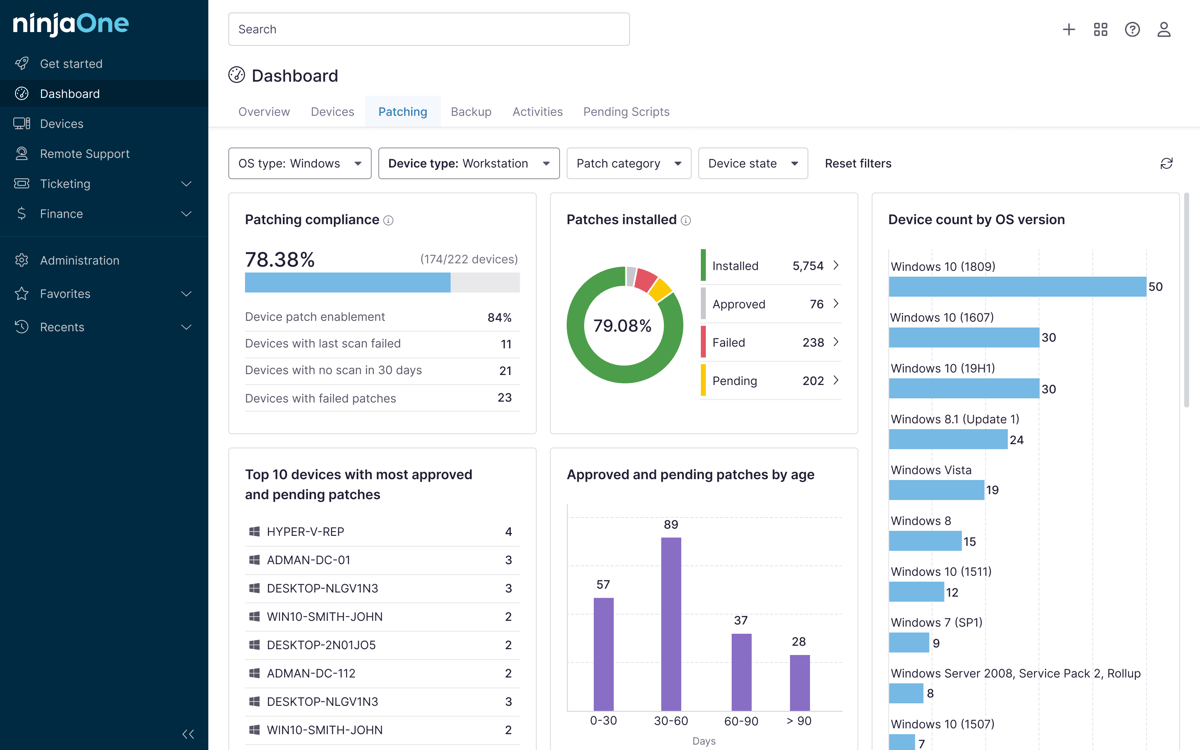
NinjaOne brings together an entire IT support toolchain, from endpoint management to remote support, helpdesk, documentation, and built-in automation tools. You can enforce naming conventions during device enrolment, tag, and report on devices that don’t follow established naming standards (or automate their renaming), and store policies in a centralized, secure, documentation repository.
Related topics: