

Key Points
- Document invisible maintenance activities: Record all proactive tasks to provide tangible evidence of service value, ensuring clients recognize that system stability is a direct result of ongoing technical effort rather than luck.
- Report business-impact metrics: Track specific KPIs like patching compliance, remediated vulnerabilities, and avoided downtime to justify IT spend and demonstrate how preventive actions minimize operational risk and costs.
- Capture automated activity logs: Utilize RMM and PSA integration to generate auditable records of background maintenance, hardware health checks, and silent fixes, making proactive work visible to stakeholders without increasing manual labor.
- Translate technical tasks into ROI: Convert complex maintenance data into clear business outcomes, focusing on risk reduction and productivity gains to help non-technical decision-makers understand the strategic importance of IT services.
- Leverage data for strategic reviews: Incorporate maintenance documentation into Quarterly Business Reviews (QBRs) to build client trust, prove consistent performance, and provide a data-driven foundation for future infrastructure and budget planning.
IT preventive maintenance—patching systems, monitoring hardware, or tuning backups—is often seen as invisible work. When issues don’t occur, it’s hard to prove the value of what didn’t happen.
If you don’t document it, you might have clients question the value of paying your monthly fees, experience difficulty in justifying renewals and upsells. Your MSP could also be perceived as reactive rather than strategic. Because of this, you must always include preventive maintenance in your quarterly reports to show the value of your services.
A guide to determining the economic value of preventive maintenance
To figure out the business value of IT maintenance, you must first define your business-relevant metrics. After that, you have to create a log that tracks the preventive measures that your team is taking, translate that data into something your clients will understand, and build client-facing reports and visuals. Finally, you must integrate all this information and materials into your QBRs and business planning sessions.
📌 Prerequisites:
- You will need your RMM/PSA platform data (patch history, monitoring alerts, and avoided incidents).
- You must know your baseline metrics (average downtime hours, cost per ticket, MTTR).
- You must have an agreed-upon and defined reporting format (dashboard, one-page client summary, or QBR slides).
- You should already have an agreement between all stakeholders on business-relevant KPIs (uptime %, cost avoidance, SLA adherence).
Step 1: Define business-relevant metrics
It’s important to focus on KPIs that connect preventive actions to outcomes. To do that, you need to clearly define which metrics are relevant to your business. For example, you can focus on the following KPIs:
- Patching compliance rates
- Number of high-severity vulnerabilities remediated
- Tickets avoided (automation vs. manual work)
- Downtime hours prevented
- Mean time to resolution (MTTR) improvement
Add or remove KPIs according to your organization’s specific situation. The expected deliverable is a preventive maintenance KPI framework that you can use to frame all your preventive maintenance actions.
To further refine your framework, map your KPIs to a Business Impact Matrix. This helps non-technical stakeholders see that a ‘Patch Compliance’ metric is actually a ‘Cyber Insurance Eligibility’ requirement.
Step 2: Capture preventive actions regularly
You should continuously document specific technician activity that prevents incidents. Documentation helps you keep track of the actions you must continue doing in preventive IT maintenance. To do that, you must:
- Automated patch deployments completed successfully
- Hardware health issues flagged before failure
- Backup validation tests confirming recovery readiness
The expected deliverable for this step is a CSV file containing a log of your monthly preventive maintenance.
Pro-Tip: The ‘Silent Fix’ Log Don’t just log what failed; log what was diverted. Use your RMM to auto-tag any script that resolved a low-disk space alert or restarted a hung service without a human ticket being opened.
Step 3: Translate technical data into business value
Preventive maintenance should add value to your organization, not done just for the sake of doing it. More importantly, you should be able to explain why it’s important during QBRs. For example, you can say:
- “90 endpoints patched = avoided ransomware exposure = estimated $X saved”
- “Early disk failure alerts prevented 12 hours of downtime = $X in productivity preserved”
- Use a standard formula to quantify “Downtime Avoided.”
- For example: $$Avoided Loss = (Employees Affected \times Avg. Hourly Rate) \times Hours of Potential Downtime$$
- Presenting this specific dollar amount transforms IT from a “cost center” into a “loss prevention department.”
The expected deliverable for this step should be a business-value report linking actions to financial actions.
Step 4: Build client-facing reports and visuals
Clients like seeing results but may have trouble understanding complicated IT preventive measures. To help them understand what’s going on and make your preventive maintenance visible to non-IT experts, you can use:
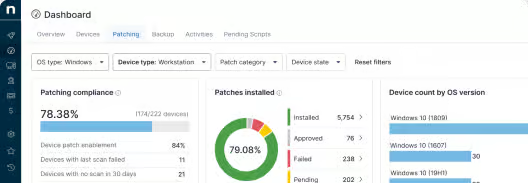
- Dashboards showing uptime improvements
- QBR slides summarizing avoided risks
- Case studies of incidents prevented
Instead of a list of tasks, use a Security Maturity Slider. Show the client where they were 6 months ago (Red/Reactive) versus where they are now (Green/Proactive) thanks to preventive maintenance. This visualizes the ‘journey’ rather than just a monthly snapshot.
There are many ways to show your clients the value of preventive maintenance. One expected deliverable is a standard one-page “Preventive Value Summary” for each client.
Step 5: Integrate into QBRs and planning
Present the results of your preventive IT maintenance at every QBR and business planning session. This way, you keep your clients updated about what you’re doing and enable them to more easily see the value of your work.
The Insurance Leverage: Use your maintenance logs to help the client complete their annual Cyber Insurance renewals. Proving that 100% of critical patches were applied within 72 hours can lead to lower premiums—this is a direct, tangible ROI that the CFO will appreciate.
The expected deliverables are QBR-ready visuals that reinforce ongoing value. For example, you can highlight how your measures align with compliance requirements and insurance mandates. The results of your preventive IT maintenance can even be used to justify new investments in things like automation tools or refresh cycles.
Summary of best practices for documenting preventive IT maintenance
| Component | Purpose and Value |
| KPI framework | This will link preventive work to measurable outcomes. It gives you a concrete way to visualize the value of preventive IT maintenance in relation to your day-to-day workflows. |
| Action logging | This will make invisible work visible. You will have an easier time tracking preventive maintenance and seeing the actual concrete value it offers to your organization. |
| Business translation | This will convert technical data into ROI. Your clients will have an easier time understanding the importance of preventative maintenance if you translate it into situations they understand and involve their interests. |
| Client reporting | This will build transparency and trust. Your clients will understand what you’re trying to accomplish through continuous IT maintenance and how that’s helping them reach their own goals. |
| QBR integration | This will reinforce the value of your services and support upsells. You can more easily convince your clients to use more tools they need so you can offer them more comprehensive IT maintenance. |
Automation touchpoint example for a patch compliance export
This script can be used with Windows PowerShell alongside your RMM API:
Get-WmiObject -Class Win32_QuickFixEngineering | Select CSName, HotFixID, InstalledOn | Export-Csv “PatchCompliance.csv” -NoTypeInformation
This will produce a CSV file that can be compared against vulnerability databases to quantify avoided risks.
NinjaOne integrations for IT maintenance
NinjaOne can support MSPs in performing preventive IT maintenance by:
- Exporting patch and backup success metrics for reporting
- Logging hardware monitoring alerts that were proactively
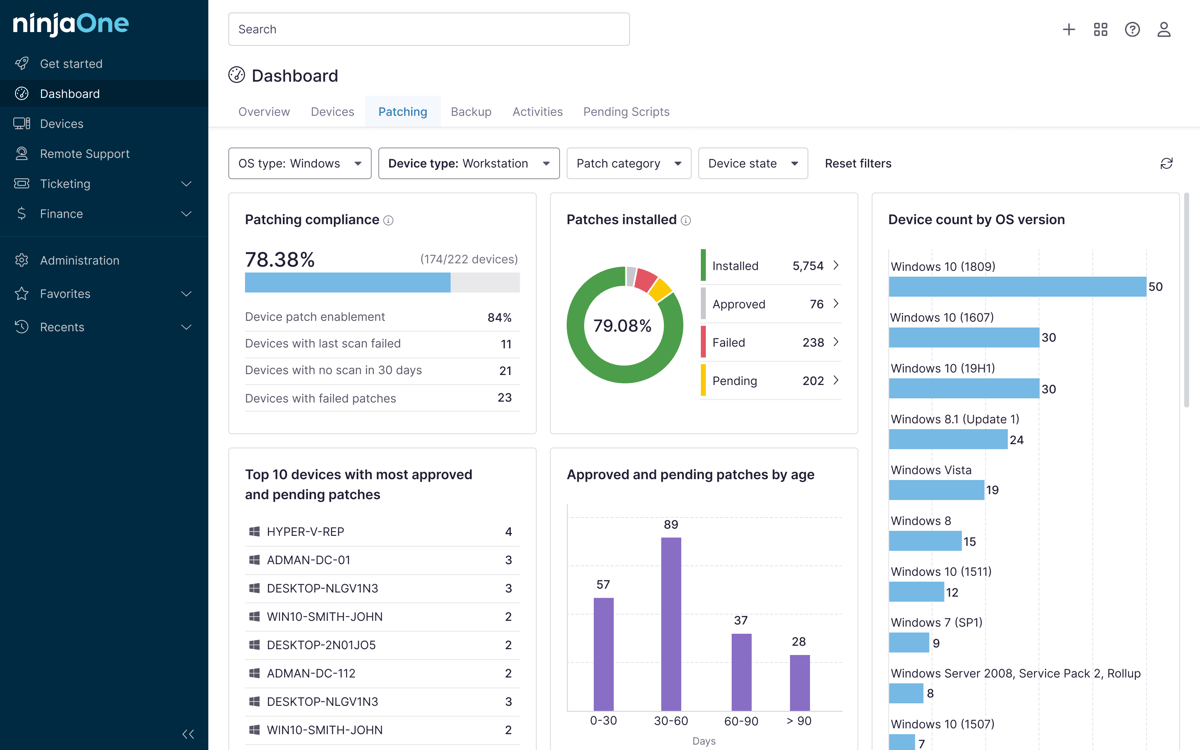
- Automating compliance dashboards for preventive work
- Hosting preventive maintenance logs in NinjaOne Documentation
- Integrating preventive metrics directly into QBR templates
Quick-Start Guide
NinjaOne can help document the business value of preventive IT maintenance:
Key Business Value Points:
1. Cost Savings
2. Increased Uptime
3. Prolonged Asset Life
4. Security Enhancements
5. Compliance
Implementation with NinjaOne:
- Automated Patch Management: NinjaOne can automate patch deployment across your environment, ensuring systems stay up-to-date.
- Remote Monitoring: Continuous monitoring identifies potential issues before they become problems.
- Comprehensive Reporting: Built-in reporting tracks maintenance activities and demonstrates ROI through metrics like reduced downtime and repair costs.
- Custom Alerts: Set up alerts for upcoming maintenance tasks to ensure timely execution.
Optimize workflows by performing preventive IT maintenance
Clients need concrete results and documentation to really understand the value of preventive IT maintenance. They need to see that their money is going to improving and maintaining their IT infrastructure and that their MSP is strategic rather than reactive in its approach.
By documenting preventive actions, translating them into avoided costs and risks, and presenting the results in client-friendly formats, MSPs can prove their strategic value and secure stronger relationships.
Related Links: