Customizable templates with NinjaOne Documentation
NinjaOne Documentation lets IT teams and MSPs build and customize templates for onboarding, troubleshooting, and client records.
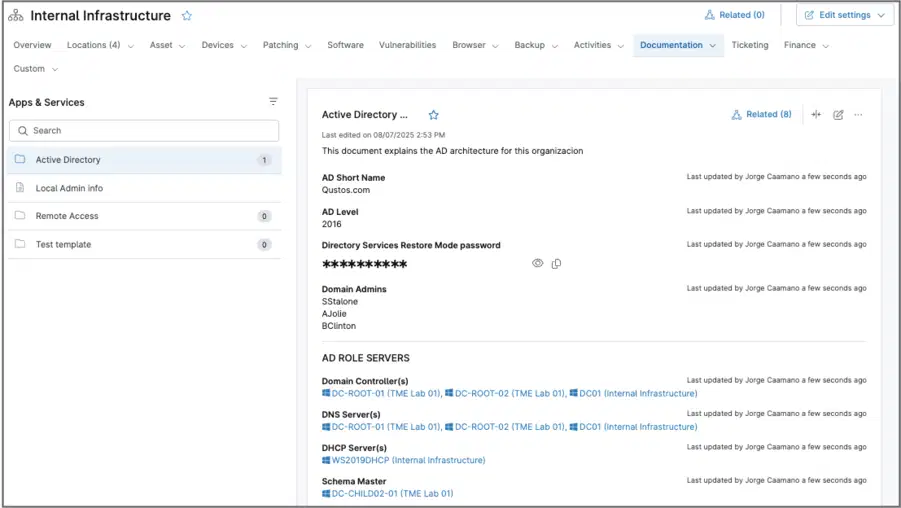
NinjaOne Documentation lets IT teams and MSPs build and customize templates for onboarding, troubleshooting, and client records.






The following problems describe common IT documentation challenges, and how NinjaOne Documentation addresses them.
| Problem | How NinjaOne Documentation resolves it |
| Scattered documentation across spreadsheets, wikis, and shared drives makes it hard to find accurate, up-to-date information. | NinjaOne Documentation centralizes templates and records in one platform, so IT teams always work from a single source of truth. |
| Building documentation from scratch for every onboarding, troubleshooting, or client record wastes IT time and leads to inconsistent formatting. | NinjaOne Documentation provides customizable templates with predefined fields, so teams start from a consistent structure instead of a blank page. |
| Documentation that doesn’t match company branding or formatting standards looks unprofessional and inconsistent across teams. | Templates in NinjaOne Documentation can be customized to match organizational branding and formatting, keeping records consistent and professional. |
| MSPs managing documentation for multiple clients risk mixing up client-specific details or falling behind on updates. | NinjaOne Documentation lets MSPs build client-specific templates with custom fields, which can be kept current through scripts or automations, so client documentation doesn’t fall behind as accounts change. |
These are the outcomes NinjaOne Documentation delivers for IT documentation.
Starting from a template instead of a blank page reduces the time IT teams spend creating guides, checklists, and records.
Predefined fields and sections keep records structured the same way, regardless of who creates them.
Standardized templates let new employees and junior staff follow clear, consistent steps instead of relying on tribal knowledge.
Custom fields can be set up for exactly the details each template needs, and kept current through scripts or scheduled automations, so IT teams and MSPs don’t have to update them by hand.

Start from templates built for common IT scenarios, such as onboarding, troubleshooting, and client documentation, then adjust them to match how the team works.

Templates start with predefined fields to ensure consistency, then can be customized to include organization-specific details, streamlining documentation creation.

Templates can be modified to align with organizational branding and formatting standards, ensuring a professional and cohesive look across all documents.

Templates in NinjaOne Documentation simplify and standardize onboarding for new employees and IT team members, with custom fields for details such as names, roles, and assigned hardware.

Templates are well suited to standardized troubleshooting guides for common IT issues, with predefined sections for initial checks, diagnostics, and escalation procedures, so even junior staff can confidently handle recurring issues.

For managed service providers, templates can be customized to create professional, consistent client documentation, including attached network diagrams, hardware inventory, and SLA agreements, using custom fields to keep records organized.

Documents can include attached files such as diagrams, images, PDFs, spreadsheets, and other office file types, up to 20 MB each. This keeps a network diagram or other reference file directly alongside the documentation that describes it, rather than stored separately.
The following practical applications describe how NinjaOne Documentation supports IT documentation in real-world IT and MSP environments.
When a new hire joins, IT can use a template to generate step-by-step provisioning and access instructions instead of writing them from scratch each time.
When a common issue like a network connectivity problem comes up, technicians can follow a standardized troubleshooting template instead of improvising a response.
When an MSP takes on a new client, they can generate client-specific documentation, including attached network diagrams and SLA details, from a reusable template instead of building it manually.
100,000
Endpoints managed
“NinjaOne is a scalable solution. It’s built on a modern SaaS architecture and it’s future-proof.”

40%
More Cost Effective
“NinjaOne’s price point is 40% less than any other endpoint management tool on the market, while being more powerful and easy to use.”

10-15
Tools Replaced
“Before, I needed 10-15 different tools to execute what NinjaOne does in its centralized, single pane of glass.”

30%
Less time for patching
“We observed a 30% reduction in the time taken for patch deployments compared to our previous solution.”

2,000
Endpoints managed
“NinjaOne gives me much more flexibility and security in my work”

30%
Annual ROI
“[NinjaOne] has already shown its value in ROI…it’s at least a hundred thousand dollars annually.”

24x
Faster Endpoint Management
“Our processes have become 24x faster with NinjaOne.”

20-40
Hours Saved Each Week
“Leveraging the automations feature within NinjaOne has enabled me to save upwards of what would likely be 20 to 30 to even 40 hours per week.”
Administrators start from a predefined template or create a new one for a specific use case, such as onboarding or troubleshooting.
Templates are customized with organization-specific fields, branding, and formatting to match how the team works.
Administrators review templates periodically and adjust fields, formatting, and structure as processes or client needs change.
Administrators periodically review templates to confirm fields, branding, and structure still match current processes and compliance needs.
See how NinjaOne Documentation helps IT teams and MSPs standardize documentation from one platform.
Customizable templates are predesigned documentation formats that IT teams and MSPs can adapt to their own workflows, covering use cases like onboarding, troubleshooting, and client documentation.
In the Administration section, go to Apps > Installed, select NinjaOne Documentation, and open Manage Templates. From there, choose Add Template, provide a name and description, and add the custom fields and UI elements needed for the use case.
Yes. Templates can be tailored for specific scenarios such as onboarding new employees, standardizing troubleshooting steps, or documenting MSP clients, each with fields relevant to that use case.
Yes. Templates can be modified to align with organizational branding and formatting standards, keeping documentation consistent and professional across the organization.
Yes. MSPs can build client-specific templates with custom fields for details like attached network diagrams, hardware inventory, and SLA agreements, keeping each client’s documentation organized and consistent.
Yes. Templates can include custom fields for details such as employee names, device information, or client data. These fields can be kept current through scripts or automations you set up, rather than updating automatically on their own.
Yes. NinjaOne Documentation lets multiple users access, edit, and review documentation with permissions, supporting secure and efficient teamwork.
No. Templates standardize structure and formatting, but teams should still review generated documentation for accuracy, since custom fields and manual entries can still contain errors.