IT Service Desk with NinjaOne Endpoint Management
NinjaOne Endpoint Management brings ticketing, IT asset management, and documentation together, giving IT teams device and asset context for every request.
Common IT service desk challenges
Internal IT teams often manage service requests across separate ticketing, asset, and documentation systems. Missing device context, disconnected knowledge, and incomplete asset visibility can add extra investigation before technicians can respond.
Problem | How NinjaOne Endpoint Management resolves it |
Tickets lack device and asset context | NinjaOne connects tickets with device health, alert history, and asset records, giving technicians relevant context as they investigate requests. |
Disconnected tools slow request resolution | NinjaOne brings ticketing, asset information, and documentation together so technicians can investigate requests, reference procedures, and determine the appropriate response without moving between separate systems. |
Service requests are difficult to track consistently | NinjaOne centralizes ticket activity so IT teams can track requests and maintain visibility as technicians investigate and resolve them. |
Manual ticket workflows add repetitive work | NinjaOne Ticketing uses automated rules and workflows to route requests and support repeatable ticket processes as service volume grows. |
Key benefits of NinjaOne IT Service Desk
Faster request resolution
Employees can get back to work sooner when technicians have the information and resources needed to address their requests without unnecessary delays.
Less manual ticket handling
IT teams can spend less time on routine ticket administration and dedicate more attention to requests that require investigation, technical expertise, or direct employee support.
Fewer disconnected workflows
Technicians can work through requests with fewer interruptions caused by searching for information across separate systems, making day-to-day support easier to manage.
More consistent service delivery
Employees receive a more predictable support experience as IT teams follow repeatable processes for handling, tracking, and responding to service requests.
Better asset visibility for service teams
IT teams can make more informed decisions about the devices and software employees rely on, from addressing support needs to planning replacements and managing asset lifecycles.
IT service desk capabilities in NinjaOne Endpoint Management Real-world IT service desk use cases

Automated routing and escalation
NinjaOne uses automation rules based on time, events, and predefined triggers to route, escalate, and follow up on tickets. This helps IT teams reduce manual handling and maintain consistent ticket workflows.

One-click remediation
Technicians can access remote support, run scripts, and deploy applications directly from a ticket. This gives them multiple ways to investigate and address endpoint-related requests from the NinjaOne platform.

Procedures linked to tickets
Connect procedures and knowledge base articles to open tickets through NinjaOne Documentation. Technicians can reference relevant instructions while working through a request without searching separate documentation systems.

Self-service end-user portal
Give end users a centralized portal to submit and manage their tickets. The portal provides a direct way for employees to communicate requests and follow their progress.

Unified asset inventory
NinjaOne IT Asset Management brings managed, unmanaged, and offline device records into a centralized inventory. Service desk teams can use this inventory to identify assets associated with requests and maintain visibility across the environment.

Software license and lifecycle tracking
Track software utilization, hardware lifecycle information, and warranty status through NinjaOne IT Asset Management. This gives IT teams additional asset information to support software and hardware management decisions.
Real-world IT service desk use cases
See how internal IT teams can use NinjaOne IT Service Desk to support employees, coordinate service requests, and manage the assets involved in day-to-day IT operations.
Resolve a device issue without starting from scratch
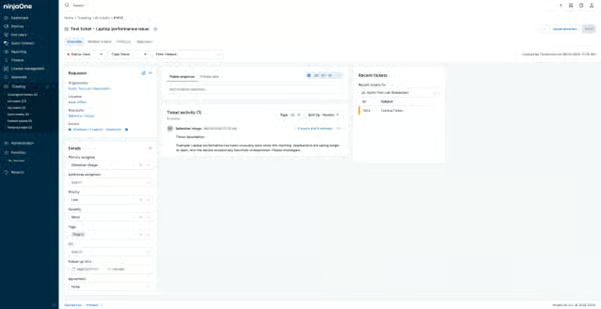
An employee reports that their laptop is running slowly, but the request provides little technical detail. The service desk can review available device and asset information alongside the ticket, reference relevant procedures, and use that context to investigate the issue and determine the appropriate response.
Coordinate a laptop or software request from one workflow
An employee requests a laptop or software needed for their role. IT teams can use the service request alongside available asset and software information to identify the resources involved and maintain visibility as the request moves through the service desk process.
Turn recurring requests into repeatable workflows
The service desk repeatedly receives similar requests that require the same routing, escalation, or follow-up. IT teams can apply automated ticket rules and established procedures to handle those repeatable parts consistently, leaving technicians more time for requests that require direct investigation.
NinjaOne’s IT ticketing system is adaptable and powerful, simplifying IT service management across diverse scenarios
Efficient Ticket Management
NinjaOne IT Service Desk Ticketing provides 360-degree visibility into incidents, tickets, and endpoints without unnecessary complexity. The software allows for customizable ticket boards, workflow automation and management, ticketing dashboards and reports, active asset management, and workspaces to improve collaboration. This ensures that technicians can manage their workloads efficiently, prioritize and resolve issues quickly, and provide reliable IT support for teams.
Automated Workflows and Processes
NinjaOne IT Service Desk Ticketing offers automated workflows and processes that can help businesses reduce manual effort and improve efficiency. The software allows IT teams to automate routine tasks like ticket assignment, escalation, and resolution, freeing up time for more strategic initiatives. With features like automated patch management and remote desktop access, IT teams can provide faster and more effective support to end-users.
Real-Time Reporting and Analytics
NinjaOne IT Service Desk Ticketing provides real-time reporting and analytics that can help businesses measure and improve their IT support processes. The software allows IT teams to track key metrics like resolution times, first response times, and customer satisfaction, providing insights into areas for improvement. With features like customizable dashboards and reports, IT teams can easily share data with stakeholders, improving transparency and accountability.
This is why customers love us
100,000
Endpoints managed
“NinjaOne is a scalable solution. It’s built on a modern SaaS architecture and it’s future-proof.”

40%
More Cost Effective
“NinjaOne’s price point is 40% less than any other endpoint management tool on the market, while being more powerful and easy to use.”

10-15
Tools Replaced
“Before, I needed 10-15 different tools to execute what NinjaOne does in its centralized, single pane of glass.”

30%
Less time for patching
“We observed a 30% reduction in the time taken for patch deployments compared to our previous solution.”

2,000
Endpoints managed
“NinjaOne gives me much more flexibility and security in my work”

30%
Annual ROI
“[NinjaOne] has already shown its value in ROI…it’s at least a hundred thousand dollars annually.”

24x
Faster Endpoint Management
“Our processes have become 24x faster with NinjaOne.”

20-40
Hours Saved Each Week
“Leveraging the automations feature within NinjaOne has enabled me to save upwards of what would likely be 20 to 30 to even 40 hours per week.”




How IT service desk works in NinjaOne Endpoint Management
I. Establish the service desk workflow
Use NinjaOne Ticketing to manage incoming IT service requests, with asset information and documentation available in the NinjaOne platform to support technicians as they work.
II. Configure request workflows
Set up ticket rules, routing, and the self-service portal so incoming requests follow the appropriate workflows and reach the right technicians.
III. Connect service desk context
Bring asset information and documentation into ticket workflows so technicians can investigate requests with relevant device data, asset records, and procedures available as they work.
IV. Monitor and refine workflows
Track ticket activity and resolution times to identify recurring service needs and adjust automation rules and workflows as request volume and IT requirements change.
Integrations
Connect IT service desk workflows with your existing tools
NinjaOne connects with service management platforms to help IT teams coordinate ticketing, endpoint information, and service workflows across the tools they already use.
ServiceNow
Connect NinjaOne endpoint alerts and device information with ServiceNow incidents, giving service desk teams additional endpoint context as they manage and investigate requests.

Zendesk
Bring NinjaOne device information into Zendesk support workflows and create tickets from supported endpoint conditions and alerts, helping teams connect service requests with the devices involved.
Freshservice
Link NinjaOne devices with Freshservice assets and create tickets from endpoint conditions, giving service desk teams device and asset context as they work through requests.
Why organizations trust NinjaOne
Helping IT teams build a more efficient service desk
Landkreis Regensburg uses NinjaOne to structure, prioritize, and manage tickets across its service desk operations. The organization reports 70 percent fewer operational tickets and 2x faster ticket resolution with NinjaOne.
“We handle tickets at least twice as fast with NinjaOne.”
Maximilian Schmidt, IT Administrator, Landkreis Regensburg
Source: NinjaOne
See how NinjaOne can improve your IT service desk
Discover how NinjaOne Endpoint Management brings ticketing, IT asset management, and documentation together to help internal IT teams manage service requests from one platform.
Resources
FAQs
What is NinjaOne IT Service Desk?
NinjaOne IT Service Desk brings ticketing, IT asset management, and documentation together in the NinjaOne platform. Internal IT teams can manage requests with relevant device and asset context available as they investigate and resolve issues.
How does NinjaOne IT Service Desk help teams manage support requests?
NinjaOne IT Service Desk provides built-in ticketing with automated routing, escalation, and follow-up rules. Technicians can also access remote support, run scripts, and deploy applications directly from a ticket when an endpoint issue requires action.
How does NinjaOne IT Service Desk connect tickets with IT asset information?
NinjaOne IT Asset Management provides a centralized inventory that covers managed, unmanaged, and offline devices. Service desk teams can use asset information alongside ticket workflows to identify the devices involved in requests and maintain visibility across the environment.
How does documentation support service desk workflows in NinjaOne?
NinjaOne Documentation connects procedures and knowledge base articles directly to open tickets. Technicians can reference relevant instructions while working through requests without searching separate documentation systems.
Can NinjaOne IT Service Desk automate ticket workflows?
NinjaOne supports time-based, event-based, and trigger-based rules that can route, escalate, and follow up on tickets. IT teams can use these rules to reduce repetitive ticket handling and create more consistent workflows.