

Key Points
- MSP cyber hygiene breaks down when tools are fragmented, reducing visibility across client environments and delaying verification.
- Silent failures — including deferred patches, unmanaged third-party applications, configuration drift, and failed backups — often go undetected until they cause security incidents or outages.
- Disconnected security tools create a reconciliation burden, forcing technicians to manually correlate vulnerabilities, endpoints, and patch status while reducing productivity and increasing operational risk.
- As MSPs add more clients, additional policies, management consoles, and reporting requirements widen execution gaps and make consistent security coverage harder to maintain.
- NinjaOne unifies endpoint management, patching, backup health, and configuration management in a multi-tenant platform, reducing manual reconciliation and helping technicians manage more endpoints
“Can you show me that our environment is covered?” is the client question that many managed service providers (MSPs) dread. Answering it can reveal more about your operations than you might like.
Pulling together a coherent answer to this question while navigating across multiple systems such as vulnerability, patch coverage, and backup health can take longer than ideal. The reason traces back to where that data lives rather than whether the work is being done. Vulnerability data is in one tool, patch status is in another, and backup health is in a third. Assembling an accurate picture of a single client’s environment can take hours. Doing it across 50 client environments can feel nearly impossible.
For mid-market MSPs who are managing hundreds to thousands of endpoints across multiple client environments, this can be a worrying operating reality.
The failures that never show up in a report
Slow reporting is only the surface of the problem.
Most monitoring is built to catch major events such as a service going down, a threshold getting crossed, or an agent that stops reporting. The failures that quietly undermine an environment rarely look like that, because they are absences rather than events:
- A patch that was deferred and never re-approved doesn’t generate an alert.
- A third-party application that fell off the update schedule doesn’t announce itself.
- A backup job that reports success but produces an unrestorable image looks identical to a healthy one until someone tries to restore it.
This is the part that scales badly. When the tooling is fragmented, no single system has a complete enough picture to know what’s missing, so the gaps stay invisible until they surface as an incident.
Where coverage breaks down
Third-party patching
Each application has its own release cadence and tracking that across separate client policies by hand is where coverage quickly erodes.
Configuration drift
A baseline gets established at onboarding, and then a client’s internal IT makes a change, or a one-off troubleshooting session leaves a setting modified. The environment no longer matches the standard it was set to, and without continuous comparison against that baseline, the drift goes unnoticed.
Backup verification
A backup console reporting a successful job confirms the job ran, not that the data is recoverable. When backup health lives in a separate tool from the endpoints it protects, no one is looking at the two together, and the gap only becomes visible at the worst possible moment.
Reconciliation tax
A vulnerability scanner flags a critical CVE on a set of endpoints. The patch tool organizes those same endpoints differently, often under different client groupings. Joining the two by hand, across every affected environment, is slow and error-prone, but must happen every time a new CVE lands. The administrative work isn’t difficult, but it competes directly with the technical, billable work that the team is there to do. To illustrate the scale of that drain, the MSP Syscomm cut its patching time by 99 percent after consolidating work onto one platform, redirecting those hours back to billable work.
The execution gap, and why it widens
The distance between knowing about a risk and acting on it is the execution gap. For a single environment, it’s narrow. Across a multi-client book, it widens with every client added, because each new environment brings another policy baseline to maintain, console to check, and place for a silent failure to hide.
The deeper problem is that coverage only holds together because technicians are doing the reconciliation by hand. Nothing in the system guarantees it. That approach has a hard limit: taking on more clients means adding more people, margins shrink as environments multiply, and a single bad patch or missed CVE can hit every client that is running the same policy.
Client expectations are rising at the same time. Clients increasingly want proof of security and compliance outcomes, and producing that proof from disconnected tools adds reporting work that grows with every environment under management.
Execution discipline is the differentiator
The MSPs that stay ahead of this tend to share one trait: their hygiene execution doesn’t depend on a technician remembering to check. That means visibility across every client environment from one place rather than per-client logins, so a silent failure has nowhere to hide.
When the fundamentals of cyber hygiene — patching, configuration, and backup — run as a consistent, automated discipline rather than a manual catch-up exercise, the economics of the practice change. The reconciliation tax falls away, coverage stops depending on heroics, and growth stops requiring a proportional increase in headcount. The same teams working this way report managing three to four times more endpoints per technician, which is what becomes possible when the system guarantees coverage instead of the team assembling it by hand.
How NinjaOne helps MSPs close the execution gap
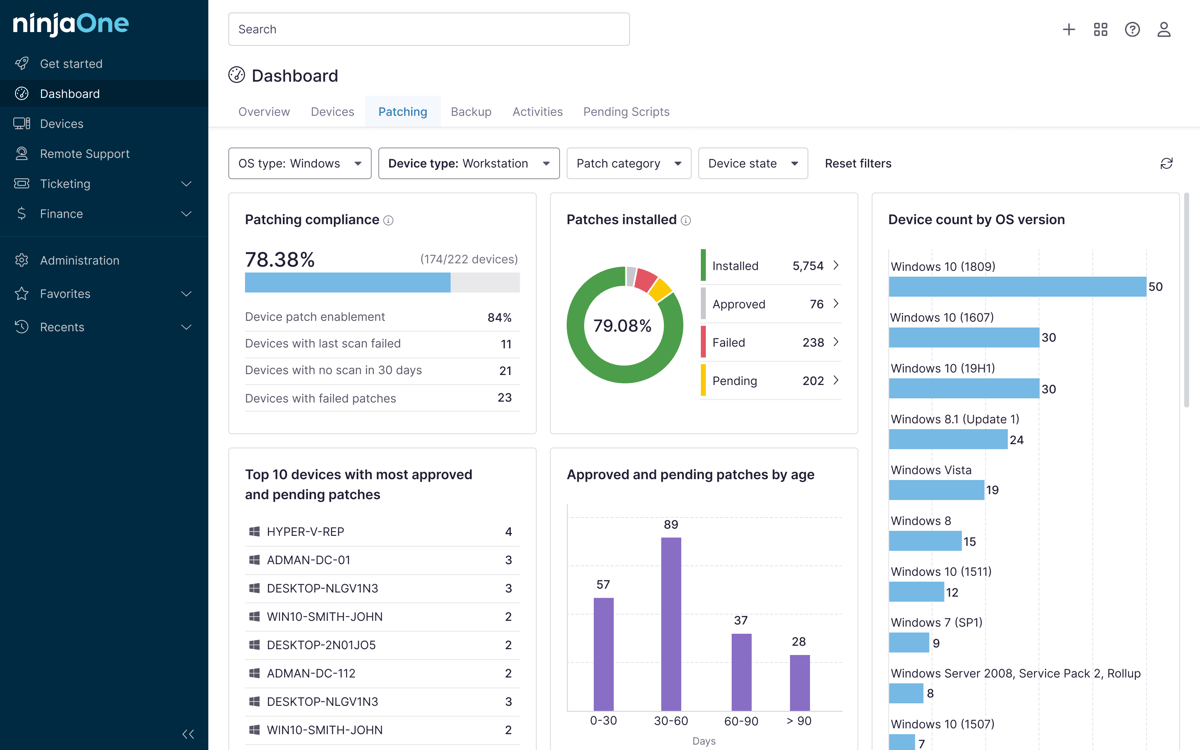
NinjaOne is a unified IT operations platform that gives MSPs a single console to manage patching, backup, and configuration across every client environment. Rather than reconciling data across separate tools, technicians see patch coverage, backup health, and configuration status in one place, so silent failures have nowhere to hide.
Autonomous patch management handles third-party application patching across client policies without manual tracking. Backup health is visible alongside the endpoints it protects, so the gap between a job reporting success and a recoverable image becomes apparent before it matters. Because the platform is multi-tenant by design, the same visibility and automation that works for one client environment scales across fifty without proportional headcount growth.
For MSPs that want to see how unified endpoint management changes the economics of cyber hygiene delivery, there’s a free trial to get started.