

Key Points
- A MySQL index stores pre-processed column values so the database engine can locate records instantly without scanning entire tables.
- MySQL primarily uses B+ tree indexes for exact and range queries, and hash indexes for fast exact-match lookups without range or ordering support.
- Indexes reduce processor load and disk I/O for reads, but slow down writes because every INSERT, UPDATE, or DELETE must also update the index.
- MySQL offers multiple index types for different use cases, including primary keys, unique indexes, standard indexes, composite indexes, and full-text indexes.
- Over-indexing increases storage usage, slows write performance, and creates maintenance overhead, so only columns frequently searched with predictable criteria should be indexed.
- Balancing read speed, write performance, and storage requirements when choosing which columns to index is critical to maintaining an optimized MySQL database.
Understanding MySQL indexes is key to improving the performance of your databases: indexes improve query speed, and there are different index types that are optimized for different use cases. This guide explains how MySQL indexes work and why they are needed (and when they aren’t), and provides further information that will help you choose the right MySQL index types for different data and queries.
What are MySQL indexes?
A MySQL index is a data structure that improves database performance by reducing the need to process an entire table to search for records. Conceptually, it works like its namesake, the index in a book: it references data from a database table to make it easier to look up. When you add an index, it stores values from a table column, allowing those records to be found without having to iterate across all records.
There are different types of indexes for different data and scenarios, so choosing the right one for your use case is important.
How does indexing work in MySQL?
On a technical level, databases commonly use a B+ tree or hash indexes for column indexing.
A B+ tree index (the default in MySQL) works by storing data in a sorted structure that is ‘balanced’ – data is sorted into nodes in a shallow tree structure for fast retrieval, with each leaf node the same distance from the root. They are efficient for exact match (for example, searching for the exact value “apple” in a column) and ranged queries (for example, finding columns with values between 5 and 10).
A hash index uses a hash table that maps search keys. It’s less common due to its limitations (it does not support range or ordering), but it can be incredibly fast for exact match queries.
How does indexing improve query performance?
The larger a database table is, the longer it takes to read all the records in it. Indexes are a way for the database engine to ‘jump’ to records by referencing pre-processed, structured data rather than having to perform a full search each time. This is much more efficient, requiring less processing and hardware I/O.
While this results in much faster read performance for indexed data, it can negatively impact write speeds, as the index needs to be updated as well as writing the data to the table itself. Indexes also require additional storage.
The different types of MySQL indexes
MySQL includes several built-in index types for different use-cases, including:
- Primary keys that uniquely identify rows are widely used to maintain database integrity by preventing duplicates and ensuring specific rows can be quickly found.
- Unique indexes enforce uniqueness but allow for multiple NULL values, for maintaining secondary data that identifies columns.
- Standard indexes that are used to speed up queries for data that is routinely searched, but does not need to be unique.
- Composite indexes cover multiple columns in the same table.
- Full-text indexes are used for searching text columns.
You can also search efficiently using manual optimization techniques like hashing data and storing it in a database column, and then indexing that, which can be faster in some scenarios.
How index structure affects query and database performance
Internally, indexes rely on a number of methods to maintain structure and keep queries as efficient as possible. This is done transparently. From a developer perspective, choosing the right index type is important to ensure that your database behaves as intended, and does not suffer performance issues.
Most of this comes down to the number of indexes and the amount of data indexed: indexes require additional disk space, which can directly impact performance. For example, adding additional indexes for all the columns in a table with a very small, fixed number of records would be inefficient when they could just be found by their primary key.
You should balance intended functionality, storage, and write/read operations when deciding which columns to index. For example, in a table that contains product data, it makes sense to have an indexed primary key to uniquely identify each item, and index the product name for easy searching. You may also index the price so that customers can quickly filter by that criteria. However, indexing the internal notes your business keeps on each product would probably not provide enough benefit to be worth the additional overhead.
Trade-offs when using indexes – the dangers of database index over-use
When deciding how to index your database, you should factor:
- Increased storage usage
- Slower write operations due to index updates
- Maintenance overhead
- Potential redundancy with multiple indexes
Database optimization requires careful planning as part of developing your application and its infrastructure, including caching and search engines like Elasticsearch.
Monitoring MySQL query and database performance centrally
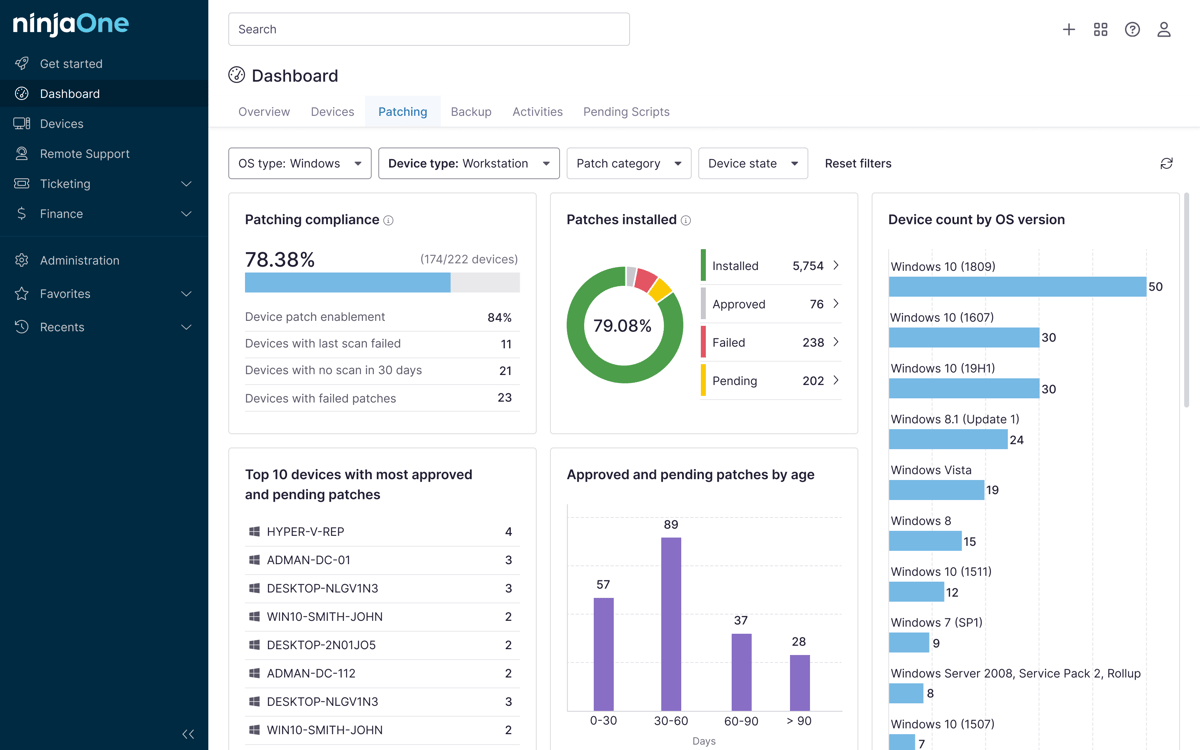
Monitoring MySQL database performance is critical for IT teams managing mission-critical internal apps and consumer-facing apps. NinjaOne centralizes server monitoring and allows you to ingest MySQL logs for centralized reporting and alerting of technicians when queries start slowing down. This provides an opportunity to pre-emptively optimize queries and MySQL indexes, ensuring that there is minimal interruption to users and that MySQL databases are responsive and cost-optimized.