Key points
- Raising prices alone won’t fix these thin MSP margins if your service delivery costs keep climbing alongside your revenue.
- Most margin problems come from the way you deliver services. Manual work, inconsistent processes, and growing operational complexity quietly drive costs up.
- As your MSP grows, client variation and inefficient workflows make every ticket more expensive unless you standardize how your team works.
- An MSP pricing strategy works better when it reflects the business value you deliver and the actual cost of providing each service.
- Automation and standardized workflows cut routine work, reduce operational friction, and improve margins without adding more technicians.
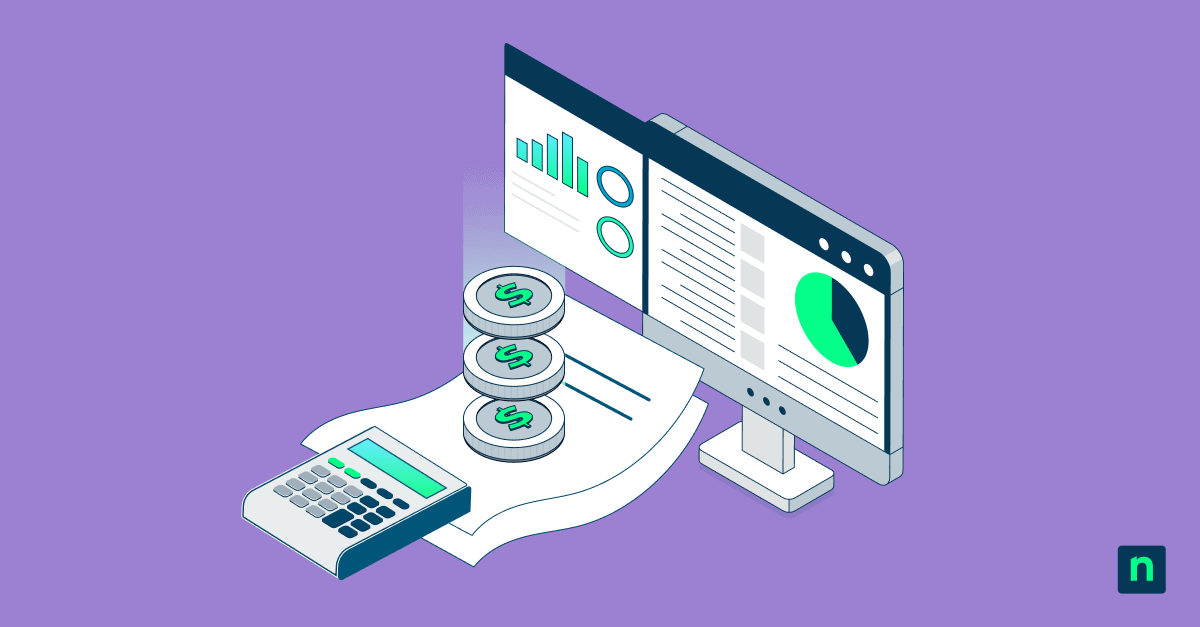
This article discusses concerns when it comes to your MSP pricing strategy and how to overcome them. When margins get thin, raising prices often feels like the obvious move. More revenue should mean more profit, as long as costs stay steady. But in MSP service delivery, costs rarely stay steady. If support hours, escalations, rework, and tool overhead keep rising, a price increase may only mask the symptoms rather than fix what is driving margin pressure in the first place.
Service Leadership Index 2026 shows a sustained profitability among top-performing IT solution providers. Best-in-class MSPs sustain 19%+ adjusted EBITDA margins, while median firms sit closer to 9–10%. That spread is consistent across markets and geographies, which means it isn’t about luck or timing. It stems from stronger operational practices that enable top-performing MSPs to deliver services more efficiently.
Why a standard MSP pricing strategy often misses the real problem
The disconnect usually sits in your cost structure. You can raise prices and expect margins to improve, but profitability may still stay flat if the way you deliver services hasn’t changed.
That is why margin pressure is often a service delivery problem, not just a pricing problem. Sustainable profitability depends on how efficiently you deliver the work, not only what you charge for it.
How the MSP operating model affects profitability
That makes your operating model just as important as your pricing model. Service delivery decisions shape your cost structure in ways that an MSP pricing strategy can’t reach on its own.
Service delivery often becomes more complex over time
As you grow, more clients usually mean more variation, from tool stacks and infrastructure setups to support expectations, escalation paths, and one-off workflow exceptions.
This can increase your costs across support hours, maintenance windows, and day-to-day service delivery. Standardizing client onboarding can help control what enters your environment from the start, so growth does not automatically turn into more work.
Growth can expose weaknesses in the operating model
Processes that work across a handful of clients often don’t transfer cleanly to a larger operation. Manual workflows create bottlenecks as service demand grows because the volumes they were built to handle were never meant to scale.
An RMM platform configured around manual processes delivers different results at 2,000 endpoints than it did at 200. The inefficiencies become visible and costly at scale, and a pricing change doesn’t reach the processes generating those costs.
Operational consistency directly affects profitability
Consistent workflows reduce rework, escalations, and service variability across your client base. When your technicians work from shared procedures and defined escalation paths, service delivery becomes faster and more predictable, and that predictability directly affects costs.
Rethinking managed services pricing
An MSP pricing strategy still matters, but the most sustainable approaches align what clients pay with the value they receive rather than the labor required to deliver it.
Align managed services pricing with business outcomes
Connecting pricing to outcomes like uptime, security, and responsiveness creates stronger alignment between what clients value and what you earn.
A 2026 report surveying more than 1,100 MSP professionals found that 42% of top-performing MSPs offer vCIO services, compared with 29% of their baseline counterparts. That gap reflects a deliberate move toward advisory and outcome-oriented work, which commands pricing based on business value rather than task completion.
Focus pricing on services customers value most
Not every service you deliver holds equal value for clients. Some activities directly support the business outcomes they care about, while others are operational work that enables those activities.
Identifying which services create measurable client value and pricing around them reduces reliance on capacity-intensive work that clients aren’t willing to pay a premium for. Service level agreements and delivery reporting both support that kind of pricing clarity by making service performance visible and documentable.
Support pricing decisions with operational data
Pricing decisions made without delivery data rely on assumptions about the cost of supporting a given client or workload, and those assumptions often underestimate the actual complexity.
Using operational metrics and IT performance data to understand the true cost of each service gives you a more accurate foundation. The data also helps you identify which services contribute most to profitability and which are priced below their actual delivery cost.
Why MSP profitability depends on efficiency as much as pricing
With your MSP pricing strategy better aligned with value and costs, the remaining lever to improve your margins is reducing delivery costs.
Reduce the cost of routine work
A significant share of what your technicians handle each week follows predictable patterns:
- Patch deployment and scheduled maintenance
- Monitoring alert triage and response
- Routine support requests and endpoint tasks
Handled manually, each consumes capacity that technicians could otherwise apply to client advisory work, proactive outreach, or escalations requiring judgment. A 2026 Kaseya report found that 53% of MSPs are already using AI to automate this type of work.
Automating routine ticket workflows and endpoint management tasks enables your team to support more clients without a proportional increase in headcount.
Improve service delivery consistency
Standardization determines how consistently technicians handle the work they receive. Where automation reduces volume, standardized procedures reduce variability across technicians, clients, and service types.
Consistent SLA enforcement also makes performance easier to measure, so changes in resolution times or escalation rates become clear performance signals instead of one-off observations.
Eliminate operational friction
Overhead also accumulates in the way work moves among people, tools, and systems. The most common sources are:
- Context switching between disconnected tools
- Duplicate data entry across systems
- Alert noise and unclear escalation paths
Simplifying workflows and consolidating tools where it makes sense helps your team get more from the same resources. You can either lower operating costs or free up capacity for higher-value work without adding headcount.
What technician utilization doesn’t tell you about margins
A busy team is not always a profitable one. Technician utilization tells you how much time your team spends working, but your MSP pricing strategy only improves margins when that work gets delivered efficiently and at the right cost.
High utilization does not always mean high performance
Utilization figures don’t tell you how that capacity is actually spent. ScalePad’s 2026 survey found that only 21% of MSPs report staff utilization exceeding 75%, but even high utilization can mask inefficiency.
Technicians can appear fully booked while spending significant time on escalations, administrative overhead, and low-complexity requests that automation or tiered support could handle. Tracking that breakdown at the activity level gives a clearer picture of where performance improvements are possible than utilization data alone.
Measure how work moves through the organization
Ticket resolution times, backlog trends, and escalation rates describe how efficiently your service delivery runs. When those metrics slip, the cause typically sits somewhere in the process.
A few patterns can help you spot where the problem starts:
- Tickets that keep getting stuck before resolution
- Issues that require repeated root cause analysis
- Client environments that generate more support volume than they should
Each one points to operational overhead somewhere in your business. Standardized workflows help you spot it sooner, measure it clearly, and take action before it spreads.
Connect technician utilization to financial outcomes
Utilization data tells you how busy your team is, but not if they’re helping you improve your margins. Pairing it with delivery cost metrics can help you see how:
- Staffing decisions affect support workload distribution
- Capacity changes affect per-ticket cost
- Service volume tracks against revenue from each client
Those connections show whether staffing aligns with actual demand and where operational changes would have the largest margin impact.
Improve your MSP profitability with NinjaOne
NinjaOne helps MSPs standardize endpoint management, automate routine tasks, and reduce the operational friction that drives up delivery costs across growing client environments.
Try NinjaOne for free to see how centralized management and automated workflows help you strengthen profitability and build more scalable service operations.