Key points
- MSPs standardize IT support by unifying ticket routing, onboarding, patch cycles, and escalation paths across clients.
- Endpoint lifecycle management applies consistent provisioning, patching, and monitoring procedures to every device across client environments.
- Accurate IT asset management gives teams a reliable view of device ownership, status, and lifecycle stage.
- Modular playbooks built into ITSM or RMM platforms document recurring scenarios like patch failures and onboarding.
- Tracking shared metrics like resolution time, first contact resolution, and SLA compliance reveals where standardization is working
A small client base can run on judgment, relationships, and informal processes. That changes as the business grows. Each new client brings different device configurations, tools, support expectations, and compliance requirements. Over time, those variations create more operational weight than most teams expect.
Heimdal’s 2025 report found that 89% of MSPs struggle with tool integration, leaving most teams toggling between disconnected environments instead of resolving issues. Standardized core processes can give your team a consistent foundation to work from across every client, without requiring each environment to operate identically.
Why IT support operations are hard to scale across clients
Scaling across client environments can be hard, as each new engagement may contain client-specific exceptions. One client may require weekly compliance reporting in a format no other client uses, while another runs legacy infrastructure that demands custom patching workflows.
Those differences in escalation preferences, tool integrations, and access requirements can push technicians to context-switch between procedures for work that should otherwise be routine.
Over time, these client-specific exceptions start to slow the team down. Work takes longer to resolve, handoffs get less clear, and new technicians have a harder time figuring out the escalation paths they should follow. At some point, managing the exceptions starts to limit how many clients your team can support well.
What IT support standardization actually looks like
Standardizing IT support operations starts with deciding what should stay consistent and what truly needs to vary by client. For instance, your client onboarding procedures, ticket triage categories, and patch deployment schedules should follow the same structure regardless of which client your technician is working on.
Standardized service delivery workflows
Start by standardizing the work your team does every day:
- Ticket categorization and routing through your help desk
- Client onboarding from first contact to managed environment
- Ticketing automations for recurring requests
- Staged patch cycles across client environments
- Escalation paths and handoff procedures
These workflows give your team a predictable process to follow regardless of which client they’re supporting, reducing the variation that affects both service quality and technician workload.
Better flexibility to handle unique client requirements
Standardization doesn’t mean every client receives identical deliverables. Reporting formats, compliance documentation, and business-specific integrations can vary between clients without undermining the consistency your team depends on to work efficiently.
The core delivery process stays consistent. What changes is how each engagement is scoped within it. A well-structured service level agreement can provide a solid framework for documenting these client-specific commitments.
How endpoint lifecycle management drives consistency
The procedures your team applies to provisioning, patching, and monitoring determine whether client environments stay predictable or accumulate exceptions that slow support work.
Use endpoint lifecycle management to reduce operational variation
Endpoint lifecycle management applies consistent procedures to every stage of a device’s operational life:
- Initial provisioning and configuration
- Ongoing patching and maintenance
- Monitoring against standardized device baselines
Standardizing those procedures across client environments reduces configuration surprises during support work and gives monitoring platforms a consistent baseline to report against, rather than different standards per client.
That consistency also speeds up troubleshooting. Technicians work faster when a device’s expected configuration is documented and uniform across environments, rather than varying based on how it was set up for a specific engagement.
Apply IT asset management best practices across clients
Consistent endpoint lifecycle management depends on knowing what assets you’re actually managing. Standardizing the following across client environments can give your team a reliable view of what exists, who owns it, and where each device sits in its lifecycle:
- Asset tracking and discovery
- Procurement documentation and ownership records
- Inventory processes that capture device status and lifecycle stage
Without that inventory foundation, undocumented assets fall outside the standard process regardless of how well the lifecycle procedures are designed.
IT asset management best practices that support standardization
Maintaining accurate asset records across multiple client environments is harder than it appears, and the gaps in that visibility create direct operational problems for your support team.
What is ITAM and why does it matter for support operations?
IT asset management (ITAM) is the set of processes your team uses to track, manage, and optimize hardware, software, and technology assets throughout their lifecycle. For IT support operations, it provides an accurate, current view of each environment that consistent service delivery depends on.
When a technician troubleshoots an issue or responds to a patch failure, they work from assumptions about what devices exist, what software they’re running, and what their configuration baseline looks like.
A 2026 report surveying 617 IT and security practitioners found that only 48% of organizations are confident in their comprehensive asset lists. Incomplete asset data means those assumptions are often wrong, increasing the likelihood of missed dependencies and incorrect remediation steps.
Build modular playbooks instead of rigid procedures
Modular playbooks give your team documented workflows for the support scenarios that recur across every client environment:
- Patch failures and rollback steps
- New client onboarding sequences
- Account provisioning and access management
- Escalation paths and handoff criteria
- Configuration change management steps
Technicians can apply these across clients while adjusting only the environment-specific details. These can be especially useful when onboarding new staff. According to HDI’s State of Tech Support 2025, 67% of tech support leaders identify information overload as the primary barrier to new hire proficiency.
Playbooks give new technicians a clear starting point for each scenario rather than requiring them to reconstruct the correct approach from memory or search across disconnected IT documentation.
Connect playbooks to real operational workflows
Documentation that lives outside your operational tools rarely stays up to date. Playbooks built directly into your ITSM platform or RMM are easier to maintain and more likely to be used. When runbooks are accessible inside the same environment where tickets are handled, documentation stays aligned with real procedures rather than drifting into a reference no one consults.
How are mature IT support operations different?
Playbooks and asset visibility are only valuable if they shape day-to-day operations. Measuring consistency across client environments shows whether they actually do.
Use shared service metrics across client environments
Without common metrics, the same process problem can appear as isolated incidents across different clients, making root causes harder to identify. Tracking performance against shared benchmarks shows where standardized workflows are followed at all times and where variation is still affecting service quality:
- Mean time to resolution
- First contact resolution rates
- SLA compliance across all clients
Freshworks’ 2025 benchmark, which analyzed more than 187 million tickets across 10,551 organizations, found that teams using AI-assisted service management achieved SLA adherence of 96.16% and first-contact resolution rates above 74%.
Treat standardization as an ongoing process
Client environments change continuously, and IT support standardization that works well today may not work when a client expands or your team takes on a new service category.
Documentation drift is the most common reason for this. Without regular review, procedures calcify into descriptions of how work used to get done. Revisiting workflows and updating playbooks as conditions change can keep your standardization up to date.
Simplify IT support standardization with NinjaOne
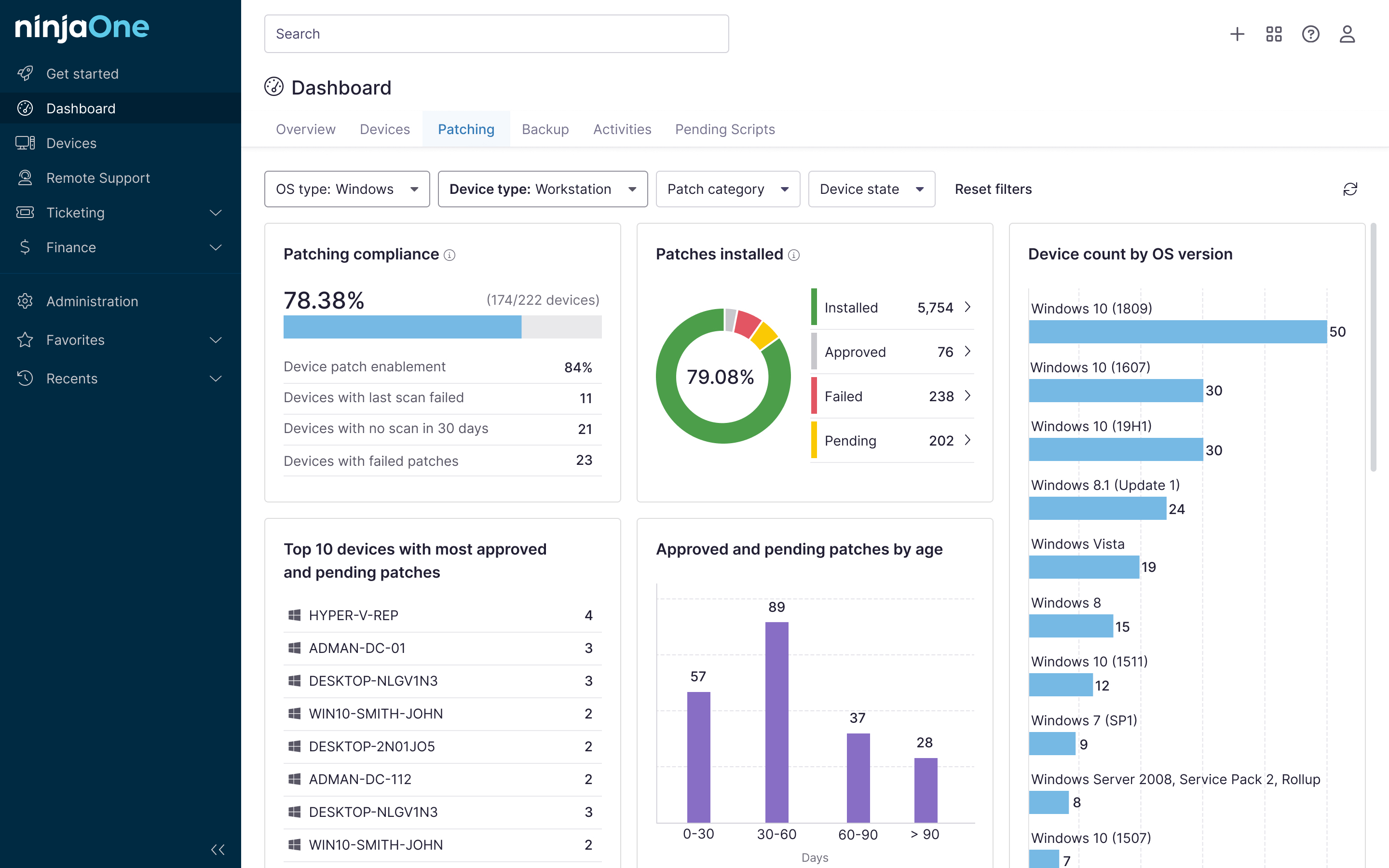
NinjaOne helps IT teams centralize endpoint management, asset visibility, and automated workflows across client environments, giving your team consistent operational data and the tools to act on it without switching between systems.
Try NinjaOne for free to see how unified endpoint management and standardized service delivery workflows support consistent IT support operations across every client you manage.