Key Points
- Duplicate patch downloads waste bandwidth and delay deployments across client sites.
- Multi-site environments magnify these inefficiencies, creating widespread bottlenecks.
- Caching and peer distribution eliminate redundancy through local sharing.
- Standardized policies ensure consistent and predictable patch rollouts.
- NinjaOne tools enforce these strategies and measure deduplication success.
For MSPs, watching dozens of computers at a single site download the same large Windows update is a massive waste of bandwidth and time. This common inefficiency slows deployments, increases costs, and risks missing critical SLA deadlines.
This guide walks through a practical framework for patch deduplication, showing you how to eliminate these redundant downloads across all your client sites.
Deduplication framework: Steps to prevent duplicate patches
Preventing duplicate patch downloads allows MSPs to maximize efficiency, reduce costs, and maintain consistent compliance across all client sites.
📌 Use case: Apply this patch deduplication strategy in three key scenarios: when managing multiple identical machines at a single site, for critical patch bandwidth optimization at locations with slow or metered connections, and when you need to meet strict SLAs for rapid deployment.
📌 Prerequisites: Before starting, ensure you have these four elements in place:
- A patch management solution with native caching or peer distribution, like WSUS, Intune, and NinjaOne.
- Clear visibility into client network topology—including sites, subnets, and bandwidth limits.
- Defined patch policies and SLAs to standardize procedures and ensure compliance.
- Basic familiarity with distribution technologies like Delivery Optimization or proxy caching for patch caching.
Step 1: Identify multi-site distribution inefficiencies
Start your patch optimization by pinpointing where bandwidth is wasted on duplicate downloads.
Step-by-step procedure:
- Audit patch cycles.
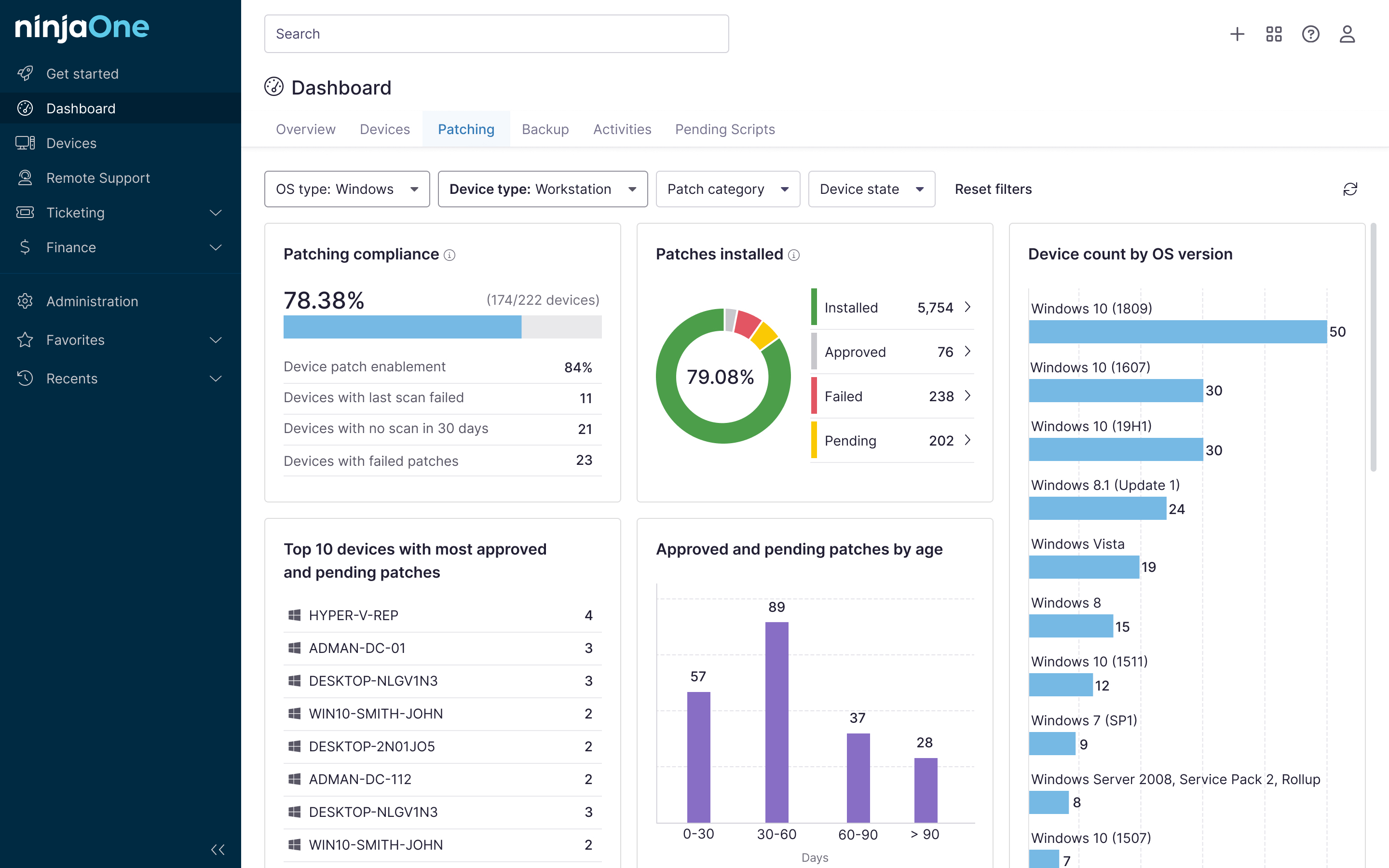
- Use a centralized dashboard to review patch status and deployment consistency across all client sites.
- Measure WAN usage.
- During patch deployments, monitor network traffic to identify bandwidth spikes that indicate redundant external downloads.
- Identify repeated downloads.
- Check the dashboard for logs that show endpoints downloading directly from Microsoft or third-party servers instead of local sources.
This data-driven method reveals which sites suffer from inefficient distribution, forming the basis for your optimization strategy. This enables you to remove redundant downloads.
Step 2: Enable cache-aware distribution
Implement cache-aware distribution to eliminate duplicate downloads and optimize bandwidth across your client sites.
Step-by-step procedure:
- Configure delivery optimization.
- Set the built-in Delivery Optimization to “Group” mode via Group Policy or Intune, enabling devices on the same network to share updates directly.
- Deploy a local proxy cache.
- Use your RMM tool to establish a local cache server at each site, creating a single local source for all patches and preventing redundant external downloads.
- Set cache retention policies.
- Configure the cache to hold updates for a sufficient period (e.g., 30 days) and size (e.g., 60 GB) to ensure all devices, including roaming ones, can patch from the local source.
Once active, this system will drastically reduce WAN usage, speed up deployment times, and create a more resilient and efficient patching process.
Step 3: Standardize patch policies across sites.
Establish consistent patch policies to ensure your technical optimizations work effectively across all client environments.
Step-by-step procedure:
- Create unified approval workflows.
- Implement a single, risk-based policy for all clients that uses phased rollouts managed from a central dashboard.
- Configure staggered schedules to use cache.
- When phasing deployments, ensure schedules leverage local caching so only the first device per site downloads externally.
- Enable consistent caching & P2P.
- Uniformly activate Delivery Optimization and local proxy caching at every multi-device site to prevent inefficient fallback downloads.
With standardized policies, you’ll achieve predictable patch cycles that fully utilize your caching infrastructure, maintaining compliance while minimizing bandwidth usage.
Step 4: Optimize for remote and branch sites
Extend your patch optimization strategy to cover remote workers and small branch offices where traditional caching isn’t feasible.
Step-by-step procedure:
- Implement cloud & P2P caching.
- For isolated endpoints, leverage Delivery Optimization in “Internet” mode and cloud-aware P2P solutions from RMM platforms, allowing remote devices to share updates securely over the internet.
- Deploy lightweight local caches.
- In small offices without a server, use an RMM probe or designated workstation as a local patch cache, creating a single download point for all devices on that local network.
- Coordinate smart restart policies.
- Set clear restart policies that work with your cache retention periods, using maintenance windows and user notifications to ensure cached patches are applied promptly without disrupting productivity.
After implementation, your remote and branch sites will operate with the same efficiency as central offices, fully integrating into your patch deduplication framework without requiring significant local infrastructure.
Step 5: Document and report savings
Measure and communicate the tangible benefits of your optimized patch strategy to demonstrate clear value.
Quantify bandwidth saved
Compare WAN usage before and after implementation to calculate bandwidth reduction. Use cache hit rates and Delivery Optimization data to present how successful the patch bandwidth optimization is.
Translate efficiency into business value
Present patch deduplication results as business outcomes: faster security deployments and reduced operational costs, showing direct client value beyond technical metrics.
Include metrics in SLA and QBR reporting
Integrate these KPIs into regular client reviews, using data on bandwidth savings and deployment speed to prove SLA compliance and ROI during Quarterly Business Reviews.
This documentation transforms technical improvements into compelling business evidence, strengthening client trust and justifying your IT strategy.
Verification: Confirm your optimization success
Verify that your patch optimization strategy is delivering tangible results.
Step-by-step procedure:
- Check compliance rates.
- Ensure patch compliance remains high across all sites using your central dashboard.
- Measure bandwidth reduction.
- Compare WAN usage before and after implementation to confirm patch bandwidth optimization.
- Audit download sources.
- Review logs to verify endpoints use local caches instead of external sources, proving patch deduplication.
Successful verification demonstrates reduced bandwidth costs, maintained compliance, and proven value to clients.
Key considerations for successful patch implementation
Keep these essential factors in mind for successful long-term patch optimization.
Regulatory compliance
Many regulated industries require documented proof of patch compliance and efficient update processes, making your patch deduplication framework not just an optimization but a compliance necessity that should generate auditable reports.
Scalability across environments
The solutions you use for caching and distribution must adapt seamlessly to different client infrastructures, ensuring consistent patch bandwidth optimization.
Client education
Clearly explain how reduced bandwidth usage and faster patching translate to direct cost savings and stronger SLA adherence, helping clients understand the business value beyond the technical benefits.
Troubleshooting common patch caching issues
Here’s how to resolve frequent challenges in your patch optimization framework.
High WAN usage persists
Verify that Delivery Optimization group policies are applied correctly in Windows 11 and ensure caching devices are properly configured and accessible to all endpoints.
Remote users are not benefiting
Enable cloud-based caching solutions or configure VPN distribution settings to include remote devices in your optimization strategy.
Patch failures despite caching
Check cache server health and storage capacity, and ensure restart policies don’t interfere with successful patch application.
Centralize caching policies, automate rings and approvals, and prove bandwidth savings with real-time dashboards and exportable SLA/QBR reports powered by built-in CVE data.
→ Measure patch caching effectiveness with NinjaOne
Leveraging NinjaOne for patch optimization
NinjaOne provides specialized tools to operationalize your patch deduplication strategy across multiple client environments.
- Centralized patch policies: Configure and deploy consistent caching and distribution policies across all clients from a single dashboard, ensuring standardized patch approval and scheduling.
- Real-time monitoring dashboard: Track bandwidth savings and patch completion rates through comprehensive widgets that show deployment status, failures, and devices needing attention.
- Value demonstration reporting: Highlight deduplication gains and compliance metrics in SLA and QBR reports using built-in CVE data and exportable patch status reports.
- Automated configuration management: Deploy and maintain caching configurations consistently using staggered deployments, patch rings, and automated approval workflows across all sites.
Quick-Start Guide
Key Features for Preventing Duplicate Patch Downloads:
1. Centralized Patch Management:
– NinjaOne provides a single, centralized console for managing patches across all client sites.
– This eliminates the need for MSPs to log into multiple client systems or use different tools for each location.
2. Smart Patch Distribution:
– NinjaOne uses intelligent algorithms to determine which patches are needed on each device, preventing unnecessary downloads.
– It scans devices to identify missing patches and only downloads the specific updates required for each system.
3. Bandwidth Optimization:
– By centralizing patch management, NinjaOne reduces redundant downloads across multiple sites.
– Patches are downloaded once from Microsoft and then distributed efficiently to the necessary devices, saving bandwidth.
4. Automated Patch Deployment:
– NinjaOne automates patch deployment according to schedules you set.
– This ensures patches are applied consistently across all client sites without manual intervention.
5. Reporting and Monitoring:
– Comprehensive reporting tools allow you to track patch compliance across all sites.
– You can easily identify which patches have been applied and which devices still need updates.
Achieve efficient patch deduplication
Implementing a robust patch deduplication strategy transforms how MSPs manage updates across multiple client environments. By leveraging caching technologies, peer distribution, and standardized policies, you eliminate redundant downloads while accelerating deployment cycles and strengthening client trust.
This framework ensures consistent compliance while converting technical optimizations into demonstrated business value through measurable bandwidth savings and reliable SLA adherence.
Related topics: