
Key Points
- ITSM improves employee experience management by delivering faster IT support through standardized workflows and prioritized incident resolution.
- ITSM boosts employee satisfaction and efficiency with self-service portals, knowledge bases, automation, real-time updates, SLAs, and improved communication and trust in IT support.
- ITSM supports digital workplace strategy and hybrid work through proactive problem management, trend analysis, cloud, and endpoint integrations, and continuous improvement of service delivery.
Modern-day employees rely on technology to keep their workflow smooth. Often, they assume and expect technology to function seamlessly, so much so that even minor issues directly impact employee experience management, productivity, and morale.
IT Service Management (ITSM) provides structured processes that align support delivery with business outcomes. If implemented properly, ITSM resolves incidents and improves how employees interact with IT, regaining productivity quickly.
Delivering faster and more reliable support
Efficient IT support depends on consistency and speed. ITSM frameworks introduce structured workflows, eliminating guesswork and reducing delays in handling incidents and service requests.
Organizations can address issues properly by standardizing how requests are logged and routed. Automation further accelerates response times by assigning tickets based on predefined rules, while clearly defined priority levels help teams focus on critical issues first.
Escalation paths prevent tickets from stalling, ensuring progress towards resolution. Assigning clear ownership also improves accountability, which results in employees experiencing less downtime and a more dependable support system that allows them to focus on work.
Enabling employee self-service
Self-service capabilities shift repetitive tasks from IT teams and give employees control over their requests. Users can easily submit requests and find answers in knowledge bases through intuitive service portals, all without needing direct IT intervention.
Properly structured knowledge articles let employees resolve common issues independently, while automated workflows handle approvals and provisioning in the background. It also reduces wait time and support tickets by instantly completing password resets and access requests.
This model improves efficiency and enhances user satisfaction by providing immediate solutions. At the same time, governance is maintained through standardized templates and approval mechanisms.
Improving communication and transparency
Clear communication is an important factor in shaping employee perception of IT support. ITSM gives visibility into every stage of a request, letting employees track progress and stay informed without needing to follow up repeatedly.
Automated status updates keep users informed of changes, while defined Service Level Agreements (SLAs) set expectations for response and resolution times. Keeping a complete communication history ensures continuity, especially when multiple teams are involved.
Dashboards and reporting tools offer users and IT teams insights into ticket status and performance. Standardized notifications for changes further reduce uncertainty. This type of transparency builds trust and creates a more collaborative relationship between IT and employees.
Supporting proactive service delivery
Modern ITSM reacts and prevents issues. IT teams can identify recurring problems and address root causes via structured problem management processes by analyzing ticket data.
Trend analysis highlights patterns that could indicate underlying system weaknesses, letting teams implement long-term fixes instead of temporary solutions.
Change management practices ensure updates and deployments are controlled and communicated to minimize disruptions. Collecting user feedback helps refine services and workflows, while insights guide resource allocation and staffing decisions. This approach reduces the incidents and their impact, resulting in a more stable IT environment.
Aligning ITSM to digital workplace strategy
ITSM has evolved to support a distributed workforce, as companies start to embrace hybrid work models. This requires integrating IT service processes with modern infrastructure such as cloud platforms and identity management systems.
ITSM plays an important role in standardizing onboarding and offboarding processes, ensuring that employees receive the tools they need while maintaining security and compliance. Integration with endpoint management tools gives better visibility into devices, enabling faster diagnostics.
Additionally, global organizations must ensure support availability across time zones, leveraging automation and distributed teams. Secure identity and access controls become even more critical in a decentralized environment.
Organizations create a support experience by aligning ITSM with digital workplace initiatives, enabling employees to work effectively from anywhere while maintaining operational consistency.
Improve employee experience management
ITSM gives structured and responsive service delivery to today’s employees, ensuring IT teams are more productive. Thanks to standardized workflows, self-service capabilities, and continuous improvement mechanisms, ITSM also helps build trust across organizations.
When aligned to workforce expectations, ITSM turns into a strategic enabler of the digital workplace.
Quick-Start Guide
NinjaOne offers several capabilities that directly support improving employee experience through IT Service Management:
Core ITSM & Employee Experience Capabilities
Remote Management & Support
- Secure remote access and control for IT personnel to troubleshoot issues quickly
- Reduces downtime and improves resolution times for employee issues
- Enables IT teams to provide faster support without requiring on-site visits
Real-Time Monitoring & Visibility
- Real-time monitoring of system health and security events
- Proactive identification of issues before they impact employees
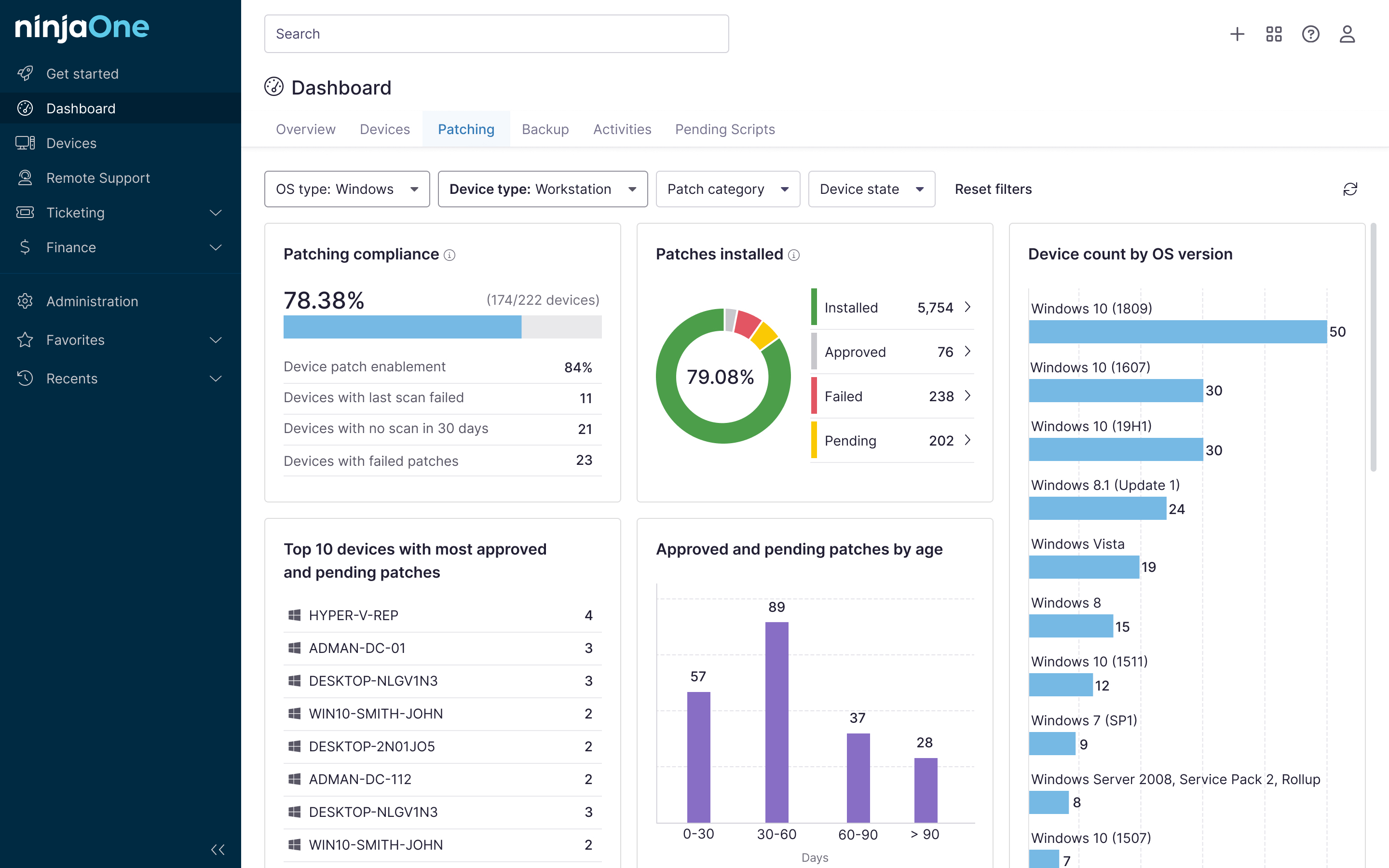
- Comprehensive dashboards for IT visibility across the organization
Automated Patch & Configuration Management
- Automated OS and software patching reduces system disruptions
- Policies and automation ensure consistent configurations across devices
- Pre-configured templates save time and reduce manual IT work
- Minimizes employee downtime from security vulnerabilities
Compliance & Reporting
- Comprehensive compliance reports demonstrate adherence to standards
- Detailed patch status reporting and tracking
- Audit trails for IT governance and accountability
Related topics: