


Key points
- The 3-2-1-1-0 backup strategy builds on the traditional 3-2-1 approach by adding one immutable or air-gapped backup copy and zero-error verification to improve ransomware resilience and recovery reliability.
- The 3-2-1-1-0 strategy secures data using immutability to ensure backups cannot be encrypted or deleted by attackers.
- The additional “1-0” addresses modern cyber threats by preventing backup tampering and verifying backup integrity before recovery is needed.
- Zero-error verification uses continuous checksum testing to guarantee that every byte of saved data is fully recoverable.
- Automating backup pipelines and restore drills replaces manual oversight with consistent, audit-ready security controls.
- Strategic tiering across disk, cloud, and archive storage maintains high security while controlling long-term operational costs.
Most backup failures don’t announce themselves. They surface during a restore, under pressure, when a job that reported “success” for months turns out to be corrupted, incomplete, or already encrypted by the attacker you’re trying to recover from. By then, the copies you counted on are the copies you can’t use.
The 3-2-1-1-0 backup strategy is designed to eliminate that surprise. It keeps the foundation of the classic 3-2-1 rule — three copies, two media types, one offsite — and adds two safeguards: one offline, air-gapped, or immutable copy that attackers can’t alter or delete, and zero recovery errors, verified continuously, so a backup is never assumed to be good without proof.
If you’re defining what the 3-2-1-1-0 backup strategy means for your environment, treat it as a measurable standard where each control can be enforced, monitored, and audited rather than left to best-effort execution.
What is the 3-2-1-1-0 backup strategy?
The 3-2-1-1-0 backup strategy (or rule) is a data protection strategy that aims to defend IT environments against modern cyberthreats, including ransomware and insider threats.
Its main salient point is the addition of ‘1-0’ to the traditional 3-2-1 backup strategy. ‘1-0’ means having one immutable backup and ensuring that your backups are verified and error-free.
Restore from a single file to full systems and SaaS data.
Why the extra ‘1-0’ matters in modern data protection
Backup failures today are rarely obvious. They surface during restores, under pressure, when time and trust are already depleted. The “1-0” elements exist to remove ambiguity from your last line of defense.
The role of immutability in ransomware defense
Ransomware groups now prioritize backup infrastructure. If they can delete or encrypt recovery points, they gain leverage regardless of how many copies you keep.
Immutability blocks that path. It enforces retention at the storage or platform level so backups cannot be changed until a defined date, even with elevated credentials. This control is available across multiple technologies, including WORM media, object-locked cloud storage, and hardened backup appliances.
Cloud providers support immutability through features like Amazon S3 Object Lock and Azure Blob Storage immutability policies, which prevent deletion or overwrite during retention. When combined with separate credentials and restricted access paths, these controls materially reduce the blast radius of a compromised credential.
Air-gapping strengthens this further. Logical separation alone is not enough if backup systems share identity planes or networks with production. Network segmentation, isolated vaults, and tightly controlled access workflows eliminate entire attack paths rather than relying on detection.
From a threat-model perspective, immutability removes the attacker’s ability to destroy your recovery options, not just slow them down.
Why zero-error verification is necessary
A backup that completes successfully is not necessarily a backup that restores successfully. Silent corruption, bit rot, misconfigured encryption, or partial ransomware encryption can all render data unusable without triggering job failures.
IBM’s Cost of a Data Breach Report 2025 highlights the operational risks posed by these failings: Organizations took an average of 241 days to identify and contain a breach, and 65% were still not fully recovered at the time of reporting. When recovery timelines stretch this long, undetected integrity issues in backups can compound disruption, turning technical defects into prolonged business impact.
Zero-error verification closes this gap. It requires checksum or hash validation during backup, after transfer, and during periodic integrity checks. Operationally, this means:
- Generating hashes at the source
- Validating data after it lands in storage
- Rechecking data during scrubbing and before restore
When verification fails, it must automatically halt promotion or rotation. A corrupted backup should never be treated as compliant.
How to implement a policy-driven 3-2-1-1-0 backup strategy
The strength of the 3-2-1-1-0 backup strategy comes from automation. Policy ensures controls are enforced consistently, not selectively.
Embedding automated integrity checks into backup pipelines
Integrity checks should be inseparable from backup workflows. Many enterprise platforms support native checksum validation or expose hooks for custom verification.
Attach checksum generation to ingestion, not post-hoc review. Validation results should determine job success, not supplement it. If integrity checks fail, downstream replication or archival should stop automatically.
Best practices include:
- Calculating hashes before and after transfer
- Storing validation results centrally for audit
- Alerting on mismatches with severity tied to data criticality
This approach prevents corruption from propagating across tiers and gives you defensible evidence during audits or incident reviews.
Scheduling and executing automated restore drills
Relying on occasional manual restores is risky. Define restore drill frequencies based on the workload’s business impact. High-priority systems might be tested weekly, while lower-tier data can follow a monthly cadence.
Track metrics such as recovery time objective (RTO) and recovery point objective (RPO) along with test coverage percentage. Dashboards in your backup console or compliance tools can help you visualize drill outcomes and spot gaps in real time.
Automate representative test restores across all storage tiers, not just the fastest. Include application-consistent tests for databases and critical services, then document pass or fail against defined SLAs.
These 3-2-1-1-0 backup best practices can turn ad hoc testing into a predictable control you can prove to auditors and executives.
Enforcing air-gapped and immutable backup copies
Immutability must be enforced independently of administrative behavior. Retention locks, access boundaries, and approval workflows should be designed so that bypassing protections requires deliberate, observable action rather than routine credentials.
Start with network controls and vaulting procedures. Use micro-segmentation to isolate backup infrastructure from production networks and restrict management access to dedicated paths. Vaulting workflows that write backups to isolated repositories on a delayed schedule further limit exposure during an attack.
In cloud environments, enforce immutability using object lock configurations and lifecycle policies. Write-once retention should prevent deletion or overwrite until expiration, even by administrators, while automated lifecycle rules manage tiering and retention consistently.
Finally, simulate ransomware-style access attempts. Test whether elevated credentials can modify or delete backups, confirm those actions fail, and verify alerts trigger as expected. Document access exceptions and revocation steps to maintain audit readiness.
Balancing cost performance and compliance in 3-2-1-1-0 backup
Long-term retention introduces cost complexity. Storage fees, retrieval latency, and egress charges can quietly eat up your budget if not modeled upfront.
Hybrid tiering often delivers the best balance:
- Disk for recent, high-velocity restores
- Object storage with immutability for medium-term retention
- Tape or deep archive for long-term compliance data
Lifecycle automation is critical. Manual transitions introduce risk and inconsistency, especially under regulatory pressure. Align retention policies with legal requirements and operational recovery needs, then enforce them programmatically.
Cost optimization should never weaken controls. In the 3-2-1-1-0 model, cost efficiency is achieved by automation and tiering, not by reducing verification or immutability coverage.
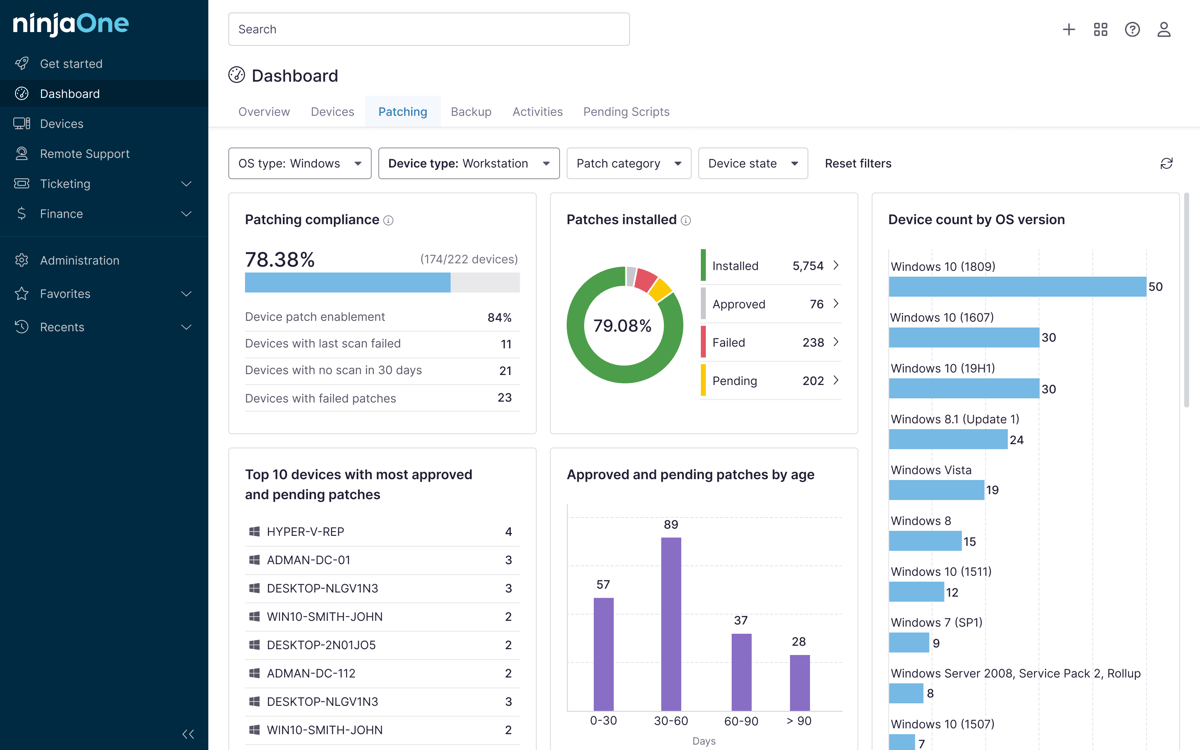
Manage backups and recovery policies from one screen.
Achieving end-to-end resilience
The 3-2-1-1-0 backup strategy reflects a shift in how organizations think about recovery. It’s no longer enough to store copies and hope they work. You need backups that resist tampering, surface corruption early, and demonstrate recoverability continuously.
When immutability and verification are enforced by policy—not habit—you gain more than protection. You gain confidence that recovery is not an assumption, but a tested capability.
Build recovery you can defend
Modern backup strategies demand more than stored copies—they require controls you can verify and explain. NinjaOne brings backup visibility into the same platform you use for monitoring, patching, and service management, helping teams standardize recovery practices and maintain audit readiness. Explore NinjaOne today.