Remote tools with NinjaOne Endpoint Management
NinjaOne Endpoint Management‘s remote tools let technicians manage a device’s tasks, files, services, and registry without taking over the screen.
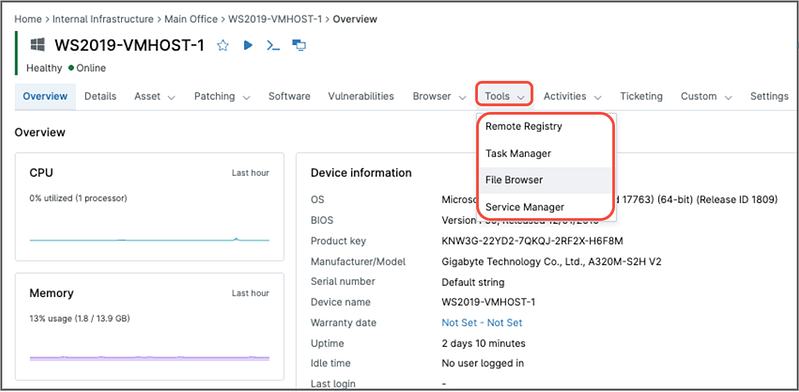
NinjaOne Endpoint Management‘s remote tools let technicians manage a device’s tasks, files, services, and registry without taking over the screen.
Simple fixes often turn into a full remote session or a request for the end user’s help. Here’s how the NinjaOne remote tools address the most common ones.
Problem | How NinjaOne resolves it |
Killing a runaway process or checking what’s using CPU usually means starting a full remote session just to open Task Manager. | Task Manager runs from the device’s Tools tab, showing running tasks and letting a technician end a process or process tree without opening a session. |
Retrieving or replacing a file on a user’s device usually means asking them to do it themselves or interrupting them with a remote session. | File Browser lets a technician view, upload, download, rename, or delete files on the device directly, without disturbing the person using it. |
A hung or misconfigured Windows service usually means either walking a user through the Services console or taking over their screen. | Service Manager lets a technician view, start, stop, or restart a device’s services directly from the console. |
Fixing a registry-level issue on a Windows device usually means a full remote session or asking the end user to make risky manual edits. | Remote Registry lets a technician view, add, modify, or delete registry keys and values directly, without a screen-share session. |
Ending a hung process or restarting a stopped service takes seconds from the Tools tab instead of setting up a screen-share.
Nothing appears on the user’s screen while a technician works, so they can keep working while an issue is fixed.
File, process, service, and registry-level fixes happen from the same console used for monitoring and management.
The same tools are available from the dashboard, device list, device page, or a ticket, so technicians don’t need to switch context to start.
Remote tools run under a system-level context, so a fix can go through even if the logged-in user doesn’t have admin rights.
saved time on manual tasks through automation
reduced ticket volumes and resolution times
replaced 3-4 tools with NinjaOne

View every running task on a device and end a process or an entire process tree, with a confirmation dialog showing everything that will end as a result.

View, upload, download, rename, delete, and compress files and folders on a device remotely, without a remote session.

View, start, stop, and restart a device’s services directly from the console, without opening a remote session.

View, add, modify, and delete Windows registry keys and values remotely. Not available on Mac or Linux, which have no registry to edit.

Remote tools run as System on Windows or Root on Mac, separate from the end user’s own session, so nothing appears on their screen while a technician works.

Open remote tools from the Organization Dashboard, the Device List, a device’s own page, or a ticket linked to that device.

Launch a CLI session under a System or logged-in user context for troubleshooting that goes beyond the four remote tools, from the same menu.

Task Manager, File Browser, and Service Manager work on Windows, Mac, and Linux devices. Remote Registry is Windows only.

For issues that need a full session instead of a single point tool, Background Mode in NinjaOne Remote opens a silent session under the system account on a separate desktop. Technicians can then use File Explorer, Registry Editor, Service Manager, and PowerShell within that session, without displaying anything to the end user.
A frozen application or a stopped service can be fixed directly from Task Manager or Service Manager, without asking the user to do anything.
A technician can open a PowerShell session under the System context to run diagnostic commands and enable verbose logging for the service or application involved, then reproduce the issue while it’s happening. File Browser retrieves the resulting log files for offline analysis, so the full troubleshooting sequence runs in the background without a screen-share session or any disruption to the person using the device.
A technician can correct a Windows registry value directly through Remote Registry, instead of walking a non-technical user through manual edits.
This overview covers the high-level flow only; full detail on each tool is covered in the Remote Tools documentation.
On the device’s own page, open the Tools tab. From the Organization Dashboard or a linked ticket, hover over the device name to reveal the play icon, then select Remote Tools from the menu.
Select Task Manager, File Browser, Service Manager, or Remote Registry, depending on what needs to be checked or changed.
End a process, transfer a file, restart a service, or edit a registry value, with a confirmation prompt for actions that affect other processes.
The change happens in the background under a system-level context, so the end user’s session and screen are untouched.
On using Background Mode to work without disrupting end users:
"I can hop on a machine, fix the problem, and go away without interrupting the user."
said Gagnon, Northeast IT Systems.
See how the NinjaOne remote tools let technicians work on a device in the background, without taking over the screen or interrupting the end user.
One platform to manage, patch, secure and support every endpoint.

This article explains how to use remote tools in NinjaOne.
NinjaOne Remote gives IT teams and Managed Service Providers (MSPs) a fast, secure, and reliable way to connect to any endpoint, no matter where it’s located.
The remote tools in NinjaOne Endpoint Management are Task Manager, File Browser, Service Manager, and Remote Registry. They let technicians manage a device’s processes, files, services, and, on Windows, registry directly from the console, without opening a remote session.
No. NinjaOne Remote is a separate capability that gives a technician full screen-share and control of a device. Remote tools run in the background instead, so nothing appears on the end user’s screen while a technician works. NinjaOne Remote also includes Background Mode, which opens a silent session for the same purpose when a technician needs a full session instead of an individual tool.
Yes. Service Manager lets technicians view, start, stop, and restart a device’s services directly from the console.
Yes, on Windows devices. Remote Registry lets technicians view, add, modify, and delete registry keys and values. It isn’t available on Mac or Linux, which have no registry to edit.