Key Points
- The UK Cyber Security and Resilience Bill would bring qualifying managed service providers into a regulatory framework as relevant managed service providers (RMSPs).
- RMSPs would need appropriate and proportionate measures to manage cybersecurity risks and minimize incidents affecting systems used to provide managed services.
- Proposed incident rules require an initial notification within 24 hours and a fuller report within 72 hours, with the regulator and NCSC informed.
- Proposed requirements also include notifying customers when qualifying cyber incidents are likely to affect them so they can take mitigating action.
- MSP readiness should focus on asset visibility, vulnerability remediation, privileged access, recoverability, incident detection, and evidence that security controls operate consistently.
- NinjaOne can support operational evidence through endpoint inventory, patch and vulnerability management, access controls, backup, configuration visibility, and centralized reporting.
For the first time, UK managed service providers (MSPs) are about to become regulated entities. Until now, the cyber obligations you dealt with were really your clients, and you met them because a customer contract or security questionnaire required it. The Cyber Security and Resilience Bill (Network and Information Systems) will change that.
As currently drafted, the Bill pulls MSPs into regulation directly, with legal duties of their own rather than duties inherited from a client. If your business connects into a client network to deliver ongoing IT management, monitoring, or support, it’s worth understanding the regulation while there’s still time to prepare.
In this article, we cover what the Bill is, what it would ask of MSPs, and how to get evidence-ready before it becomes law.
Harden your endpoints
What is the UK Cyber Security and Resilience Bill?
The Bill is the most significant update to UK cyber regulation in nearly a decade, expanding the NIS Regulations 2018. After leaving the EU, the UK built its own framework rather than adopting the EU’s NIS2, so the two aren’t identical, but share similarities.
The Bill widens the rules to include data centers, designated critical suppliers, and managed service providers. MSPs become “relevant managed service providers,” or RMSPs, a category that covers any provider that remotely manages, monitors, or supports a client’s IT systems.
The logic behind adding MSPs is that they often hold privileged access into hundreds of client environments at once, which makes them a single point that attackers can use to reach many organizations. Bringing MSPs into scope is meant to close that gap.
Where the Bill currently stands
The Bill is not yet law. It has reached Committee Stage in the House of Lords. Royal Assent is expected in late 2026 or early 2027, with phased enforcement through 2028.
What the Bill would change for your MSP
As drafted, RMSP status is expected to bring new duties:
- Direct regulation
- Your MSP would be regulated, with a duty to register with the regulator once you’re in scope.
- Faster reporting
- You’d notify the regulator and the NCSC of a significant cyber incident within 24 hours, then file a fuller report within 72 hours.
- Customer notification
- You’d tell affected clients to ensure they can protect themselves.
- Defined standard
- You’d work to satisfy the NCSC’s Cyber Assessment Framework (CAF), with Cyber Essentials as the fastest route to the five core controls: firewalls, secure configuration, access control, malware protection, and patch management.
- Turnover-linked fines
- Penalties would run to the greater of £10 million or 2% of global turnover for a standard breach, and the greater of £17 million or 4% for a serious or repeated one.
MSPs already patch, control access, back up, inventory, and log incidents to keep clients running. What the Bill would add is the expectation that you have continuous coverage that you can demonstrate when required.
How MSPs can prepare for the cyber security and resilience Bill
Most of the readiness work comes down to four operational disciplines you already recognize:
- Know what you have and what’s exposed. Keep an inventory that reflects what’s running across every client environment and document your vulnerability remediation processes.
- Control who can access what. Make privileged access role-based, enforce MFA, and keep a reviewable record of who had access and when it ended.
- Keep systems recoverable. Back up what matters, including SaaS data, and prove you can restore it.
- Be ready to report. Build the logging, alerting, and reporting process that lets you document an incident within a day.
Bring order to IT asset chaos
How NinjaOne helps
CAF is outcomes-based, and regulators and insurers are moving away from self-attestation toward continuous, provable control coverage. MSPs shouldn’t need a separate compliance tool bolted onto their RMM/PSA stack.
NinjaOne’s native tools map cleanly onto the CAF outcomes, and the five Cyber Essentials controls the Bill leans on.
- Native patch and vulnerability management
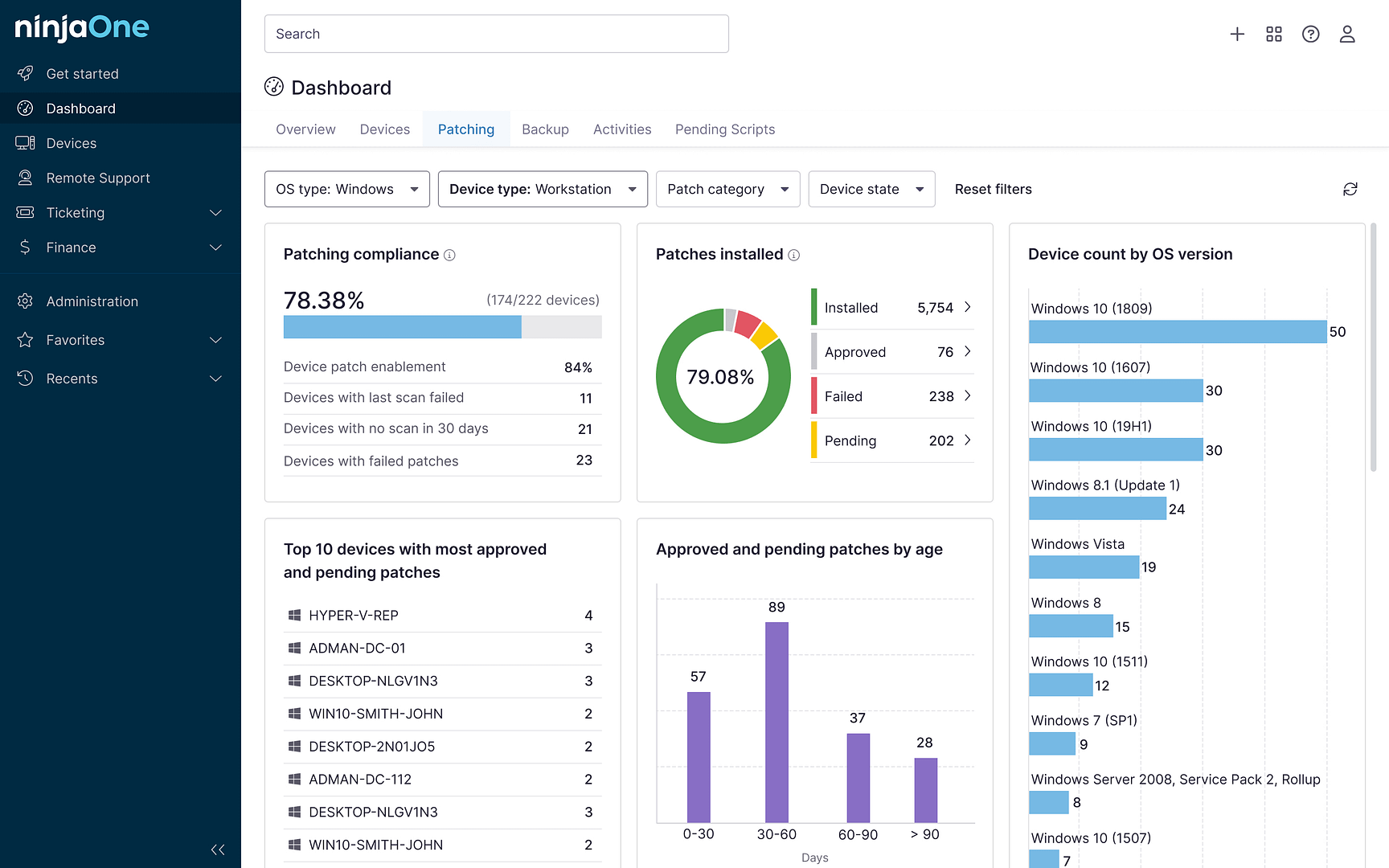
- Your patch history is a continuous, provable record.
- Endpoint documentation
- Patch status, software inventories, device health, and configuration baselines sit in one place.
- Role-based access controls
- Granular permissions and clear audit logs let you verify who accessed which systems and when.
- Backup and recovery
- NinjaOne Backup covers endpoints, servers, and SaaS data such as Microsoft 365, with completion records and restore validation.
- Audit-ready reporting
- Patch history, configuration state, and access logs come together as the always-on evidence trail you can show a regulator or client on demand.
The platform handles the operational layer where much of the evidence gets created, built into the tools you already run rather than bolted on.
Why MSPs should get ahead of the Bill
The Bill isn’t law yet, and the timeline may still shift, but the overall direction is clear. The MSPs that start preparing now will lead the compliance conversation with clients instead of scrambling to catch up to it.