
Key Points
- Ensure governance policies, technical controls, operational workflows, and organizational culture work in unison to improve the effectiveness of security compliance frameworks.
- Map governance policies directly to enforceable technical controls, as undocumented gaps between policy intent and infrastructure can lead to compliance drift.
- Standardize evidence collection through automation and centralized logging to ensure controls are defensible at any point in the audit cycle.
- Embed compliance checkpoints into change management, patch cycles, and onboarding processes to make audit readiness a continuous output of daily operations.
- Role-specific training, defined escalation paths, and leadership accountability help facilitate compliant end-user behavior.
- Continuous metric tracking, including control coverage percentage, MTTR measurements, and recurring audit findings, serves as a feedback loop that helps compliance frameworks mature over time.
A security compliance framework helps IT teams and leadership enforce security controls that align with applicable regulatory mandates and frameworks. These enforcements help organizations reduce breaches and ensure regulatory compliance over time.
Designing a security compliance framework that supports data security governance
A well-designed security compliance framework is only effective if its parts work in unison. Without structure, your control orchestration can become fragmented, resulting in unenforceable policies due to misaligned infrastructure and hidden vulnerabilities.
Closing these gaps requires a framework that ties governance to enforceable controls, standardizes evidence workflows, embeds compliance into daily operations, fosters a compliance-aligned culture, and measures maturity over time.
Aligning security compliance governance strategy with enforceable controls
Governance policies frame an organization’s security intent; however, intent alone can’t guarantee compliance. That said, when compliance strategies outline a policy, organizations should also ensure that it is enforceable within their environment.
Effectively translate policies into configurations by performing the following actions:
| Action | Rationale |
| Mapping of security framework requirements to specific control objectives | Translates specific compliance requirements into measurable configurations to streamline implementation and validation workflows. |
| Identifying technical enforcement mechanisms per compliance requirement | Helps ensure that each applicable policy requirement has a corresponding system or control that actively enforces it. |
| Assigning ownership with clearly defined responsibilities and adequate access permissions | Establishes clear accountability to help preserve controls, manage exceptions, and resolve gaps promptly. |
| Defining a review cadence for policy updates | Aligns governance with evolving regulations and threat landscape by preventing policies from becoming stale. |
| Eliminating gaps between documented baselines and implemented controls | Reduces the gap between policy objectives and what the technical environment is capable of enforcing. |
Aligning governance and technical controls helps surface and manage risk to support proactive remediation of compliance drift. Through this, organizations can ensure that their IT infrastructure can meet the security requirements specified by applicable regulatory frameworks.
Standardize evidence collection and reporting to streamline audits
Proving the effectiveness of compliance strategies requires proof that enforced controls function as intended. A standardized approach to evidence collection provides context-rich metrics, minimizing ad hoc evidence collection procedures that can further obscure control effectivity.
Best practices include:
| Action | Rationale |
| Automating control validation where possible | Automation reduces time-consuming and error-prone manual checks while streamlining continuous compliance to ensure controls meet defined thresholds. |
| Centralizing audit logs and configuration baselines | Storing baselines and findings centrally eliminates information silos that cause dispersed visibility across teams. |
| Defining evidence retention policies | Defined retention policies ensure collected evidence is only kept within the allowable period to preserve compliance with regulatory frameworks. |
| Establishing reporting templates for audits | Standardized templates ensure evidence packets follow a unified structure that clearly maps controls to regulatory requirements, helping speed up audits. |
| Tracking remediation timelines | Integrating remediation tracking with ticketing systems gives clear visibility into pending remediations, preventing unresolved issues from carrying into the next audit cycle. |
Together, these practices foster ongoing evidence collection to ensure audit readiness, reducing unnecessary administrative overhead during compliance audit and review cycles.
Embedding security compliance frameworks into daily operations
Separating compliance strategies and standard workflows causes compliance to become dependent on periodic reviews and manual troubleshooting. Preserving regulatory compliance requires compliance controls to be woven directly into workflows that teams execute daily.
Integration strategies should include the following:
| Action | Rationale |
| Incorporating control checks into change management | Ensures that all infrastructure changes, such as application and configuration changes, are compliant, preventing misconfigurations from reaching production systems. |
| Aligning security reviews with patch cycles | Reviewing compliance after patch deployments helps IT teams document deviations early to support regulatory alignment and speed up remediations. |
| Integrating compliance checkpoints into onboarding processes | Compliance checkpoints, including acceptable use policy acknowledgments and third-party security requirements, align new actors with organizational compliance obligations. |
| Building compliance dashboards to monitor compliance posture continuously | Real-time visibility enables proactive remediation before gaps escalate into incidents or audit findings. |
| Including compliance metrics in quarterly reviews | Incorporating compliance metrics within QBRs helps drive cross-functional accountability and ensures resource allocation meets compliance priorities. |
Instead of being a one-off workflow to meet audit deadlines, this strategy helps your organization maintain audit readiness by making compliance evidence an output of standard workflows.
Fostering a compliance-centric organizational culture
Even a robust security environment can be undermined by an insider threat, such as failure to escalate violations or access control bypass. While technical enforcements and governance policies strengthen compliance posture, end-user behavior still determines the effectiveness of compliance strategies.
Cultural reinforcement strategies include:
| Action | Rationale |
| Conducting regular security awareness trainings | Role-specific, scenario-based training programs help connect compliance obligations to end-user workflows, keeping end-user behavior aligned with required compliance actions. |
| Defining clear escalation paths for policy violations | Providing end-users with documented escalation procedures supported by a non-punitive reporting culture enables early detection of compliance failures. |
| Leadership endorsement of governance standards | When leadership behavior serves as a model for compliance behavior, it helps establish compliance as a shared organizational priority. |
| Transparent reporting of compliance performance | Communicating control gaps, audit findings, and remediation progress across stakeholders builds accountability and discourages non-compliance. |
| Incentives tied to compliance | Integrating secure behavior into performance evaluations and recognition programs transforms compliance into a professional standard. |
Building an organizational culture where compliance is understood and practiced helps advance awareness that strengthens your organization’s overall compliance posture.
Measuring the maturity of security compliance governance strategies
Maintaining compliance with regulatory frameworks isn’t a one-off task. Over time, controls can degrade over time as updates pour in and threats evolve. Without sufficient data to confirm the effectiveness of governance strategies, organizations are left to assume compliance, leaving gaps unchecked and vulnerabilities hidden.
The following comprises effective maturity measurement strategies:
| Action | Rationale |
| Tracking control coverage percentage | Surfacing coverage gaps helps identify which areas compliance strategies underperform due to resource constraints, technical limitations, or policy drift. |
| Monitoring audit findings over time | Longitudinal monitoring helps identify repeat issues and determine whether they stem from isolated errors or deeper infrastructure weakness. |
| Measuring mean time to repair | This surfaces remediation bottlenecks, ownership issues, and insufficient tooling that can cause long or inconsistent remediation cycles. |
| Identifying recurring compliance gaps | Analyzing recurring gaps directs remediation efforts toward root causes rather than their symptoms, reducing unnecessary surface-level fixes that can overwhelm technicians. |
| Reviewing incident trends related to compliance control failure | Connecting incident trends with compliance metrics shows leadership the real business value and return on investment (ROI) of compliance strategies. |
Ongoing maturity measurement and refinement keep organizations consistently audit-ready. This serves as a feedback loop that keeps governance and compliance strategies aligned, ensuring the whole framework evolves as risk profiles and regulatory requirements shift.
Ensure ongoing alignment using a security compliance framework
Compliance breaks down when intended policies and tools are misaligned. Aligning policies, governance, controls, workflows, and organizational culture shifts compliance from being a periodic audit exercise into a maintained governance strategy.
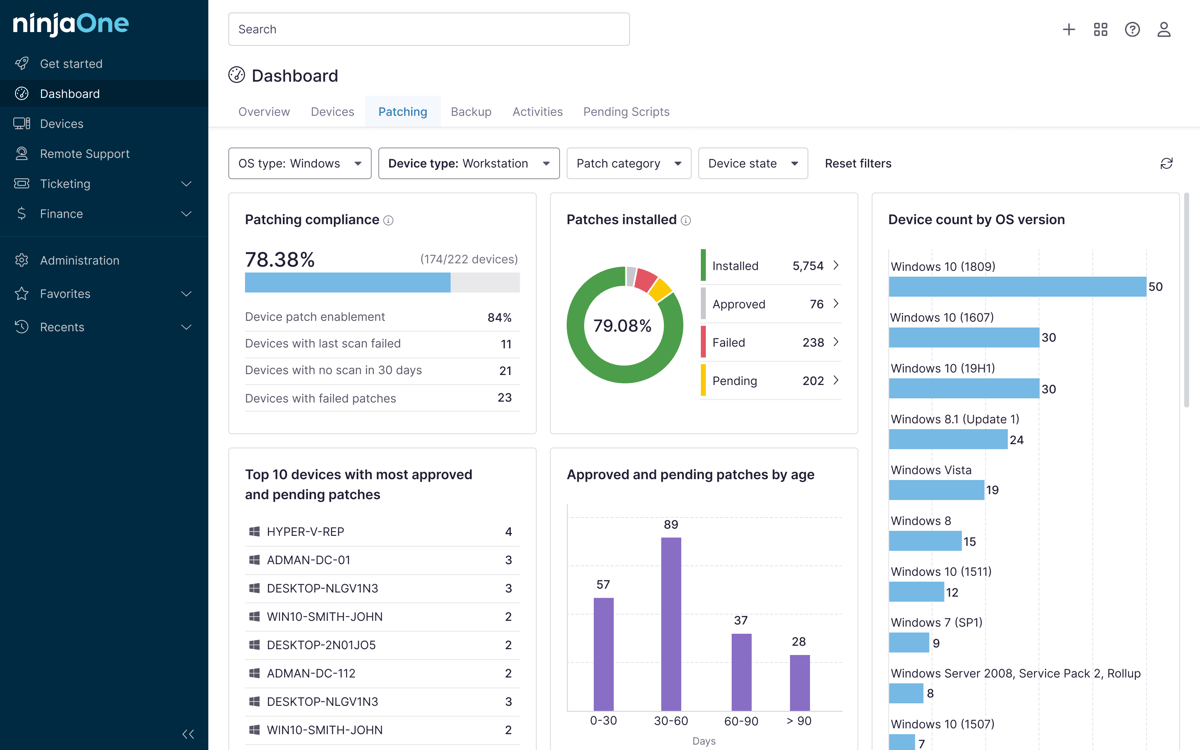
NinjaOne NMS helps organizations maintain compliance through its unified platform that automates and centralizes policy management, technical controls, and operational workflows.
Related topics: