Key Points
- Match Storage to Workload: Use SAN for low-latency databases and VMs, NAS for shared file access, and DAS for simple, single-server setups.
- Ensure Reliability and Security: Strengthen storage with RAID, MPIO, snapshots, encryption, and network segmentation to protect data and uptime.
- Simplify Management with NinjaOne: Automate discovery, monitoring, backups, and restores across SAN, NAS, and DAS with NinjaOne’s automation tools.
Storage Area Network (SAN), Network-Attached Storage (NAS), and Direct-Attached Storage (DAS) are three local storage options with perks and use cases.
As such, the debate over SAN vs. NAS vs. DAS has been ongoing for quite some time. It usually revolves around which local storage is best for Small and Medium-sized Business (SMB) workloads.
This article will discuss the differences between the local storage options and how to choose between them for SMB workloads.
SAN vs. NAS vs. DAS: What is the best for SMB workloads?
NAS provides file-level access over Ethernet and excels at team shares and unstructured content. Meanwhile, SAN gives block-level access to servers over iSCSI or Fibre Channel. Lastly, DAS keeps storage attached to a single server.
📌Prerequisites:
- Inventory of candidate workloads with capacity, IOPS, and latency targets
- Business RPO and RTO requirements per workload
- Network diagram with current speeds, VLANs, and security zones
- Team skills assessment for SMB, NFS, iSCSI, Fibre Channel, snapshots, and replication
- Backup and disaster recovery approach and retention policy
Decision framework: Workload to storage choice
Understanding what each workload needs is crucial to knowing what storage type is best for your business.
- Virtualization clusters and databases: SAN is best here, as it offers consistent and low-latency performance. If you already have a virtualization platform, consider hyperconverged options.
- Departmental file shares and media repositories: Go with NAS, as it’s ideal for shared access, snapshots, and replication.
- Single-server or edge systems: Choose DAS, as it’s the direct and cost-efficient option amongst the three. DAS is also easy to manage, making it perfect for solo workloads.
- Mixed environments: Start with NAS for general storage before you add SAN for workloads where latency is crucial.
Protocol and fabric selection
Choose the proper protocol and fabric to ensure performance, reliability, and compatibility.
- NAS file services: SMB is best for Windows-centric environments, while NFS is best for mixed systems. Confirm proper integration with Active Directory or LDAP, align ACL models, and test file-locking behavior to avoid access conflicts between clients.
- SAN block services: Deploy iSCSI over 10 GbE or 25 GbE with dedicated VLANs and MPIO for path redundancy. FC with zoning and dedicated fabrics provides proven performance for organizations with established Fibre Channel infrastructure.
- Hyperconverged or vSAN: Only consider this option when compute and storage need to scale together. These simplify operations, reduce hardware silos, and integrate seamlessly with modern virtualization platforms.
Reliability and data protection
To build a reliable storage environment, you need layers of protection across hardware, software, and processes. Elements such as RAID configuration and backup policy are crucial in maintaining data integrity.
The choice of RAID depends on workload characteristics. RAID 10 is ideal for write-heavy databases or virtualization pools, as it combines performance with fast rebuild times. Meanwhile, RAID 6 is more efficient and stronger against disk failures, making it a good choice for read-heavy or archive workloads.
Dual-controller arrays should be standard in production storage systems. Pairing them with multipathing (MPIO) between hosts and storage eliminates single points of failure and maintains access continuity.
Snapshots provide point-in-time recovery and should be scheduled frequently to minimize data loss. Important datasets should be replicated off-site to prevent issues during site disasters. However, it’s vital to keep in mind that RAID and replication are not backups; they merely guard against hardware issues.
Lastly, a robust backup strategy should capture snapshots or replicas into a dedicated backup system with immutability to prevent tampering or ransomware encryption.
Performance planning
High-performing storage requires balanced media types, network design, and real-world testing.
- Media and tiering: Use SSD or NVMe for frequently accessed data and HDDs for bulk or archival capacity. Enable caching features when available to accelerate reads and writes for active workloads.
- Network design: Standardize on 10 GbE or faster for iSCSI or NFS connectivity. Before enabling jumbo frames, verify that they are consistently supported across all network devices.
- Benchmarks: Run synthetic and application-level performance tests replicating real-world read and write ratios, block sizes, and concurrency.
Security and governance
Isolation, authentication, and continuous monitoring are necessities for strong storage security.
Segmentation
Keep storage VLANs isolated from network traffic. Restrict management interfaces to trusted subnets or jump hosts to reduce exposure and prevent unauthorized access.
Authentication and access
Integrate SMB shares with Active Directory for NAS and apply consistent group-based permissions. For NFS, configure exports carefully to limit access by host or subnet. Secure iSCSI with initiator ACLs and CHAP authentication.
Encryption
Enable encryption at rest to ensure data is protected. Use TLS or IPsec to secure management sessions and data in motion, especially across shared networks.
Auditing
Monitor changes to shares, LUN mappings, and access controls. Track failed mount attempts and replication health, and ensure all storage modifications follow established change control processes for traceability.
Pilot and validation checklist
Validate capacity, performance, resilience, and operability under real-world conditions.
- Capacity and growth: Confirm usable capacity and ensure at least a 12-month growth runway based on projected consumption.
- Latency and throughput: Measure 95th percentile latency and sustained throughput under expected loads.
- Failover: Test controller failover scenarios and validate host rescan behavior to ensure fast recovery and minimal disruption.
- Rebuilds and maintenance: Measure rebuild times, background impact, and firmware update paths.
- Operability: Evaluate setup time, backup integration, and monitoring compatibility.
NinjaOne integration
The following NinjaOne services can help you manage the network storage of your choice:
Asset discovery and inventory
With NinjaOne, you can automate the discovery of Microsoft 365 and Google Workspace assets. You can also track user accounts, mailboxes, and OneDrive or Google Drive storage.
Monitoring
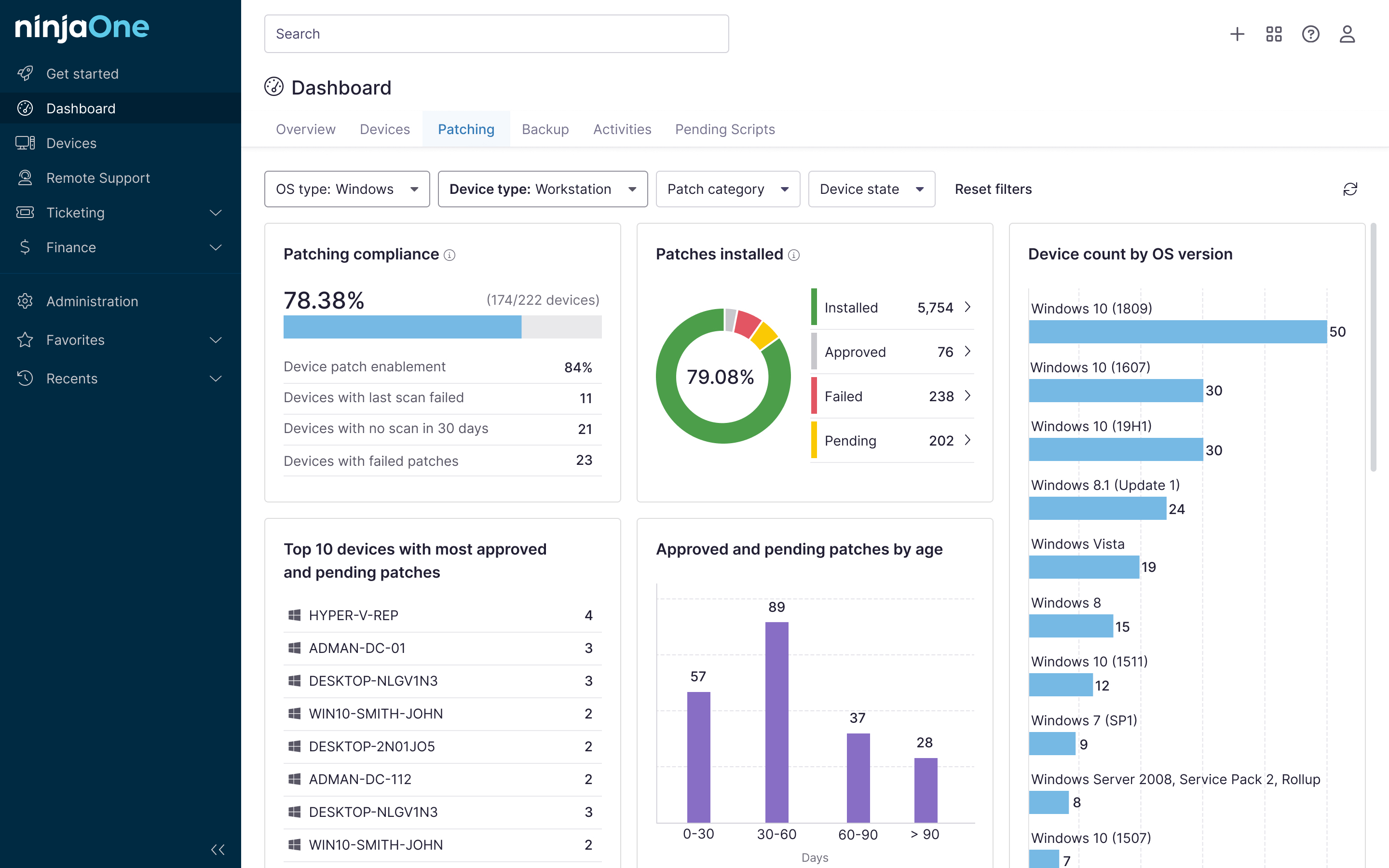
Backup and monitoring with NinjaOne include backup status tracking, automated backup frequency, and notifications.
Automation
NinjaOne’s automation capabilities include auto-discovery for new users and sites, pre- and post-backup automation scripts, and retention policy configuration.
Backup verification
Lastly, NinjaOne’s backup verification features include point-in-time restores, multiple restore options, system status tracking for restores, and email and download notifications.
Choose the correct storage option for SMB workloads
Choosing between NAS, SAN, and DAS is easy if you factor in workloads, needs, team skills, and an honest pilot. NAS serves file workloads economically, SAN delivers low-latency block access for VM and database tiers, and DAS keeps isolated apps simple. Pairing the right platform with security and monitoring should enhance performance and reduce cost.
Related topics: