Key points
- Operational resilience keeps critical IT services running during disruptions through continuous validation rather than one-time disaster recovery planning.
- Centralized visibility across cloud, hybrid, and on-premises systems prevents small infrastructure issues from escalating into costly outages.
- Regular micro-failover drills and risk simulations help IT teams uncover hidden dependencies and validate recovery procedures without disrupting production.
- Automating patch deployment, backup validation, and escalation workflows reduces manual delays and ensures consistent recovery across distributed environments.
- Standardizing recovery procedures and conducting cross-functional training reduces process fragmentation and strengthens overall resilience during incidents.
Cockroach Labs’ State of Resilience 2025 report found that companies dealt with an average of 86 outages per year. Yet, downtime rarely comes from a single catastrophic failure. More often, service disruptions stem from smaller issues such as missed patches, delayed failover actions, fragmented monitoring, or unclear recovery ownership across teams.
If you manage distributed infrastructure, operational resilience helps your team maintain critical services during outages, cyber incidents, infrastructure failures, and operational changes.
Instead of treating resilience as a disaster recovery exercise that only matters during major outages, you can build repeatable processes that support faster response and more consistent recovery every day.
What is operational resilience?
While traditional disaster recovery focuses primarily on restoring systems after major outages, operational resilience takes a broader approach by helping your team prepare for instability before outages affect users directly.
This includes maintaining service continuity during:
- Infrastructure failures
- Cybersecurity incidents
- Cloud service disruptions
- Operational changes
Operational resilience also depends on continuous validation instead of static planning. Your team should regularly test recovery procedures, continuously evaluate infrastructure dependencies, and refine response workflows using feedback from real incidents and simulations.
When you treat resilience as an ongoing process instead of a yearly compliance exercise, your team can reduce recovery delays and respond more consistently during service disruptions.
Operational resilience challenges for IT environments
Even mature IT teams can fall prey to poor resilience practices. Fragmented tooling, inconsistent workflows, and manual recovery processes can create delays that extend your downtime during outages.
Reducing operational blind spots across distributed systems
When monitoring, patching, backup, and endpoint management systems operate independently, your team can easily face blind spots that expose your business to unnecessary risk.
Without consistent visibility, even small infrastructure problems can escalate into larger disruptions before your team recognizes the impact. For instance, Splunk’s State of Observability 2025 found that 73% of organizations experienced outages due to ignored or suppressed alerts.
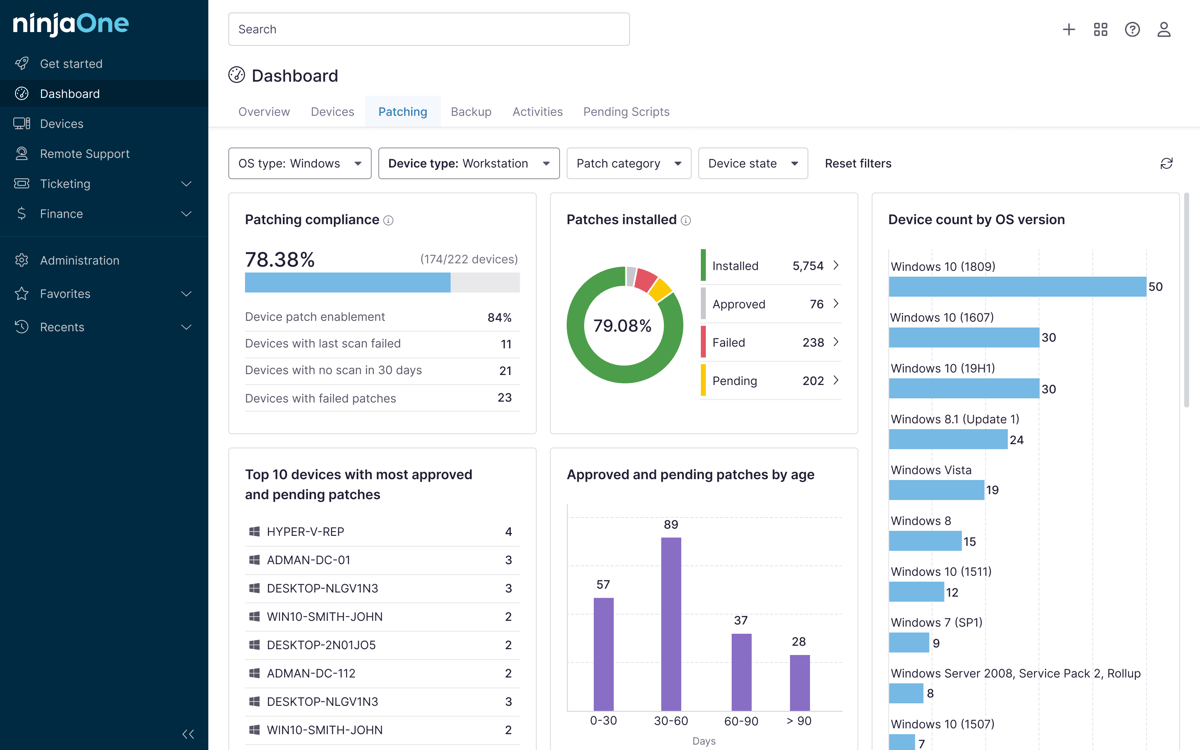
Improving operational resilience for IT starts with centralized visibility across cloud, hybrid, and on-prem systems. Your team should consolidate monitoring data, standardize endpoint reporting, and automate routine maintenance tasks so infrastructure conditions remain visible across environments.
Automated patching schedules and continuous backup validation also help reduce the risk of undetected failures during operational incidents.
Addressing compliance and recovery coordination challenges
You can significantly reduce recovery times by defining ownership and escalation paths before an outage occurs. Make sure your team knows who is responsible for backup validation, failover approvals, escalation decisions, and service recovery so there is no confusion when every minute counts.
This becomes especially important in environments where infrastructure, security, and support teams all participate in recovery operations simultaneously. The challenges of operational resilience also increase as regulatory requirements evolve. Your environment may need to maintain recovery documentation, incident-reporting procedures, and audit records aligned with operational continuity requirements.
Operational resilience best practices for proactive IT operations
Operational resilience best practices focus on continuous validation instead of occasional testing. Rather than waiting for annual disaster recovery exercises, your team should evaluate recovery readiness through ongoing simulations and smaller operational tests.
Use proactive risk simulations to identify hidden dependencies
Your team can identify weak points across applications, cloud workloads, and operational dependencies using scenario-based reliability testing. For example, your environment may depend on identity services, storage systems, and networking paths that fail together during a disruption, even though they appear unrelated during normal operations.
Risk simulations can also help your team test how systems respond under stress while validating failover behavior, escalation timing, and service recovery procedures.
Your team should also:
- Run targeted failover simulations regularly
- Document newly discovered infrastructure dependencies
- Update recovery procedures using operational findings
As your environment evolves, your recovery plans should evolve with it. Ongoing testing helps your team validate processes, uncover weaknesses, and stay prepared for real-world disruptions.
Conduct micro-failover drills to improve recovery readiness
Full disaster recovery exercises are important, but they are usually conducted infrequently due to the risk and scheduling complexity they carry. On the other hand, micro-failover drills can give your team a way to test smaller recovery scenarios without disrupting production services broadly.
For instance, your team can validate database replication behavior, test failover for individual applications, or rehearse service restoration workflows for specific systems during controlled maintenance windows.
These smaller exercises can help your team become more familiar with recovery procedures while identifying gaps in escalation paths, documentation, and failover timing. Over time, repeatable drills can improve recovery consistency by enabling your team to refine procedures continuously rather than relying on outdated recovery assumptions.
How to embed operational resilience into daily IT workflows
To build resilience, your team needs to treat it as part of normal IT operations instead of a separate initiative.
Automate patching, backup, and failover workflows
Manual recovery workflows can cause delays and increase the likelihood of inconsistent execution during outages. Your team can standardize failover execution and remediation across distributed systems using automated workflows.
Your environment should automate:
- Patch deployment scheduling and rollback actions
- Backup integrity validation
- Escalation workflows tied to service failures
Centralized automation also reduces the number of manual handoffs required during incidents. Rather than relying on disconnected scripts and undocumented recovery steps, your team can follow standardized workflows tied to infrastructure conditions and recovery thresholds.
Use resilience metrics to support operational decision-making
Operational resilience depends on measurable recovery outcomes. Your team should track metrics directly tied to downtime, service availability, failover readiness, and recovery speed so leadership can evaluate operational risk with concrete data rather than assumptions.
Key resilience metrics may include mean time to recover (MTTR), recovery point objectives (RPO), and failover test success rates. You should also review how incidents affect SLA attainment, customer-facing services, and operational continuity across environments.
Connecting resilience metrics to business impact can help technical and executive teams prioritize infrastructure improvements using the same operational benchmarks.
Why operational resilience depends on consistency
Teams that follow inconsistent recovery procedures or maintain disconnected operational standards can have a massive impact on your resilience posture.
Reduced process fragmentation across IT operations
Fragmented recovery workflows create delays because teams often follow different escalation paths, backup validation procedures, and incident response processes during outages. One team may validate backups manually, while another relies on automated checks, or infrastructure and support teams may escalate incidents through entirely separate workflows.
Standardizing patch management, monitoring procedures, backup validation, and escalation processes across cloud and on-prem systems can help your team respond more consistently during disruptions.
This shared structure improves coordination because infrastructure, security, and support teams work from the same operational procedures and recovery expectations during incidents.
Fortified resilience through repeatable operational practices
If critical knowledge only exists in individual team members’ heads or outdated documentation, your recovery procedures can become unreliable over time. Your team should maintain centralized runbooks, update recovery procedures after drills and incidents, and document changes as infrastructure environments evolve.
This helps ensure your recovery steps remain accurate when outages affect cloud services, endpoints, or internal systems unexpectedly. Cross-functional training also improves your operational resilience because infrastructure, security, and support teams rehearse the same response procedures together, rather than coordinating for the first time during a live incident.
Strengthen operational resilience with NinjaOne
NinjaOne helps you automate patching, monitor endpoints, and support more consistent recovery workflows across distributed IT environments. Try NinjaOne for free to see how integrated endpoint management and automation help your team strengthen operational resilience across daily IT operations.
Quick-Start Guide
Can NinjaOne Help with Operational Resilience?
Yes, NinjaOne provides several capabilities that directly support operational resilience and help IT teams reduce disruption and downtime:
Key Resilience Capabilities
1. Proactive Patch Management
– Automated software patching across Windows, Mac, and Linux endpoints
– WinGet integration supporting 6,000+ third-party applications with automatic updates
– Reduces vulnerability windows and prevents security-related downtime
– Configurable approval workflows to balance speed with control
2. Comprehensive Asset Lifecycle Management
– Track devices from purchase to decommissioning, ensuring nothing falls through the cracks
– Automatic device linking and conversion between managed and unmanaged states
– Maintains asset information and custom fields throughout the device lifecycle
– Prevents operational gaps caused by untracked or misconfigured devices
3. Centralized Endpoint Management
– Remote monitoring and management (RMM) across all endpoints
– Mobile Device Management (MDM) for Android and other mobile platforms
– Zero-touch enrollment for streamlined device onboarding
– Reduces manual intervention and human error
4. IT Asset Management (ITAM)
– Complete visibility into all managed and unmanaged devices
– Track asset status, ownership, and assignment changes
– Enables faster incident response through better asset intelligence
How This Reduces Disruption & Downtime
Benefit
Automated patching – Prevents security breaches and system failures
Proactive monitoring – Identifies issues before they cause outages
Centralized control – Faster remediation across all endpoints
Asset visibility – Quicker troubleshooting and resource allocation
Lifecycle tracking – Prevents configuration drift and orphaned devices
Bottom Line
NinjaOne’s integrated approach to endpoint management, patching, and asset tracking creates a foundation for operational resilience by reducing unplanned downtime, improving security posture, and enabling IT teams to respond faster to issues.