Key Points
- When adopting Macs, enterprise IT must account for employee preference, strong performance, cloud-first integration, and a mature security posture.
- Apple Business Manager and MDM form the foundation of enterprise Mac management, working together to enable zero-touch deployment and control over the device lifecycle.
- Effective Mac management involves well-defined operational workflows for onboarding, provisioning, patching, and support, which require structured planning.
- Effective Mac management also requires consistent security enforcement, patch management, inventory visibility, and audit-ready compliance reporting across all devices.
- Mac management can introduce challenges such as evolving support models and cross-platform consistency, which influence enterprise readiness.
Macs have become more common in enterprise environments. The major factors include user preference, performance, and platform maturity. However, managing Macs goes beyond device enrollment. Enterprise Mac management requires structured device provisioning, secure enrollment, compliance visibility, and support workflows.
To manage Macs in an enterprise environment, enroll every device through Apple Business Manager and an MDM platform, apply a security baseline that covers encryption, passwords, approved apps, and patching, keep a live inventory with compliance reporting, and define lifecycle workflows for onboarding, remote support, and secure offboarding.
This guide provides a broad view of enterprise Apple macOS management beyond just MDM configuration.
Why enterprises adopt Macs
Macs are now widely adopted in enterprise environments for several reasons:
Employee preference
Many employees prefer using a macOS device for work, noting that it’s easy to use and navigate. In addition, the Apple ecosystem allows seamless integration with other devices (for example, iPhone and iPad).
Platform stability and performance
According to a Total Economic Impact (TEI) study by Forrester, organizations that adopted Macs experienced both quantified and unquantified benefits from the platform’s stability and performance. These include:
Quantified benefits
- Device support and management costs have been cut by almost one-third.
- Employee productivity has increased by 3.5% due to better device performance and reliability.
- Devices retain three times more residual value after four years of use.
Unquantified benefits
- Device lifetimes have been extended.
- Lower energy usage led to reduced emissions.
Integration with cloud services
Since Macs are designed to work in cloud-first IT setups, they integrate cleanly with cloud services (IaaS, PaaS, SaaS), making it easier for organizations to manage modern enterprise environments.
Perceived security posture
macOS is known to have one of the strongest security postures because protection is built in at multiple layers and enabled by default. This includes hardware-backed full-disk encryption, System Integrity Protection, and strict app verification through Gatekeeper, notarization, and XProtect.
While these benefits are valuable for enterprises, IT teams must also consider the challenges that come with Mac adoption, such as more complex support requirements, tooling gaps, and cross-platform policy alignment.
Enrollment and device lifecycle management
Similar to other platforms, enrollment is the first step in Mac management. There are two components in the Mac management architecture:
Apple Business Manager (ABM)
This is the foundation of enterprise Mac management. ABM offers features such as automated device enrollment, app and book licensing, and managed Apple accounts. It also integrates directly with enterprise MDM.
Mobile Device Management (MDM)
MDM is required for effective enterprise macOS management. It allows organizations to centrally enforce security policies, deploy configuration profiles, push apps, scripts, and updates, and remotely lock or wipe devices.
With ABM and MDM working together, enterprises can enable zero-touch deployment and provisioning while maintaining consistent policy application from first boot through device retirement.
Security and compliance considerations
After enrollment, security and compliance should be addressed immediately. In enterprise environments, this ensures Macs are held to the same security standards as other corporate devices.
Effective enterprise Mac management focuses on these core areas:
Policy enforcement (passwords, encryption, apps)
Define what’s allowed and what isn’t by enforcing the basics, including strong passwords, disk encryption, and approved apps.
Patch and update management
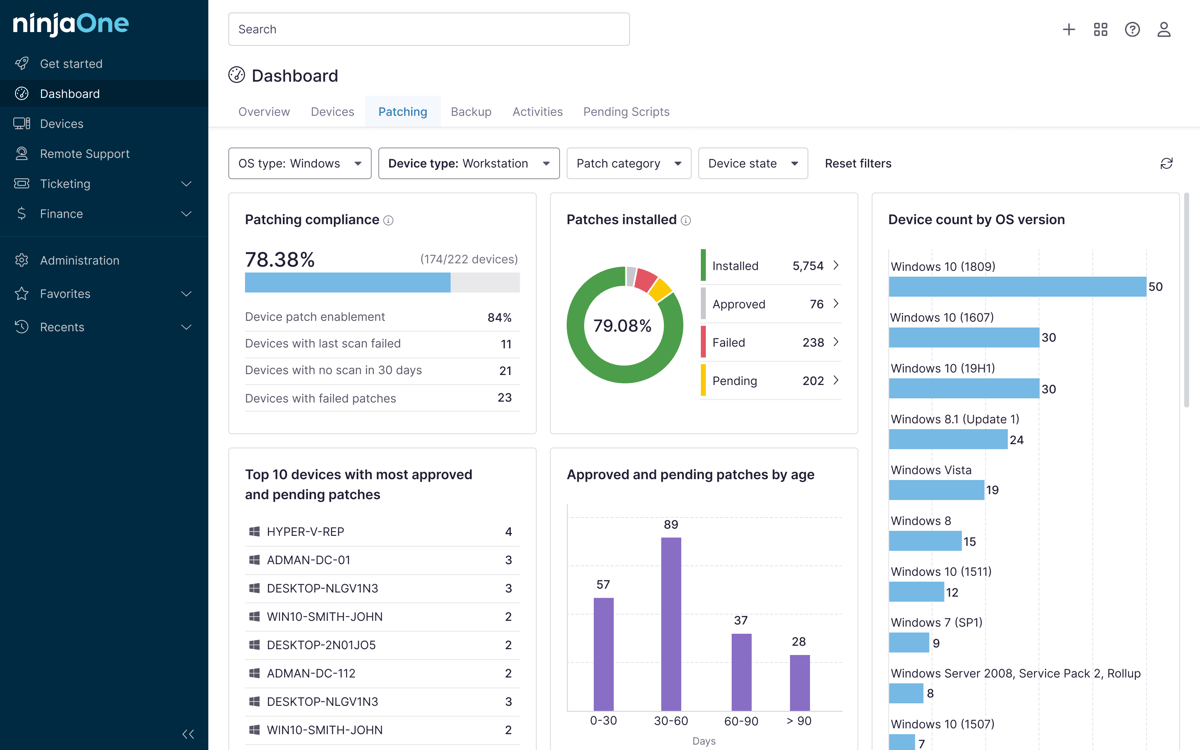
Prevent security gaps caused by unpatched Macs. Centrally control macOS updates, maintain visibility into which devices are behind, and enforce timely security patches for both the OS and third-party apps.
Compliance reporting and audit readiness
Maintain the ability to report on encryption status, identify devices that are out of compliance with security policies, and capture details such as who last logged into a device and when. This provides clear evidence that Macs meet internal policies and external requirements.
Inventory and configuration visibility
Keep a clear record of how many Macs exist in the environment, who they’re assigned to, and which OS version, apps, and configurations they’re running. When all assets are visible, it’s easier to understand what needs to be secured and how.
Operational workflows and support
Beyond security settings and policies, Mac management focuses on making sure day-to-day IT workflows work smoothly across the entire device lifecycle, from when employees join, to when they need support, and when they leave the company.
Managing Macs in an enterprise involves workflows such as:
Onboarding and provisioning new hires
When a new hire starts, their Mac should be ready with security settings applied, required apps installed, and the appropriate access for their role granted.
Standardized imaging and baseline configuration
This involves a standardized baseline configuration, which replaces traditional imaging in modern macOS environments. Security, network, and system configurations are applied automatically, helping IT teams avoid custom, one-off setups that are difficult to support later.
Remote support and troubleshooting
To maintain steady operations, IT teams need remote visibility into device status. They must be able to push fixes or configuration changes without user intervention and guide users through self-service tools for common issues.
Secure decommissioning and data wipe
When a user leaves, company data must be securely removed, access revoked immediately, and devices reset, reissued, or retired safely.
Enterprises must align these workflows with helpdesk processes and cross-platform support models to avoid gaps and delays.
Enterprise Mac management at a glance
Here’s a quick summary of the steps you’ll take when managing Macs and the result of each step:
| Step | What to do | Result |
| Enroll | Register Macs in Apple Business Manager and assign them to an MDM platform | Zero-touch provisioning from first boot |
| Enforce a security baseline | Require encryption, strong passwords, and approved apps | Consistent posture across the fleet |
| Patch | Control macOS and third-party updates centrally | Fewer unpatched devices |
| Track inventory and compliance | Keep a live record of devices, owners, OS versions, and compliance status | Audit-ready evidence |
| Run lifecycle workflows | Standardize onboarding, remote support, and secure offboarding | Fewer support gaps and delays |
Challenges unique to enterprise Mac fleets
Managing Macs at scale is not without challenges. Here are common issues enterprise IT teams face:
- Bridging gaps between Mac and non-Mac tools within the same environment.
- Training support staff on macOS-specific behaviors and error handling.
- Maintaining visibility across mixed OS environments.
- Striking the right balance between user autonomy and corporate policy enforcement.
Understanding these challenges allows IT leaders to design more cohesive and efficient support structures.
Best practices for enterprise Mac management
Manage Macs the right way by following the best practices used by organizations that excel at Mac management:
- Standardize enrollment through Apple Business Manager (ABM) and an MDM platform.
- Automate security baseline configurations, including encryption and password requirements, OS and system settings, and required security tooling.
- Maintain a centralized inventory and compliance dashboards to quickly identify compliant and non-compliant devices, OS versions and patch status, and assigned users and device ownership.
- Define cross-platform support playbooks to ensure Mac and non-Mac platforms don’t create gaps that disrupt workflows.
- Review usage patterns and adapt policies over time.
Common misconceptions
As Macs become more common in enterprise environments, several misconceptions can lead to underinvestment, weak controls, or reactive support models. It’s important to address these early.
Macs don’t require endpoint management
This misconception is risky. Macs in enterprise environments operate at a completely different scale and have different requirements compared to individual use. Once Macs are subject to corporate policies, regulatory requirements, and shared data access, active management becomes critical. Unmanaged devices can quickly turn into security blind spots.
Mac management is only about MDM
MDM is a critical part of Mac management, but it’s only one component. Effective Mac management combines MDM with operational workflows and visibility, such as onboarding and offboarding processes, inventory and compliance reporting, and defined helpdesk workflows and escalation paths. Without these, enterprise Mac management remains incomplete.
Macs are always more secure by default
Macs are known for strong built-in security features, but security isn’t automatic. It depends on proper configuration, including encryption, access controls, system permissions, and disciplined patch management.
Where NinjaOne fits in enterprise Mac management
NinjaOne manages Macs alongside Windows, Linux, and mobile devices from a single console, addressing the cross-platform consistency challenge covered above. The capabilities listed below map to the steps in this guide:
| NinjaOne capability | How it helps |
| Automated device enrollment through Apple Business Manager | Syncs company-owned Macs from ABM for zero-touch enrollment and supervised management |
| MDM-based Mac management | Enforces security policies, configurations, and controls across managed Macs |
| macOS patch management | Controls macOS updates and third-party application patching from one policy |
| Centralized visibility | Provides a single view of Mac hardware, OS versions, configurations, and compliance status alongside other platforms |
| Compliance reporting | Provides visibility into device compliance and audit readiness |
| Remote support tools | Allow teams to diagnose and resolve issues without physical access |
Building consistency and control with enterprise Mac management
When managing Macs in an enterprise environment, it’s important to plan beyond enrollment alone. To be effective, IT teams must also account for device lifecycle workflows, security and compliance requirements, support processes, and cross-platform integration.
When these are consistently controlled and enforced, Mac management stays aligned with broader organizational policies and IT standards.
Related topics: