


Key Points
- Establish a standard lifecycle from evaluation to post-adoption review for predictable, repeatable results.
- Develop scalable playbooks and templates to ensure consistent execution and communication across all clients.
- Automate core steps like ticketing and configuration to enforce consistency and free up technical resources.
- Integrate practical ITIL principles for essential governance and change management without the complexity.
- Implement continuous feedback loops to systematically identify bottlenecks and improve every future rollout.
- Verify success with concrete metrics on adoption rates, SLA compliance, and client satisfaction.
Every client rollout feels different, leading to duplicated efforts and unpredictable results. A structured service adoption framework eliminates this chaos by creating a repeatable process for deploying everything.
This guide will walk you through building your own framework, from defining a standard lifecycle to automating deployments and measuring real success.
Steps to building your service adoption framework
A repeatable framework helps eliminate ad-hoc rollouts by giving you a clear set of steps that ensure consistency across all clients. It replaces chaotic or improvised deployments with a structured process that improves efficiency and reduces compliance risks.
📌 Use case: Deploy this structured IT rollout service approach for any significant change that requires consistency. This includes onboarding new clients to your standard stack, introducing a new security tool (like EDR or M365 policies), or performing major upgrades, such as a Windows 11 migration.
📌 Prerequisites: Before you begin, secure these essentials:
- The administrative authority to define processes
- A defined service catalog
- Access to your core operational tools, like your PSA, RMM, and documentation platform.
- Familiarity with IT Infrastructure Library (ITIL) framework principles (advantageous for streamlining change management)
Once you’re all set, follow the steps below to start building your IT rollout service framework.
Step 1: Define a standard adoption lifecycle
A standardized lifecycle turns complex service rollouts into a predictable, repeatable process. Follow these six steps to ensure consistent success.
Step-by-step procedure:
- Evaluate the service.
- Assess the new service’s technical fit and business value. This means confirming hardware compatibility and defining the benefits, such as enhanced security and a modern user interface.
- Run a pilot implementation.
- Test the service with a small, controlled group first. A limited deployment validates your process, uncovers software conflicts, and gathers initial user feedback before a full-scale IT rollout service.
- Standardize client communication.
- Manage expectations with clear, consistent messaging. Use pre-made templates to announce the change, explain the benefits in simple terms, and provide training guides. This helps reduce support tickets and minimizes user anxiety.
- Conduct approval & compliance checks.
- Secure formal sign-off from stakeholders and verify the service meets all security and regulatory requirements. This formal ITIL framework step creates a necessary audit trail and ensures governance.
- Execute deployment & training.
- Roll out the service using automated scripts and standardized checklists. Follow with targeted training, like quick guides on new Windows 11 features, to ensure users can leverage the new tool effectively from day one.
- Perform a post-adoption review.
- Measure success by confirming service usage, collecting user feedback, and analyzing performance data. This proves the value of the investment and identifies opportunities for future improvement.
Completing this lifecycle ensures the service is fully integrated and valued, providing a proven blueprint you can repeat for every new offering.
Step 2: Create templates and playbooks
Templates and playbooks turn successful one-off projects into a scalable, repeatable system.
Step-by-step procedure:
- Develop client communication templates
- Create standardized emails, FAQs, and guides for announcements and training. For a rollout, this provides consistent, clear messaging that reduces user confusion and support tickets.
- Build internal technical playbooks.
- Document every technical step, escalation path, and common pitfall. A playbook ensures all technicians follow the same proven procedure, guaranteeing a consistent and efficient deployment for every client.
- Centralize your resources for reuse.
- Store all templates and playbooks in a single, accessible repository like your PSA or documentation platform, like NinjaOne Documentation. This enables instant reuse across clients, eliminating redundant work and ensuring consistent rollout.
This library of ready-to-use resources enables your team to execute future service adoptions with greater speed and confidence, creating a foundation for automation.
Step 3: Automate core adoption steps
Automation transforms your framework from a manual checklist into a scalable engine for delivering consistent service.
Step-by-step procedure:
- Automate ticketing for standardized rollouts.
- Configure your PSA to generate a predefined task list for every new rollout, ensuring no critical step is missed.
- Script environment preconfiguration.
- Build PowerShell or RMM workflows to automatically deploy standardized, secure configurations, guaranteeing consistency across all deployments.
- Trigger automated status updates.
- Set up systems to auto-send client updates and dashboard alerts, maintaining full transparency throughout the IT rollout service.
With these automations active, your service adoption process runs with minimal intervention, freeing your team to focus on strategic oversight and preparing for final measurement and optimization.
Step 4: Align with ITIL/ITSM without complexity
Gain ITIL’s benefits without its complexity by focusing on these key actions.
Step-by-step procedure:
- Adopt core ITIL concepts.
- Implement basic change enablement for approvals and use Standard Operating Procedures (SOPs) for consistency. This gives you a practical ITIL framework without bureaucratic overhead.
- Measure real-world outcomes.
- Track KPIs like adoption rates and client satisfaction scores. Focus on delivering consistent results, not just following processes.
- Clarify roles with SLAs.
- Use Service Level Agreements to set client expectations and internal agreements to define team responsibilities. This eliminates confusion during service rollouts.
This streamlined approach provides enterprise-grade consistency with MSP agility, creating a robust foundation for ongoing service excellence.
Step 5: Continuous improvement and feedback loops
Your framework should evolve through systematic learning after every rollout.
Step-by-step procedure:
- Conduct post-adoption reviews.
- Hold structured debriefs after each deployment to identify what worked and what didn’t, turning individual projects into learning opportunities.
- Analyze and eliminate bottlenecks.
- Use review data to find recurring issues, then update playbooks and scripts to permanently resolve these obstacles.
- Centralize lessons learned.
- Document all insights in a shared knowledge base, ensuring your entire team benefits from every deployment’s experience.
This feedback loop transforms your framework into a self-improving system that grows more efficient and valuable with each client engagement.
Verification: Measuring your framework’s success
Verification transforms your service adoption from a hopeful guess into a measured success.
Step-by-step procedure:
- Track adoption success rates.
- Measure how much the service is actually being used compared to your goals. For example, during a rollout, track how many deployed devices are actively using the key features. This shows the real impact and effectiveness of your framework.
- Review SLA compliance and timelines.
- Analyze whether each deployment phase met its scheduled deadline and quality metrics. This proves your IT rollout service delivers consistent, predictable results.
- Confirm satisfaction with post-adoption surveys.
- Gather direct client and user feedback about their experience. This reveals if the business value was effectively communicated and delivered.
This data-driven verification not only proves your framework’s value but also identifies precise areas for refinement, creating a cycle of continuous improvement and stronger client partnerships.
Troubleshooting common service adoption framework challenges
Even the best-designed framework will face hurdles. Here’s how to overcome them proactively.
Client resistance
When clients hesitate, leverage your pre-approved communication templates that clearly articulate business value. For a rollout, this means emphasizing tangible benefits like enhanced security and a modern interface, reframing the change from a technical update to a strategic business improvement.
Framework drift
Prevent teams from skipping steps by scheduling regular process audits. Compare recent service rollouts against your defined lifecycle checklist to ensure consistent execution and maintain the integrity of your ITIL framework principles.
Automation gaps
Avoid deployment failures by rigorously testing all scripts and workflows during the pilot phase. Always have rollback plans, system backups, and a snapshot validation during pilot testing before production rollout.
An upgrade script must be validated in a controlled environment first to identify compatibility issues before affecting the entire organization.
Key considerations when building a service adoption workflow
A successful framework must be scalable, compliant, and integrated with client governance from day one.
Scalability across client environments
Design your core lifecycle and templates to work seamlessly for both small businesses and large enterprises.
A standardized rollout playbook, for instance, should use scalable automation that adjusts whether deploying to 20 or 2,000 devices, ensuring your IT rollout service delivers consistent quality regardless of client size.
Proactive compliance integration
Build regulatory checks directly into your adoption lifecycle. For clients in finance or healthcare, automatically trigger compliance validations (e.g., for DORA or GLBA) during the deployment phase of a Windows upgrade, ensuring security configurations meet industry standards by design, not as an afterthought.
Formal change management alignment
Integrate your framework’s approval gates with client governance models. For organizations with a Change Advisory Board, ensure your ITIL framework steps include formal review points, making the service adoption process a collaborative, sanctioned effort rather than a separate IT initiative.
Ready to operationalize service adoption at scale? Standardize configs, enforce approvals, and prove ROI with live rollout dashboards.
→ See how NinjaOne powers a governed, automated adoption framework
How NinjaOne can strengthen your service adoption framework
Here’s how to leverage NinjaOne to operationalize your service adoption framework with precision and scale.
- Automate standardized configurations: Use NinjaOne’s policy management to deploy uniform security and application settings across your entire environment, supporting Windows 10, Windows 11, and macOS, ensuring every device meets your standards upon deployment.
- Enforce governance with approval workflows: Integrate NinjaOne with your PSA to mandate formal approvals via webhooks before executing major changes, embedding essential ITIL controls directly into your rollout process.
- Maintain cross-client consistency: Deploy identical templates and device roles across all managed tenants. This guarantees a uniform deployment experience, whether for Windows 10, Windows 11, or macOS, while allowing client-specific adjustments through custom fields and policy inheritance.
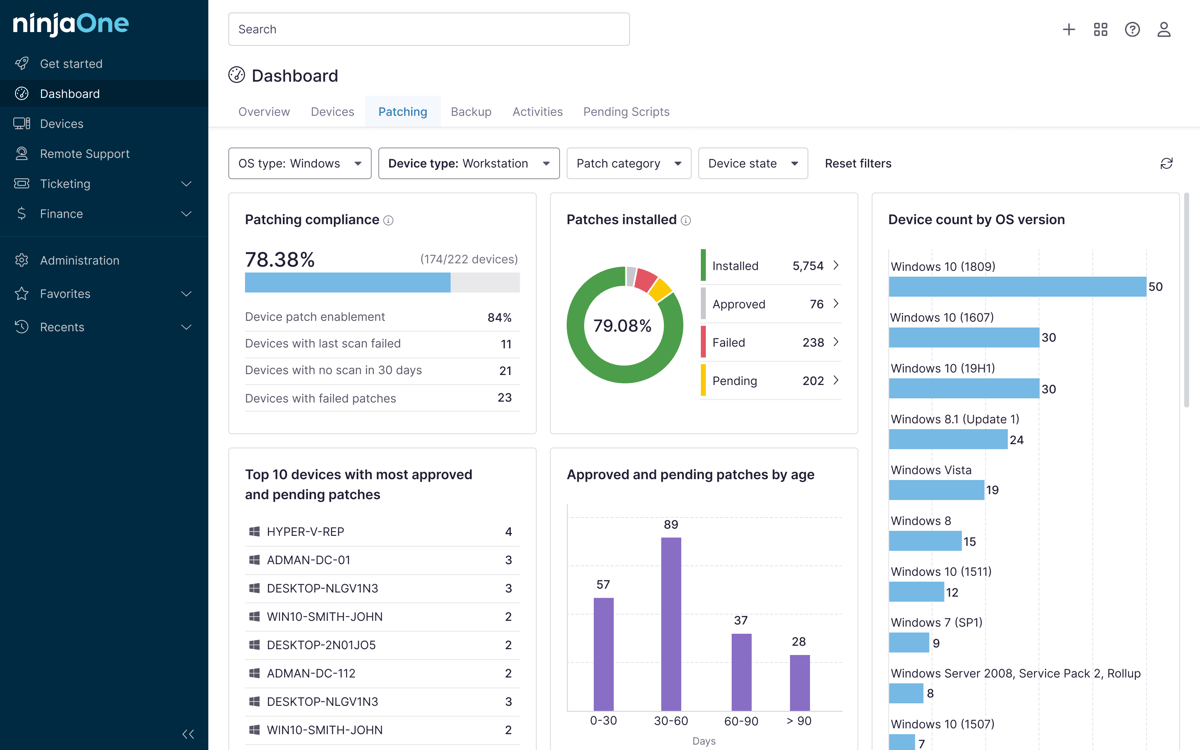
- Monitor rollout health in real-time: Track deployment progress through NinjaOne’s dashboards and activity logs. Use custom alerts to flag issues immediately, verify success rates, and generate adoption reports to demonstrate value and support compliance requirements.
- Centralize reporting for continuous improvement: Use built-in reporting to track adoption metrics and SLA compliance across all clients. This data provides the insights needed to refine your framework and prove ROI after every deployment.
Quick-Start Guide
Key Framework Components
1. Standardized Onboarding Process
– Use NinjaOne’s PSA integration to create standardized onboarding workflows
– Implement checklists and templates for consistent client setup
– Automate initial device discovery and policy assignment
2. Service Delivery Framework
– Create service packages with predefined NinjaOne policies and automation
– Use NinjaOne’s remote monitoring to track service health and performance
– Implement service level agreements (SLAs) with automated reporting
3. Client Adoption Strategy
– Provide client portals with usage dashboards and reporting
– Create adoption playbooks with best practices for client teams
– Use NinjaOne’s communication tools for regular client updates
4. Continuous Improvement
– Track adoption metrics through NinjaOne’s reporting features
– Implement feedback loops with clients using built-in survey tools
– Regularly update service offerings based on client needs and technology changes
Achieve consistent service delivery with your adoption framework
Implementing a structured service adoption framework helps turn chaotic rollouts into predictable, repeatable processes that scale across your client base.
By combining standardized lifecycles, automated workflows, and continuous improvement, you increase deployment consistency and reduce operational overhead.
This systematic approach ultimately builds stronger client partnerships through reliable, measurable results that justify your managed services.
Related topics