
Key Points
- Continuous visibility across clinical and operational technology assets is a core requirement in healthcare vulnerability management.
- According to HIPAA’s Security Rule, healthcare organizations must implement a formal security management process.
- Medical devices operate under unique constraints that make them difficult to patch, requiring organizations to maintain purpose-built visibility and apply compensating controls when remediation isn’t possible.
- Decision-making has to be coordinated across cross-functional teams to produce strong vulnerability governance.
- Organizations should prioritize remediation based on patient impact, clinical operational risk, exploitability, and compliance exposure.
Healthcare organizations manage some of the most operationally sensitive environments in modern enterprise IT, where a security gap can directly affect patient care.
As attack surfaces expand across systems, the consequences of unmanaged vulnerabilities grow more serious. This guide explains how healthcare organizations can operationalize healthcare vulnerability management effectively.
Why healthcare is one of the hardest environments to secure
Healthcare organizations run in uniquely complex environments because, unlike in any other industry, cybersecurity decisions don’t just disrupt workflow in healthcare; they directly affect patient care.
For example, in retail, patching is mostly a scheduling issue. All you need to do is set a maintenance window, apply the update, and you’re done. In healthcare, however, that calculation changes entirely. You can’t just take an infusion pump offline for a firmware update if it’s actively administering medication.
The need to keep clinical systems running because patient care depends on them creates remediation constraints that are typically acute in healthcare and less common in standard enterprise IT.
What healthcare organizations are actually managing
Apart from the remediation constraint mentioned, the sheer diversity of assets healthcare organizations must secure further makes centralized security so difficult:
| Asset type | Role in the healthcare environment |
| Electronic Health Record (EHR) systems | Store decades of protected health information, making them high-value targets |
| Medical IoT devices | Include infusion pumps, ventilators, and patient monitors that operate in real time |
| Imaging systems | MRI, CT, and PACS platforms that support diagnostic workflows |
| Cloud-connected applications | Support telehealth, scheduling, billing, and other patient services |
| Remote clinical endpoints | Used by staff across dispersed and mobile care environments |
| Third-party healthcare software | Integrated with labs, pharmacies, and insurance providers |
| Legacy infrastructure | Systems that predate modern security architecture but remain operationally essential |
| Multi-site environments | Health systems spanning multiple facilities with inconsistent security controls |
Achieving continuous visibility across healthcare environments
Continuous visibility is critical in healthcare organizations because it allows them to maintain a complete and updated picture of every asset that carries risk. The following areas represent some of the most critical to monitor.
Medical device visibility
There should be a continuous visibility into:
- Connected medical devices across clinical networks
- Unsupported or end-of-life operating systems
- Clinical workstations used in care delivery
- Imaging systems such as MRI, CT, ultrasound, and PACS
- Any interconnected infrastructure within hospital environments
Organizations that rely on standard IT discovery tools often miss this layer entirely. Medical devices don’t respond to the same scanning methods as endpoints, and without purpose-built visibility, they become a major unmonitored segment of the attack surface.
PHI-critical asset awareness
Organizations should also maintain specific awareness of systems involved in:
- Processing or storing protected health information (PHI)
- Managing patient records across clinical and administrative workflows
- Supporting identity and access management for clinical staff
- Running core healthcare applications tied to care delivery
When a vulnerability is discovered, knowing whether the affected asset stores, processes, or transmits PHI is often a major factor in deciding how urgently it needs to be addressed.
Continuous vulnerability monitoring
Continuous monitoring closes the gap between what you scanned and what’s actually true right now. It continuously monitors for:
- Missing patches across endpoints and clinical systems
- Newly discovered vulnerabilities on already-inventoried assets
- Misconfigurations that create exposure without a CVE attached to them
- Third-party software risk from vendors and integration partners
- Emerging risk on legacy infrastructure that can’t be patched but must be tracked
One of the most common mistakes healthcare organizations make is treating vulnerability management as a periodic assessment rather than a continuous operational process.
Aligning vulnerability management with HIPAA governance
Governance has to operate within a specific regulatory framework in healthcare. HIPAA’s Security Rule requires covered entities and business associates to implement a formal security management process, including risk analysis and risk management.
Meaning, every healthcare organization’s vulnerability program must be structured, documented, and defensible under audit.
Standardizing vulnerability policies
A single issue can affect clinical operations, infrastructure, compliance, and patient safety at the same time; that’s why multiple teams must work together for effective vulnerability governance. Here are the core policy areas that support consistent vulnerability management practices.
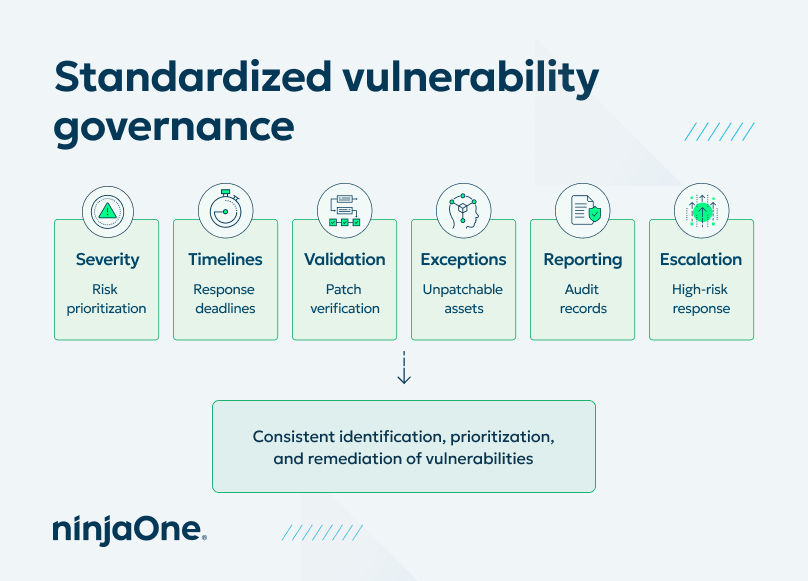
If policies are standardized like this, teams can identify, prioritize, and address vulnerabilities more consistently across the organization.
Supporting audit readiness
During a HIPAA audit, your most valuable tool is documented proof that your organization identified risks and acted on them. Below is a view of how centralized documentation supports operational oversight and compliance reporting simultaneously.
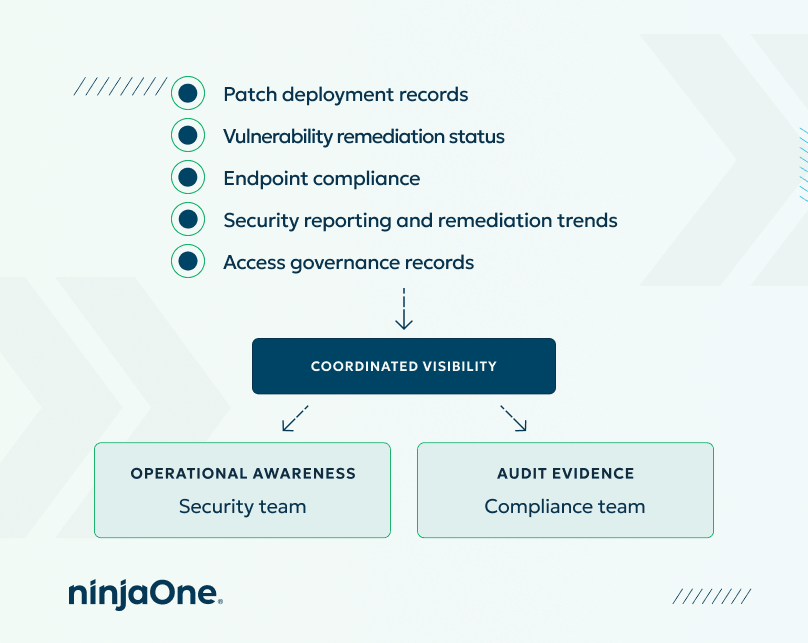
Documentation keeps your security team operationally aware, and at the same time, gives your compliance team the evidence they need when regulators ask questions.
Coordinating compliance and security operations
Effective vulnerability governance requires alignment across multiple teams as vulnerabilities rarely stay within a single domain. Here’s how organizations align remediation decisions across these domains.
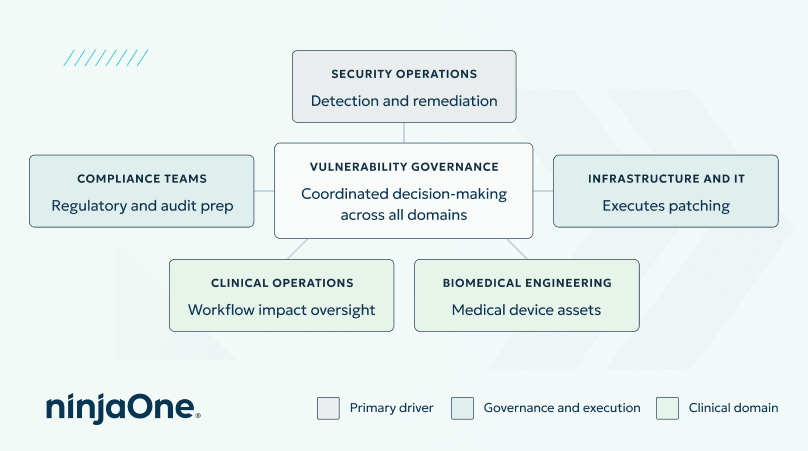
With coordinated decision-making, organizations are less likely to overlook vulnerabilities because responsibility is clearly defined across teams.
Operationalizing risk-based remediation in healthcare
Once you have visibility, the next goal is to translate your vulnerability data into remediation decisions that reflect clinical impact and patient safety. Here’s what that looks like:
Protecting patient data and privacy
The starting point for any remediation priority framework is knowing which assets, if compromised, create the greatest harm. Security operations should maintain an active focus on:
- PHI protection across systems that store, process, or transmit patient data
- Access control governance to prevent unauthorized data access
- Data integrity that detects unauthorized changes to patient records
- Endpoint visibility across devices handling patient data
- Secure remote access for distributed care teams
Reducing attack surface exposure related to:
Before sequencing individual vulnerability fixes, organizations should systematically reduce the number of exposure points available to attackers. That means addressing:
- Unsupported or end-of-life systems – isolating or decommissioning end-of-life infrastructure that can no longer receive patches
- Unpatched devices – accelerating remediation on assets where patches exist but haven’t been applied
- Internet-facing services – reviewing and restricting external exposure points that don’t require public accessibility
- Weak authentication – enforcing multi-factor authentication across clinical and administrative systems
- Third-party integrations – assessing and controlling access granted to vendor and partner systems
Prioritizing risk-based remediation based on:
Healthcare organizations need a prioritization framework that layers clinical and operational context on top of standard severity scoring. Remediation priority should be determined by:
- Patient impact – does exploitation of this vulnerability have a direct or indirect effect on patient care or safety?
- Clinical operational risk – would remediation itself disrupt care delivery, and if so, what is the appropriate window?
- Exploitability – is this vulnerability being actively exploited in the wild?
- Business continuity impact – what happens to operations if this system is compromised or taken offline during remediation?
- Compliance exposure – does this vulnerability create direct HIPAA or regulatory risk?
Together, these priorities help healthcare organizations align remediation decisions with patient safety, operational resilience, and compliance requirements.
What healthcare organizations should prioritize in vulnerability platforms
Healthcare organizations need to scrutinize vulnerability management platforms carefully because most of them are built for standard enterprise IT environments, and healthcare is anything but standard. When evaluating platforms, here is what to prioritize.
| Centralized visibility
Platforms should provide: | Continuous monitoring Platforms should support: | Remediation coordination Platforms should simplify: | Compliance reporting Compliance reporting capabilities should include: |
| Multi-site visibility | Recurring vulnerability assessments | Patch management workflows | HIPAA alignment |
| Medical device awareness | Real-time exposure visibility | Workflow escalation | Audit readiness |
| Endpoint reporting | Endpoint validation | Risk reporting | PHI exposure risk |
| Compliance dashboards | Operational reporting | Compliance alignment | Security metrics |
| Endpoint governance |
Healthcare vulnerability management in complex clinical environments
Vulnerability management is one of the most critical disciplines in healthcare because in this industry, a vulnerability doesn’t just pause workflows; it directly puts patient care and safety at risk. To be effective, organizations must operationalize centralized visibility, align their programs with HIPAA governance, and coordinate remediation consistently across teams.
Quick-Start Guide
To fully evaluate NinjaOne for your healthcare vulnerability management needs, consider:
- Discussing specific compliance requirements (HIPAA, HITRUST, etc.) with your NinjaOne representative
- Reviewing detailed patch management and reporting capabilities
- Assessing integration with your existing security tools and workflows
- Evaluating the platform’s audit and compliance reporting features
NinjaOne’s combination of patch management, asset tracking, and policy enforcement provides a solid foundation for healthcare vulnerability management.
Related topics:


