
Key Points
- An IT QBR template can simplify reporting to non-compliance-heavy SMB clients when used properly.
- To create a concise QBR template:
- Identify relevant core metrics.
- Draft a simple report template.
- Translate technical data into business outcomes.
- Standardize the use of the template across SMB clients.
- Integrate the template into your account growth strategy.
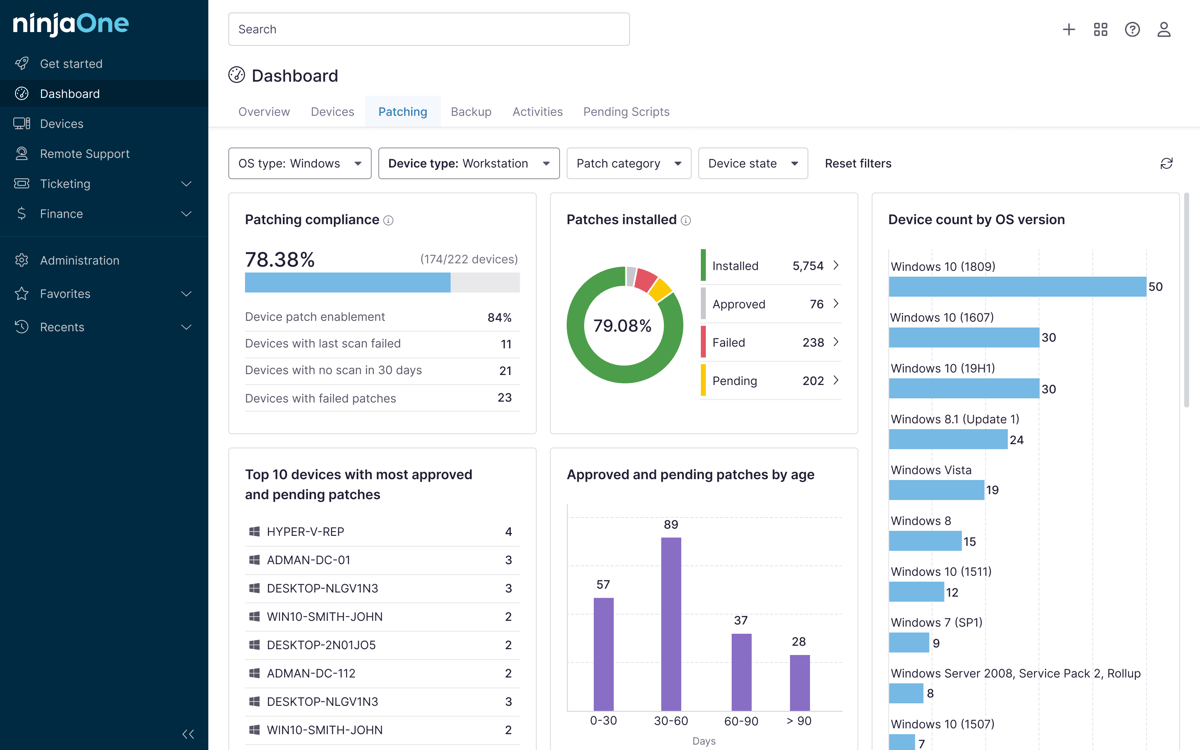
- MSPs can also use NinjaOne to streamline the QBR creation process, especially when it comes to collecting relevant data.
Quarterly business reviews, or QBRs, are a critical part of any client-MSP relationship. However, no QBR should look exactly the same. This is especially true when looking at IT reports for compliance-heavy enterprises and SMBs.
In this article, we guide you through the process of creating a flexible IT QBR template that’s ideal for SMBs with minimal compliance obligations.
For a quick visual overview, watch our video guide on How to Build a Quarterly Review Template for SMB Clients Without Compliance Needs.
How to structure a QBR for MSPs with SMB clients
Creating a solid QBR involves knowing the value you deliver and what your client expects of you. When you understand both, you’ll be able to structure a report that provides value without overwhelming your client with technical jargon or unnecessary data.
Things that can help you structure your MSP QBR template
While it’s possible to structure a report from scratch, it can be extremely time-consuming. Having the following can make the process easier and more streamlined:
- Defined categories of what SMB leaders care about (cost savings, uptime, productivity, risk reduction)
- Access to PSA/RMM reporting for ticket resolution times, patching, automation, and endpoint status
- A standardized one-page or slide-based template for SMB reviews
- A recurring cadence for reviews (quarterly or semi-annual)
Step 1: Identify relevant core metrics for your SMB clients
If your client isn’t focused on compliance, then knowing the relevant metrics is crucial to ensure that your report is of value to them. Instead of compliance, you can focus on the following:
- Service performance: ticket resolution, uptime percentages
- Cost optimization: automation success, reduced downtime costs
- Risk management (lightweight): patching coverage, backup success rates
- Business enablement: onboarding/offboarding efficiency, user satisfaction
Once you’ve identified your core metrics, you should have a list of KPIs that are aligned with your client’s needs.
Step 2: Design a simple template
With your core metrics identified, it’s time to design a simple yet informative template. A good rule of thumb is to have the following sections:
- Executive Summary: 1–2 sentences on value delivered
- Key Metrics Dashboard: 3–4 visualized KPIs
- Highlights: notable incidents resolved, improvements since last quarter
- Recommendations: low-friction upgrades, efficiency opportunities
Once your template is designed, you should either have a one-page or a 3-slide client-facing template.
Step 3: Translate technical data into business outcomes
Valuable reports provide insights into how the data has impacted business outcomes. Rather than just showing numbers, translate technical data into the effects of your services on your client’s business.
For example, consider phrasing your reports similarly to the table below:
| Technical Data (What you usually say) | Business Impact (What you can say instead) |
| 100 ticket resolution | Less downtime for staff |
| 100% Backup success | Reduced risk of disruption |
| Improved patch coverage | Improved resilience against ransomware |
This helps you improve communication with your clients and allows them to see your value as an MSP.
💡 Tip: Sometimes, you’ll still need to use technical data on your reports to emphasize a point; in such cases, having a glossary of business-friendly translations for common metrics helps your clients understand the impact of your service.
Step 4: Standardize your QBRs across all SMB clients
Now that you have identified your core metrics, created a template, and have a general idea of how to phrase your reports, the next step is to standardize your QBRs across your SMB clients.
Some ways to do this include:
- Applying the same template across SMB accounts
- Allowing light customization for industry verticals (retail, healthcare-lite, services)
- Ensuring consistent delivery for efficiency and scale
After this step, you should have a standardized SMB quarterly review framework.
Step 5: Integrate into account growth strategy
A well-made QBR can be a powerful asset in account growth. You can use such a document to:
- Position incremental upgrades (improved backup tiers, endpoint replacements)
- Keep conversations strategic and forward-looking without compliance jargon
- Reinforce MSP’s role as a business partner, not just a break-fix provider
How to integrate NinjaOne in your MSP QBR templates
NinjaOne can support this process by:
- Exporting uptime, ticket, and automation success data
- Automating KPI report generation for SMB accounts
- Hosting quarterly review templates in NinjaOne Docs
- Embedding SMB-focused metrics into dashboards
- Tracking upgrade recommendations across QBR cycles
Quick-Start Guide
Implementation Steps:
- Use NinjaOne’s reporting features to gather the above data points
- Create custom dashboards for each section
- Schedule quarterly exports or automated reports
- Add notes section for technician observations
- Include a summary page with key findings and recommendations
Create a compact IT MSP QBR template for easy understanding of non-compliance-heavy clients
SMB clients without compliance needs still benefit from quarterly reviews, but only if those reviews are simple, business-focused, and value-driven. By trimming out compliance-heavy reporting, MSPs can deliver QBRs that resonate with SMB leaders, strengthen relationships, uncover incremental opportunities, and show their value as an MSP.
Related topics: