
Key Points
- What is SOC compliance?: AICPA auditing framework that proves a service organization’s controls protect client data and build trust.
- SOC 1 vs SOC 2 vs SOC 3: SOC 1: financial reporting controls; SOC 2: Trust Services Criteria (security, availability, processing integrity, confidentiality, privacy) restricted-use; SOC 3: public summary for marketing.
- SOC 2 Type I vs Type II: Type I: point-in-time design; Type II: 6–12 months of operating effectiveness, and often required by enterprises.
- SOC audit and results: CPA-led audit with opinions: Unqualified (clean), Qualified, Adverse, Disclaimer—driven by documentation, evidence, scope, operational consistency, remediation, and training.
- Timeline and value: SOC 2 Type I ~1–3 months; Type II ~6–12 months; benefits (trust, stronger security, win/retain clients) vs challenges (complexity, time, cost $20k–$150k).
- How NinjaOne helps: SOC 2–2-certified platform for IT asset management, security monitoring, and automated patching to operationalize and evidence controls.
SOC compliance is an AICPA auditing framework that verifies a service organization has the controls in place to protect client data it can access. It stands for the System and Organization Controls (SOC) compliance) and is an auditing framework created by the American Institute of Certified Public Accountants (AICPA). It examines and audits service organizations to ensure that controls and processes are in place to protect client data they access. The SOC compliance framework helps organizations know what they need to do or how they can improve to increase the security of data in their possession.
For managed service providers (MSPs), SaaS companies, and other service-based businesses, SOC compliance is not a regulatory requirement; it’s proof of trustworthiness.
Obtaining a SOC compliance report and certification provides your customers with evidence that you have the appropriate controls and protocols in place to protect their data. There are currently 3 types of SOC compliance, which are:
Types of SOC compliance
SOC 1
SOC 1 evaluates a service organization’s internal controls over financial reporting (ICFR), which are the processes that could affect a client’s financial statements if they failed.
SOC 2
Unlike SOC 1, which focuses on financial reporting controls, SOC 2 evaluates how well an organization protects data, such as its security, availability, processing integrity, confidentiality, and privacy practices. SOC 2 is a more general framework than SOC 1, and it’s a standard for service organizations. It covers the “Trust Services Criteria,” which includes the five categories of security, availability, processing integrity, confidentiality, and privacy. A SOC 2 report is a “restricted use” report, meaning only the organization and its current clients have access to it.
SOC 3
SOC 3 covers the same information as SOC 2, but the generated report is for “general use.” When organizations are SOC 2 compliant and would like to use their compliance for marketing purposes, they require a SOC 3 report. SOC 3 is less formal and provides less detail, but it can be used widely.
| Focus | Audience | |
| SOC 1 | Financial reporting controls (ICFR) | Auditors, finance teams at client orgs |
| SOC 2 | Security, availability, processing integrity, confidentiality, privacy | Restricted, clients and prospects under NDA |
| SOC 3 | Same criteria as SOC 2, summarized | Public, used in marketing |
What is a SOC audit?
A SOC audit, conducted by a Certified Public Accountant (CPA), is an assessment of an organization’s systems and controls to determine whether it has effective measures in place to comply with SOC requirements.
How to prepare for a SOC audit
To prepare for a SOC audit, gather your company’s policies, procedures, systems, and security controls. Identify areas in your processes and actions that might be problematic and cause issues during the SOC audit, and seek to resolve the gaps. Once you have prepared and have a solid security strategy in place, contact a SOC auditing firm.
Preparation often begins with a readiness assessment or gap analysis. This step helps highlight weaknesses in your controls before the official audit begins. For example, you may discover that certain access controls aren’t documented properly, or that incident response procedures are outdated. Addressing these issues early allows you to go into the audit with greater confidence.
We also recommend ensuring that your technical safeguards, such as monitoring systems, encryption standards, and user authentication, are functioning consistently and can be demonstrated to auditors.
SOC audit results explained
When the audit is complete, the results are delivered in the form of an auditor’s opinion. The four possible outcomes are:
1. Unqualified opinion
This is considered the “clean” report and is the best outcome. An unqualified opinion means the auditor found that your organization’s controls were both properly designed and operating effectively during the audit period. Receiving this opinion demonstrates to clients that your systems are reliable and trustworthy. It is the strongest proof of compliance and the outcome most businesses aim for.
2. Qualified opinion
A qualified opinion means that, while most of your controls are operating effectively, the auditor has noted some exceptions or deficiencies. These issues might not be severe enough to cause failure but still require remediation. Clients may still accept a qualified opinion, but it shows there is room for improvement in your compliance efforts.
3. Adverse opinion
An adverse opinion is a serious finding. It indicates that your controls failed to meet SOC requirements in significant ways, and as a result, your organization did not demonstrate the necessary safeguards to protect client data. This outcome can damage credibility and often requires immediate corrective action before the business can pursue new client relationships.
4. Disclaimer of opinion
A disclaimer occurs when the auditor cannot issue an opinion at all, usually because the organization did not provide sufficient documentation or evidence to support its controls. This may also happen if the scope of the audit was too limited to form a conclusion. While less common, a disclaimer raises concerns with clients and can delay or block business opportunities until the issues are resolved.
Checklist: What can influence an SOC auditor’s opinion?
Several factors can influence whether your SOC audit results in an unqualified, qualified, adverse, or disclaimer opinion. We’ve listed some factors that could influence your audit. Keep in mind, however, that these are not extensive or comprehensive.
- Documentation quality: Are policies, procedures, and controls clearly documented and available for review?
- Evidence availability: Can the organization produce logs, reports, and system records that demonstrate controls were followed?
- Consistency of processes: Are security measures consistently applied, or do gaps exist in daily operations?
- Scope of controls: Were all relevant systems, services, and data-handling processes included in the audit scope?
- Remediation efforts: Were the identified issues addressed in advance, or left unresolved before the audit?
- Employee training and awareness: Do staff understand compliance procedures, or are they unclear on responsibilities?
By preparing for these factors ahead of time, MSPs and IT enterprises increase their chances of receiving an unqualified opinion and demonstrating strong SOC compliance to clients.
When does an organization need a SOC audit?
Companies need to prove to their customers that they are very careful with their data. Doing so communicates to clients that the business is reputable and trustworthy. The reports generated through SOC audits demonstrate that the business takes data protection seriously and enforces strict security controls.
Here are other considerations:
- Organizations typically pursue an SOC 2 audit when enterprise customers, regulated industries (such as financial services or healthcare), or channel partners require SOC 2 certification as part of their procurement requirements or in vendor assessments.
- Service providers that handle, process, or store customer information use SOC 2 to shorten security questionnaires and accelerate contract cycles. They are also important when maintaining HIPAA compliance.
- Even when not strictly required, SOC 2 can be a strategic differentiator during RFPs, proof of concept, or security reviews by prospective clients.
- Common triggers include signing your first major enterprise deal, expanding into regulated markets, or managing multi-tenant environments.
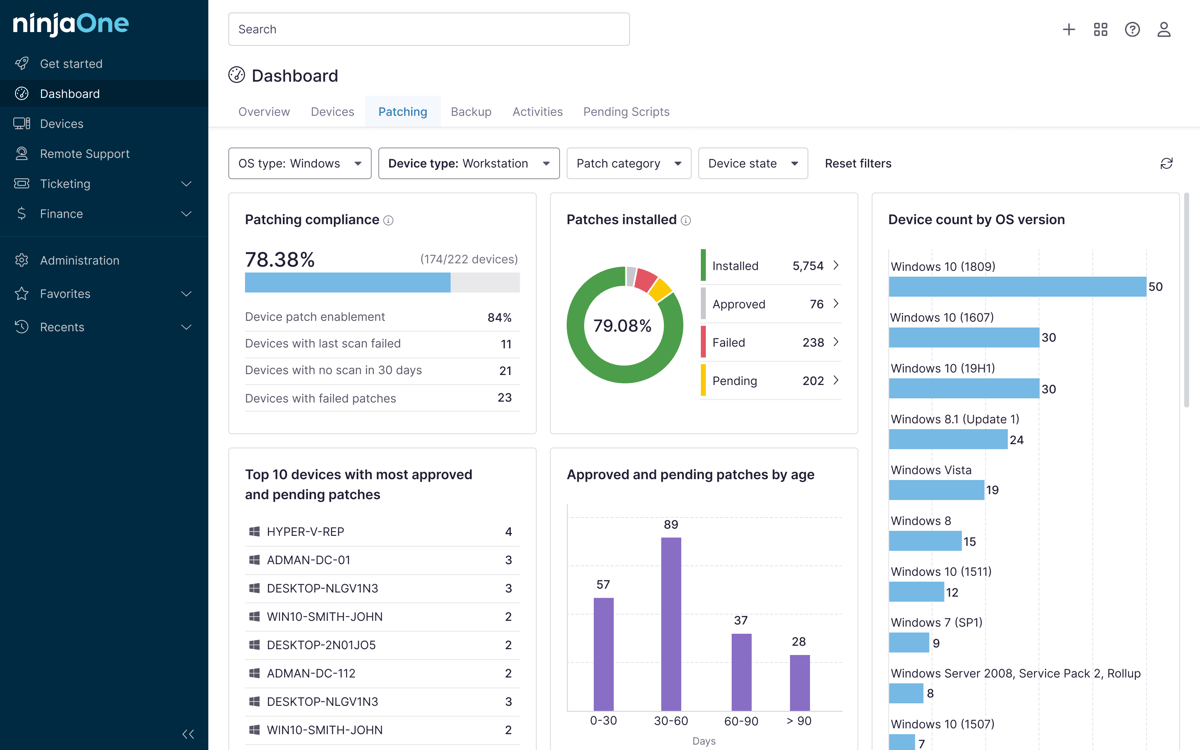
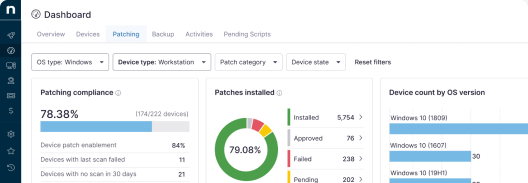
Automate IT asset management, security monitoring, and patching to support SOC 2 compliance with NinjaOne.
How long does it take to get SOC compliant?
The timeline for becoming SOC compliant varies depending on the report type you choose, your current security maturity, and the extent of remediation needed (if any).
Even so, here are some general timeframes to keep in mind:
- SOC 2 Type I typically includes a readiness or gap assessment and remediation (often 4–10 weeks depending on scope), followed by evidence collection and the audit itself (often 2–4 weeks). In practice, well-prepared teams can complete a Type I in roughly 1–3 months from kickoff.
- SOC 2 Type II takes longer because it tests whether controls operate effectively over After readiness and remediation (commonly 4–12 weeks), you’ll need an observation window—most organizations choose 6–12 months—during which you consistently run and document your controls. Once the period ends, auditors perform testing and finalize the report (often 2–6 weeks). End-to-end, many teams see 6–12 months for Type II, and up to 12–18 months if significant remediation is required.
- SOC 1 timelines are similar in shape to SOC 2: a focused readiness phase, then either a Type I point-in-time report or a Type II period-of-time report.
- If you plan to use SOC 3 for public marketing, it typically follows from your SOC 2 results, so its timing generally rides on your SOC 2 schedule rather than adding substantial extra time.
3 benefits of SOC compliance
1. Create and implement effective controls
Adhering to the SOC compliance framework and becoming certified, it enables you to establish controls and processes in your organization that effectively protect customer data. The requirements of SOC are fairly strict, standardized, and well-established, so they will help guide your business as you establish how client data is handled. You can feel confident when you’re working to become SOC compliant, or are already SOC compliant, and you’re taking the necessary actions.
2. Evaluate and improve data security
Another benefit of becoming SOC compliant is that you’ll be able to evaluate your organization’s data management and identify ways to improve it. The aim of SOC compliance is to protect your customer data by ensuring data privacy and preventing data breaches. The process of a SOC compliance audit and eventual certification allows you to assess your current procedures, determine whether they’re secure and align with the SOC framework, and make the necessary changes.
3. Obtain and keep clients
A SOC compliance certification shows other businesses and potential clients that you’ve gone through the process of adhering to the SOC framework. This is an external validation of your business’s controls, and more businesses will be open to working with you. Current clients are also more likely to keep doing business with you if they know proper actions have been taken to protect their information.
3 challenges of SOC compliance
1. Understanding the requirements
The requirements of SOC compliance can be extensive and hard to understand. For example, SOC 2 compliance has five different categories that service organizations must meet the requirements for, and it can be a challenge to know what the expectations are in each category as well as whether your business meets the expectations.
2. Difficult to obtain
SOC compliance is not something that businesses can easily obtain. Getting SOC compliant and then validating that you’re SOC compliant is a difficult and lengthy process. Usually, you will need assistance from outside experts to help ensure you have the right controls in place to be compliant.
3. Expensive to conduct
Linford & Company, a CPA firm specializing in SOC audits, reports that SOC audit costs typically range from $20,000 to $150,000, with a median price around $30,000. That cost doesn’t include other preparation costs, training costs, and other costs that may come up. Since the compliance certification isn’t free or easy to obtain, SOC compliance is an investment for your organization.
Optimize your SOC 2 compliance efforts by leveraging SOC 2-certified IT platform NinjaOne.
Start a free trial or watch a demo today.
Watch what is SOC compliance and get the facts behind data protection frameworks.
Use NinjaOne to help you achieve SOC compliance
SOC compliance for your MSP is challenging to achieve, but the payoff is well worth it. If you’re a service organization that handles customer data, determine whether you should become SOC compliant, which SOC framework you need, and establish what needs to happen for your business to be certified. Additionally, check out our guide to customer data protection.
NinjaOne is SOC-2 certified and can help you effectively manage your customer data and achieve SOC compliance. Sign up for a free trial today to discover how you can better protect and manage your client data using our software.