
Key Points
Choosing Free Open Source Tools for Active Directory
- Open source AD tools primarily support LDAP-based tasks and are best used to supplement, not replace, native AD functionality.
- These tools are commonly used for targeted needs such as directory inspection, Linux interoperability, and specific identity management tasks.
- Alternative management approaches (e.g., RMM) can reduce infrastructure complexity in environments where full AD deployment is not required.
Microsoft Active Directory (AD) is one of the most widely used and accessible tools for network administration on Windows-based systems. However, it doesn’t necessarily have all the tools for fully centralized IT management.
To address some of the gaps, corporate IT and MSP teams rely on third-party or RMM software to ensure consistent coverage across various networks and assets. In this article, we’ll uncover some of these open source tools for AD and their practical applications.
Free open source Active Directory management tools
The open source tools primarily support AD management and integration using LDAP (Lightweight Directory Access Protocol), the standard protocol for accessing directory services. These tools complement native AD utilities rather than replacing them entirely.
| Open source tool | What it does | Best for |
| Apache Directory Studio | Provides a graphical interface for managing LDAP directories, including AD, with support for browsing, editing, and schema management. | Administrators who want a GUI-based LDAP editor for manual Active Directory tasks. |
| OpenLDAP | Acts as an open source LDAP directory service that can integrate with AD for authentication and directory queries. | Organizations needing LDAP interoperability or custom directory integrations. |
| Samba | Enables Linux systems to interact with AD, including acting as a domain controller or joining Windows domains. | Mixed Windows and Linux environments requiring AD compatibility. |
| FreeIPA | Provides identity management for Linux environments with LDAP, Kerberos, and policy-based access control, and can integrate with AD. | Linux-centric environments that need centralized identity management alongside AD. |
| Zentyal | Offers an open source server platform with AD-compatible domain services and a web-based management interface. | Small organizations seeking an AD-like experience with simplified administration. |
Open source AD management tools are best suited for targeted tasks like LDAP inspection and cross-platform integration, rather than full-scale AD administration.
Pros and cons of open source Active Directory management tools
Given AD’s central role in identity and access management, it’s no surprise that many open-source software solutions have been created to optimize specific AD-related tasks. With that said, these tools come with their own advantages and disadvantages.
✅ Access to community expertise
Open source projects benefit from contributions across a global community, leading to faster iteration, broader testing, and quicker issue resolution.
❌ Inconsistent support models
Support often depends on community forums or maintainers, which can lead to slower resolution times for critical issues.
✅ No licensing costs
The absence of licensing fees reduces both upfront and ongoing expenses, making open-source tools appealing for budget-constrained teams or supplemental use cases.
❌ Con: Limited warranties and legal protections
Unlike proprietary software, open source licenses typically do not include indemnification, liability coverage, or strong warranty guarantees.
✅ Secure and reliable code
Perhaps its most alluring advantage, publicly accessible source code allows vulnerabilities and defects to be identified and patched through continuous peer review, improving overall reliability.
❌ Scope and feature gaps
Most open-source tools are designed for specific tasks rather than comprehensive AD administration, requiring additional tools or native Windows utilities to fill the gaps.
Open source AD management tools can be effective in the right context, but their value hinges on support expectations, feature requirements, and how well they align with existing workflows.
An alternative approach to centralized device management
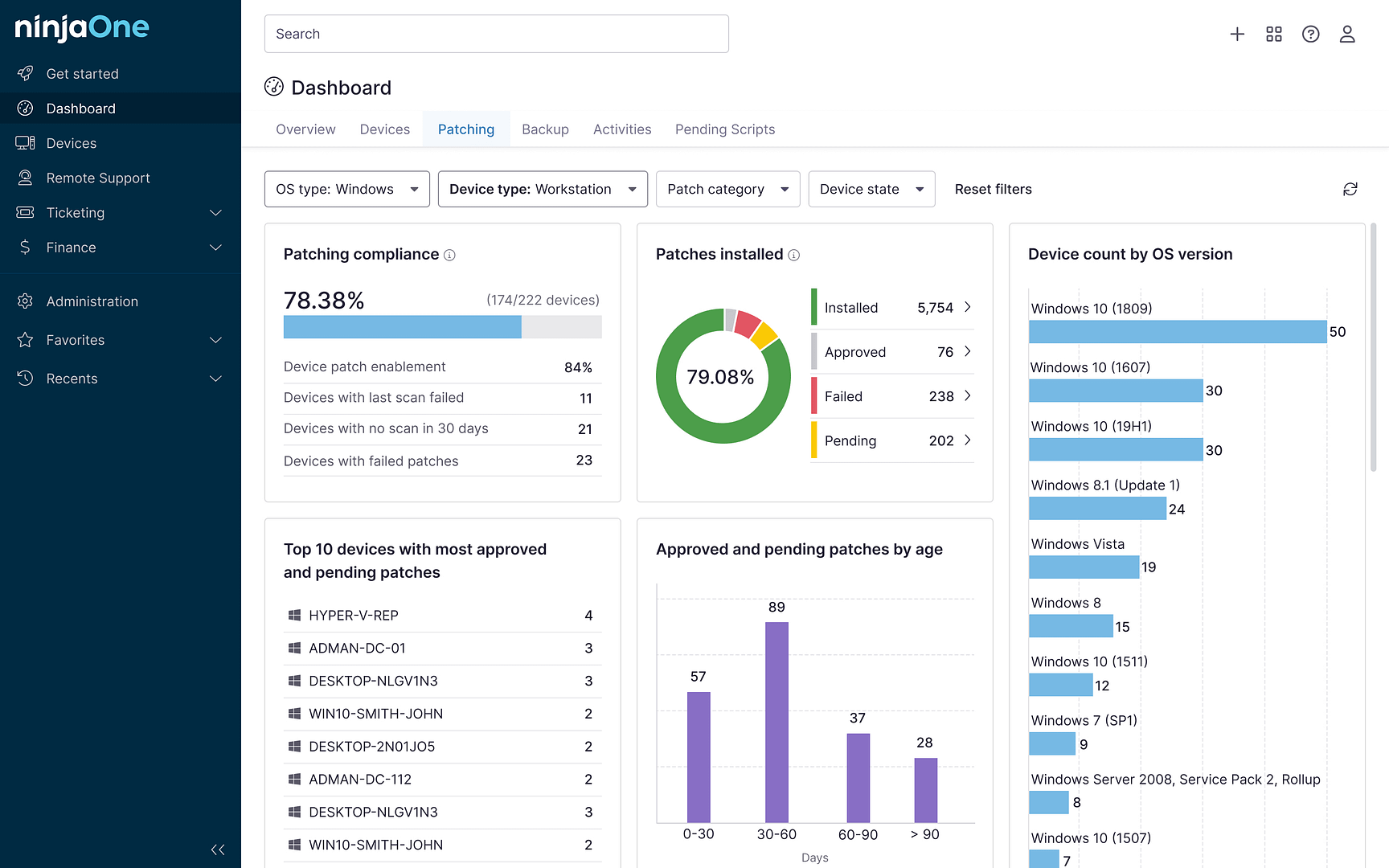
NinjaOne offers centralized device and identity management capabilities that overlap with certain traditional Active Directory applications, eliminating the need for dedicated domain controllers or complex administrative interfaces.
These capabilities include enforcing security policies, executing scripts, and performing mass configuration changes across multiple endpoints from a single interface, including non-Windows systems. This can reduce infrastructure overhead and simplify management in environments where a full AD deployment is unnecessary or impractical.
Related topics: