Key Points
How to anticipate and solve client churn
- Client Growth Awareness: Spot when client demands exceed your MSP’s current capabilities to prevent churn and plan for scalable support.
- Proactive Service Delivery: Use automation and monitoring to resolve issues early, reduce ticket backlogs, and enhance service reliability.
- Scalable MSP Infrastructure: Adopt flexible tools, APIs, and integrations to accommodate expanding client needs and new technologies.
- Strong Communication & Trust: Maintain clear, consistent communication and proactive check-ins to align services and expectations.
- Automated Security & Compliance: Enforce cybersecurity standards and automate compliance to protect clients and meet regulatory mandates.
Client churn is a persistent challenge for managed service providers (MSPs) with rapidly scaling clients. However, rather than being a concern, it can be seen as an opportunity to scale with them by meeting their requirements with an extended scope and enhanced IT services.
By recognizing the early signs that a client’s business and technology requirements may exceed current IT support capacity and service agreements, your MSP can position itself to readily meet these needs, retaining long-term customers and promoting growth for both your MSP and its customers.
What services do managed service providers (MSPs) deliver?
MSPs take care of all the IT needs for organizations that don’t want to expend the resources for an in-house 24/7 IT team that responds to user support issues or cybersecurity incidents. Successful MSPs are able to offer a broader range of better services than internal teams by managing multiple clients, optimizing their resources across them. This often means higher availability and capacity for a lower cost than in-house tech support.
Services that MSPs provide include cybersecurity incident detection and response, managing services like websites and internal web portals, licensing, deployment, and management of devices and software, and maintaining critical infrastructure like email hosting, networking, as well as deploying and patching end-user devices.
This is achieved at scale using remote monitoring and management (RMM) and mobile device management (MDM) platforms for remote support, monitoring, and software deployment. These are usually combined with documentation and helpdesk software to help users self-service and to raise support tickets.
How to meet evolving demand and avoid client churn in your MSP
If your service scope begins to fall out of alignment with your client’s current requirements or ambitions without you noticing, it can be hard to get back on track.
By recognizing the signs that your clients are growing faster than you can scale your MSP services, you can coordinate with them and make plans on how you will continue to support and grow with them, or help them onboard with a more suitable MSP.
Problem: Rising support volume and complexity
If the number of unsolved support tickets for a client remains consistently high, you may be reaching your capacity limits. This can be acutely felt if there’s an unexpected outage, leading to a spike in support demand when your team is already at capacity.
End-user problems that go unsolved for too long cause frustration and dissatisfaction, and infrastructure and security issues that are left unfixed could lead to wider compliance, data protection, or reliability concerns.
Solution: Maintain oversight of your support capacity
Support tickets are the key metric for support capacity, and your helpdesk platform should provide you with analytics and insights into this that will let you maintain oversight.
It is critical that you keep ticket response times as short as possible. This doesn’t have to mean growing your team immediately: improving communication, optimizing team assignments, and leveraging helpdesk automation can reduce existing workloads to increase overall capacity across MSP clients.
Problem: A reactive support posture
A support ticket backlog caused by insufficient capacity eventually leads to a purely reactive stance (“putting out fires”), where your team is just trying to keep its head above water. This often involves prioritizing the most prominent issues to try to keep clients on board, but will eventually lead to a systemic failure.
Solution: Proactive service dynamics
Once capacity concerns are addressed, a proactive approach to fixing issues can prevent small problems from cascading into future outages, and help your team be ready for unexpected demand spikes. Monitoring of servers, network infrastructure, and endpoints is necessary for this, allowing you to detect issues as they happen, and analyze logs for patterns that may indicate either technical or capacity issues before they can have an impact.
Dashboards can also be created for additional oversight and for demonstrating to clients how you are ensuring the security and reliability of their systems, and that their users are well-supported in a timely manner.
Problem: Limited scalability and advanced capabilities
The IT landscape is becoming increasingly complex, and continues to change rapidly. Businesses now rely on an increasing array of SaaS apps that must be integrated, cloud technologies that must merge seamlessly with on-site infrastructure, and AI tools that are fueling new use cases and cybersecurity concerns. All of this is compounded by the ever-growing array of consumer privacy and data protection laws that must be adhered to across all policies, infrastructure, and processes.
Every business will have unique demands reflecting the impacts of developing technologies on their industry, as well as their unique operational and regulatory environment. Inflexible MSPs that cannot keep up with this for one of their clients may quickly find that it applies to all of them.
Solution: Maintaining flexibility with extendable, compliant MSP tools
A flexible toolchain addresses this: MSP platforms that can be extended through integrations and APIs can be integrated with new or custom software. This allows you to support new use-cases not specifically supported by your platform with scripting and automation, ensuring that the critical tools your clients use are monitored for issues. Custom scripting can also be used to monitor and enforce compliance measures.
There are also SaaS-specific backup tools to ensure that data stored in the cloud is protected.
Problem: Communication breakdown
Delays in responding to support tickets will quickly frustrate users, who will either assume that they are being ignored, or that your MSP is not operating effectively and meeting agreed targets. Vague responses and timelines to resolve issues will also erode trust, as businesses will need to make decisions based on when service is expected to return.
Solution: Ensure capacity and make strategic check-ins
Communication is key to the success of every MSP. If there is an outage, you should have established protocols and communication channels to keep stakeholders up-to-date. Aside from ensuring there is sufficient capacity to respond to support tickets in a timely manner, you should regularly check in with clients to ask for suggestions and make sure they feel heard and supported. This may also involve directly or indirectly assessing their potential evolving needs and whether you need to realign your services to match them.
Internal communication matters too – make sure that your teams are in alignment and that major projects do not conflict, or coincide with planned employee absences or predicted ticket spikes (for example, during a patch window).
Problem: Security gaps are under greater scrutiny
Clients no longer just expect robust security for the sake of protecting their proprietary information or maintaining their business reputation. Regulatory frameworks for customer data protection like CCPA, GDPR, and HIPAA, impose hefty fines for non-compliance caused by insufficient security measures – whether decisions or implementation mistakes leading to them were made internally or by their MSP.
Persistent security issues will also lead to capacity problems when they are inevitably discovered and exploited, leading to downtime while systems are restored.
Solution: Automate and demonstrate compliance measures
You should leverage automated detection and response for cybersecurity threats in both your infrastructure and endpoint devices, and configuration scanning to look for potentially insecure misconfigurations across your deployments.
Document these measures so that you can compare them with the legal requirements your clients must adhere to and have them sign off on it. This both demonstrates to them that you are meeting requirements and ensures that they are aware of their responsibilities.
Position yourself for growth with NinjaOne
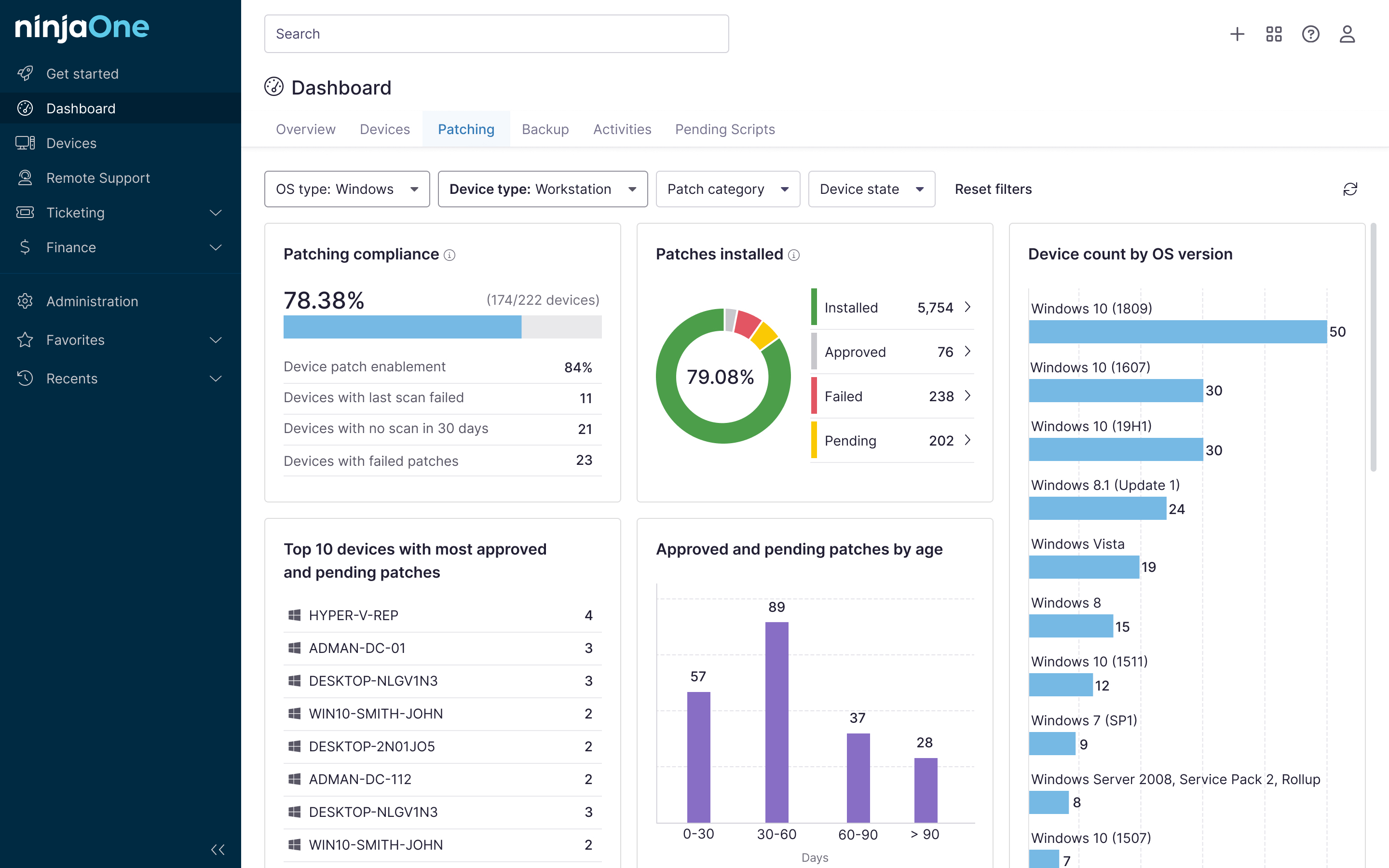
NinjaOne includes tools designed to help your MSP operate as efficiently as possible, while providing oversight so that you can plan ahead and make sure your team’s capacity and service scope always match client expectations. Ticket analytics can be used to identify support volume and time-to-resolution trends, while endpoint monitoring can track service usage.
NinjaOne contains flexible automation tools and an API, so you can integrate it with clients’ toolchains to identify the problems that are unique to their IT environments and critical tools. You may even be able to provide additional value by identifying trends and usage that the client has not yet recognized, and proactively facilitate the growth of their business, further solidifying an MSP-client relationship.
Quick-Start Guide
Signs a Client May Be Outgrowing Your MSP Services
1. Increased Complexity of IT Needs
– The client’s IT infrastructure becomes more complex and sophisticated
– They require more advanced monitoring and management capabilities
– Their technology stack expands beyond your current service offerings
2. Scaling Challenges
– NinjaOne’s patch management features highlight the importance of scalable solutions
– Clients may need advanced features like:
– Ring deployments for patches
– Comprehensive device management
– Advanced reporting and insights
3. Security Requirements
– Growing need for more robust security integrations
– Requiring advanced security tools like:
– SentinelOne for threat detection
– Comprehensive backup solutions
– Multi-factor authentication
– Compliance and data protection features
4. Volume and Complexity of Support Tickets
– Significant increase in support ticket volume
– More complex, time-consuming technical issues
– Require deeper technical expertise or specialized support
5. Technological Growth Indicators
– Expanding device ecosystem
– Adoption of cloud services
– Need for advanced remote management
– Requirement for cross-platform device management
Recommended Actions
1. Proactively discuss the client’s evolving IT needs
2. Demonstrate your ability to scale services
3. Offer solutions that match their growing complexity
4. Consider advanced tools and integrations
5. Be transparent about service limitations
By staying attentive to these signs, you can anticipate client needs and adapt your MSP services accordingly.