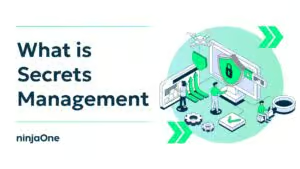
What is secrets management? IT security best practices. As more organizations move to the cloud and adopt modern technologies like containerization and automated deployment pipelines, the number of passwords, keys, and credentials they need to protect keeps growing. That's where secrets management comes in. It's how teams securely store, distribute, rotate, and manage sensitive credentials throughout their entire lifecycle. Before we begin, be sure to subscribe to NinjaOne's IT Video Hub and our YouTube channel for more tech content like this. What is secrets management? Secrets management is the process of securing, storing, distributing, rotating, and auditing sensitive credentials across your IT environment. But unlike regular password management, which is built around human users, secrets management focuses primarily on machine-to-machine authentication, where systems and applications authenticate programmatically without human intervention. Why secrets management is critical today. The security landscape has changed dramatically. Where a few admin passwords used to be enough, modern environments now contain hundreds or thousands of secrets, including API keys, database credentials, encryption keys, certificates, and service account passwords spread across on-prem systems, cloud platforms, and third-party services. How does secrets management work? Effective secrets management centralizes control through dedicated vaults that encrypt credentials at rest and in transit, and manage who can access them. Identifying sensitive data. Start by taking inventory of every credential across your environment. You might be surprised by how far your secrets have spread, hidden in config files, scripts, CI/CD pipelines, and infrastructure-as-code templates. Use automated scanning tools to detect credentials in your codebase and deployment artifacts, and manually review cloud configurations, environment variables, and access controls across dev, test, and production environments. Storing and rotating secrets. Next, migrate your secrets into a dedicated vault. Platforms like HashiCorp Vault, AWS Secrets Manager, Azure Key Vault, and Google Secret Manager offer encryption, access controls, auditing, and automated rotation. Regularly rotate credentials to limit the potential damage if a secret is compromised. Integrating with IT workflows. For secrets management to work, it needs to fit into your existing workflows. Most platforms offer APIs, SDKs, and plugins that let applications retrieve credentials automatically so developers don't have to build their own authentication logic. For DevOps teams, this means secrets can be integrated directly into CI/CD pipelines, keeping deployments secure without introducing unnecessary friction. Still managing credentials manually? Modern IT environments are too complex for that. Secrets management gives you a centralized, automated way to protect sensitive credentials while reducing manual credential handling and strengthening security across the credential lifecycle. For more information, check out our official blog post on secrets management, linked in the description below.