Unified IT
Management


What is Unified IT Management?
Unified IT management focuses on centralized and remote IT management to drive radical efficiency for IT teams, deliver on IT automation at scale, reduce risk across IT operations, and improve the productivity and satisfaction of today’s hybrid, remote, and distributed workforces.
Unlike traditional approaches to IT, unified IT management aligns the entire IT organization around the goal of driving business growth and productivity by avoiding, negating, and solving business user pain. By focusing on user outcomes, unified IT management highlights the impact of IT on business growth and elevates IT operations to a strategic business contributor.
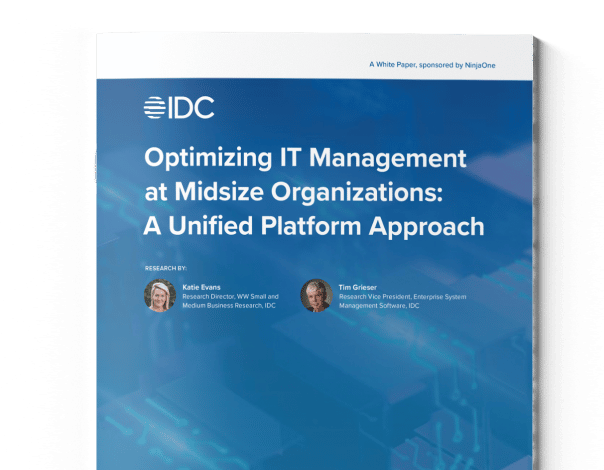
According to industry analysts IDC, an integrated approach to IT management delivers:
- Plug-and-play toolsets that simplify operations
- Unified data models that support tool integration
- Increased opportunity for automation
- Improved IT efficiency
- Improved performance and availability
- Improved user satisfaction.
The Unified IT Management
Framework
Centralize and consolidate IT management
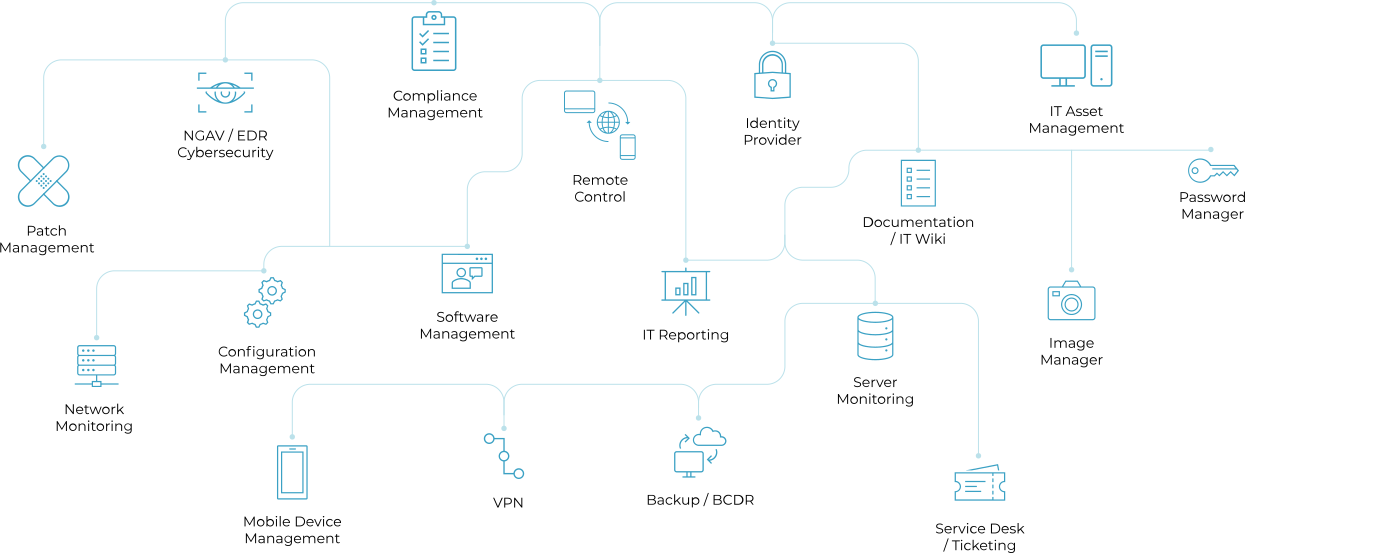
ITSM, ITAM, ITOM, RMM, BDR, IDP… IT teams use 20+ tools on average to manage endpoints, secure their environment, and support end users. Consolidating solutions and centralizing management drives radical efficiency, improves security, and helps you make better informed decisions.
Make automation part of your DNA
Complex tasks are prone to human error and repetitive tasks take time away from critical projects. IT teams must invest in automation to drive standardization, reduce human error, and drive radical efficiency across all IT function. Mature automation drives better technician outcomes and allows IT to focus more on strategic outcomes.
Deliver user productivity and satisfaction
Align behind modern workflows
Benefits of Unified IT Management
Radical IT efficiency
Centralized management and automated workflows drive productivity and reduce support strain.
50–70%
faster issue remediation
Improved security
Enhanced visibility into endpoint and user activity – along with automated alerts and mitigation – is more essential than ever to securing modern environments.
90% faster patching with higher patch compliance rates
More productive users
More proactive and efficient support combined with standardized delivery ensures end-users are more satisfied and productive.
20–30%
fewer support tickets
Reduced risk
Building a single source of truth for IT makes it easier to set and maintain compliance baselines.
Up to 80% reduction in downtime
Reduced costs
From reducing stack complexity to reducing training requirements for technicians, unifying IT operations helps reduce IT costs without losing capabilities.
>5% lower
IT costs
Why now?
The way we work is changing. IT teams have not had the bandwidth or time to adjust their own processes. While productivity suites and end-user applications have transitioned to a cloud-based SaaS model that supports modern work environments, IT tools have lagged behind, requiring on-premises, network- or domain-based models to deliver services.

The above chart shows the percentage of IT teams leveraging on-premises versions of software versus cloud-based solutions. Based on a 2021 Ninja survey.
That model works well for traditional location-based work environments, but treats remote and distributed employees as second-class citizens. With almost two-thirds of American employees working at least partially remote in 2022, IT teams need to unify IT operations to deliver modern IT services.
Your world without Unified IT Management
The Unified IT
Management Platform
One lightweight agent, one centralized console, and a unified data model to manage, monitor, and secure all your devices, wherever they are.
Manage
Monitor and manage every endpointProtect every endpoint, remote, hybrid, or on-site, with intelligent, automated patching and immutable backups that are easy and painless to restore.
Protect
Patch and back up endpointsSupport endusers with fast, secure remote access, automated self-healing, and automated service management workflows
Support
Support every employeeMonitor, support, and control all Windows, Mac, and Linux end-user devices, servers, VMs, and networking devices from a single easy-to-use interface.
NinjaOne Automated Endpoint Management Platform
Standardize and automate device management with policy-based control.
The reports you need, the way you need them.
Built-in multitenancy provides flexibility to manage distributed environments at scale while preserving governance and oversight.
NinjaOne features extensive integrations with a variety of third-party solutions and APIs to unite your IT operations into a single, easy-to-use dashboard.
We provide IT teams and technicians with AI-driven intelligence to make better decisions, faster, incorporate end-user experience, and automate with autonomy.