Key points
- Build a sustainable Windows security posture with a proactive security strategy and role-based access control aligned to business continuity.
- Use continuous monitoring and AI-driven threat detection to improve real-time visibility and identify indicators of compromise and endpoint risks early.
- Implement risk-based patch management and centralized governance to prioritize vulnerabilities, enforce security policies, improve compliance, and reduce overall attack surface.
Windows systems are the backbone of most IT environments, running critical applications and enabling distributed workforces worldwide. Yet many organizations still rely on reactive security: patching after breaches occur and investigating threats only after alerts fire, adding cost and regulatory exposure.
As an IT manager or MSP leader, you need a proactive strategy that anticipates risks, scales with your environment, and aligns security work directly to business continuity objectives. Without a sustainable Windows security strategy, your security posture can become fragmented across tools and teams, leaving windows of vulnerability that attackers actively exploit.
What defines a strong Windows security posture
Your secure Windows environment management encompasses the full set of policies, controls, and procedures that protect your infrastructure, spanning configuration management, endpoint detection and response (EDR), identity governance, patch management, and incident response.
That said, gaps can emerge when security becomes siloed across different teams and tools. According to IBM and Ponemon Institute research, the average data breach cost in 2025 was $4.4 million, with recovery times extending months. Organizations using AI-powered security detected and contained breaches 80 days faster than others, saving $1.9 million per incident on average.
Organizations most commonly struggle due to a lack of real-time threat visibility, inconsistent patching discipline across device types, or unenforced security policies. A sustainable strategy embeds continuous risk assessment into routine operations, ties security decisions directly to business priorities, and establishes governance frameworks ensuring clear accountability for measurable security outcomes.
Continuous monitoring and automated audits for cybersecurity posture
Continuous monitoring, paired with automated threat hunting, can transform raw telemetry into actionable intelligence. This can help reduce your mean time to detect (MTTD) and establish baselines so anomalies stand out immediately.
Advanced threat hunting and proactive detection
Instead of waiting for alerts to fire, you can continuously query endpoint telemetry to surface early indicators of compromise (IoCs), lateral movement, and privilege escalation before they become incidents.
Here’s how you can operationalize threat hunting with repeatable workflows:
- Continuously scan endpoint telemetry for known attack patterns:
- Office applications spawning PowerShell or cmd
- Suspicious parent-child process chains
- Abnormal authentication or access patterns
- Establish and maintain visibility across your fleet:
- Track file hash changes to catch tampering or unauthorized binaries
- Monitor network connections to detect command-and-control (C2) activity
- Identify drift from known-good system states
- Combine device health, identity, and security telemetry to:
- Prioritize high-confidence threats
- Reduce noise from isolated alerts
- Accelerate triage with enriched context
- Move from ad hoc investigations to a structured process:
- Build a library of reusable hunt queries
- Integrate hunts into daily SOC workflows
- Track outcomes to refine detection logic over time
Unified monitoring through XDR platforms
Extended detection and response (XDR) platforms consolidate alerts, telemetry, and identity events into a single unified console, eliminating the need to jump between disparate tools. Dashboards highlight risk scores, patch status, policy compliance, and overall device health. A recent endpoint security report noted that 54% of security professionals reported more than 20% of endpoints remain unmanaged, underscoring the critical importance of centralized visibility.
- Centralized alerting dramatically reduces context switching and accelerates triage
- Risk scoring prioritizes which endpoints need immediate attention, enabling efficient resource allocation
- Unified health metrics surface configuration drift and compliance violations before they become incidents
XDR platforms integrating identity and SIEM data create truly sustainable security by automating data collection and eliminating manual reporting overhead for your team.
Risk-based patching and Windows security governance
Fixed patch calendars cannot keep pace with real-world threat dynamics and emerging vulnerabilities, which may languish until next month’s update. Risk-based patching prioritizes by severity, exploit likelihood, and asset criticality, ensuring that dangerous vulnerabilities are addressed first, regardless of the calendar date.
Dynamic patch scheduling based on vulnerability risk
Patch management can’t operate on static schedules in a threat landscape that moves hourly. Treating all updates equally or batching them into rigid monthly cycles creates unnecessary exposure. Modern security teams are shifting to risk-driven patching, where remediation is continuously reprioritized based on real-world exploit activity and asset criticality.
At the center of this approach is dynamic vulnerability scoring. It’s not enough to rely on CVSS alone. You need to factor in whether a vulnerability is actively exploited in the wild, using sources like the CISA Known Exploited Vulnerabilities (KEV) catalog, and how it intersects with your environment.
Here’s how you can turn patching into a risk-driven workflow:
- Prioritize exploitability over severity: Focus on KEV-listed vulnerabilities, exposed assets, and business-critical systems
- Continuously re-rank the backlog: Adjust priorities as new threat intelligence and zero-days emerge
- Automate scheduling with context: Align deployments to maintenance windows and roll out in controlled stages
- Target high-impact assets first: Patch critical systems first; mitigate or isolate lower-risk exposures
This approach shrinks your attack surface faster, reduces exposure windows significantly, and enables targeted, rapid responses to emerging zero-day risks.
Compliance workflows and automated reporting
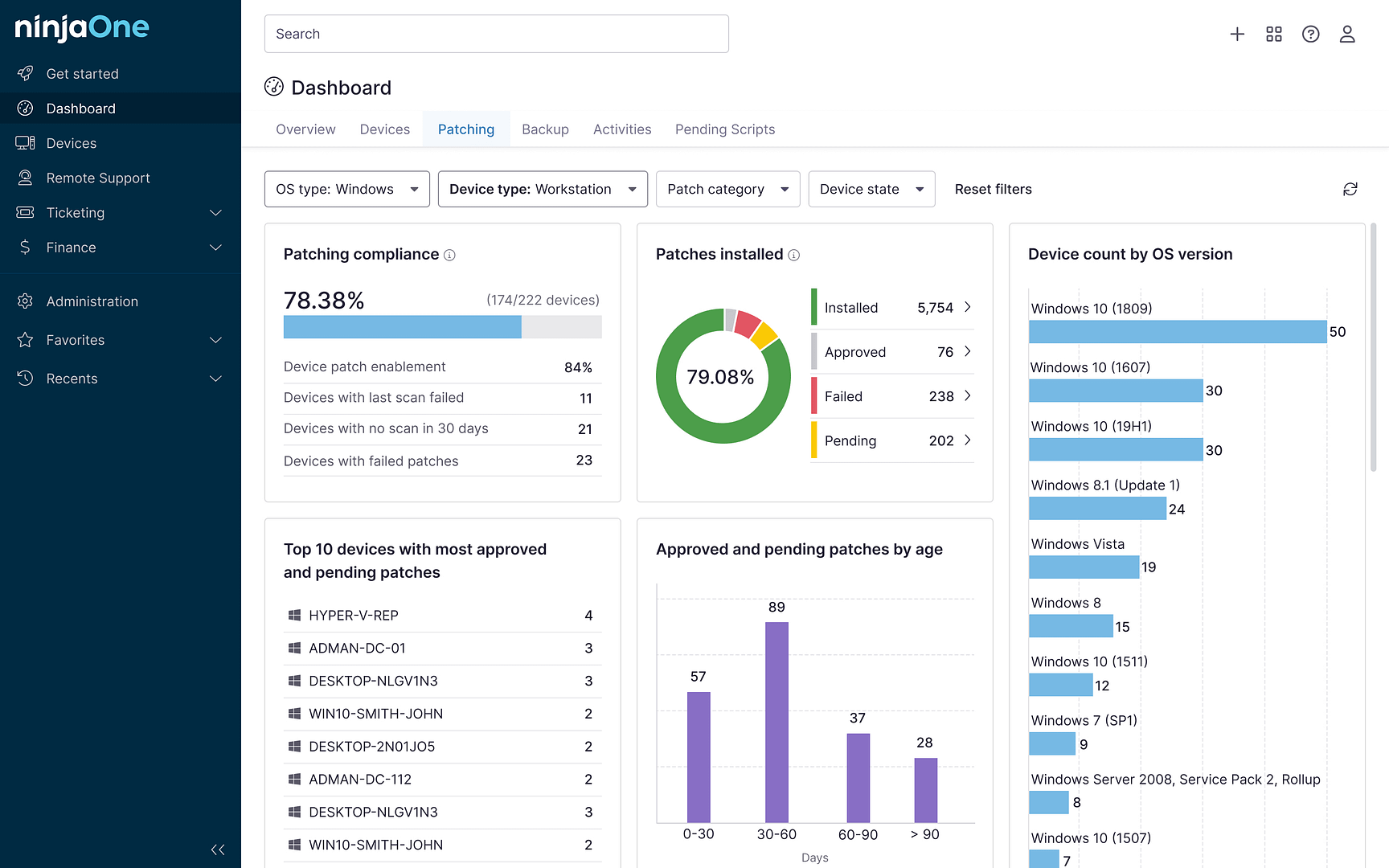
Compliance tracking shouldn’t consume your security team’s time and effort. Build structured, integrated patch workflows with clear checkpoints to ensure every device is accounted for, then automate reporting to keep audit-ready data flowing in real time.
Role-based access and operational security controls
Over-permissioned environments are one of the fastest ways to turn routine operations into security incidents. When too many users have broad access, small mistakes scale into system-wide risk.
Strong Windows security governance starts by tightening control. You define exactly who can deploy patches, change configurations, or respond to incidents, and enforce those boundaries through role-based access control (RBAC).
In practice, that means separating responsibilities across teams, restricting high-impact changes to approved users, and issuing temporary access only when it’s needed. Every action is logged, and every change is attributable.
Building an enterprise Windows security framework
To build a strong Windows security framework, start by aligning security efforts with business outcomes. Define how your cybersecurity posture impacts uptime, risk reduction, and operational continuity, and use those metrics to guide your decision-making.
Aligning security metrics with organizational outcomes
Map your security metrics to what the business actually cares about. Tie patch compliance, risk scores, and response times directly to service availability, resilience, and delivery KPIs.
This shift reframes security from an IT function to a business enabler. When you show that faster patching leads to fewer outages or that improved response times reduce operational disruption, you make the impact more tangible.
Centralized reporting for security and leadership teams
Bring your security and operational data into one view. Combine endpoint telemetry with operational dashboards to create clear, executive-ready reporting using trend lines, heat maps, and visual indicators to highlight progress and gaps across teams and locations.
Tailor these insights for leadership. When executives can see risk trends, compliance status, and the impact on uptime and customer trust, they can prioritize the right initiatives at the right time.
Sustaining Windows security resilience
Sustaining a strong Windows security posture means moving beyond reactive fixes to continuous, measurable improvement. That shift comes from embedding automated audits into daily operations and prioritizing patches based on real risk rather than static schedules.
Unifying alerts, telemetry, and compliance data in a single platform gives you the visibility to act quickly. Layer in role-based access controls and structured workflows, and you create governance that scales without losing control.
See it in action with NinjaOne
NinjaOne brings endpoint management, patching, monitoring, and helpdesk into a single platform, so you can operationalize everything from risk-based patching to continuous compliance without added complexity.
Start your free trial and see how unified Windows security governance helps you reduce risk and maintain a resilient cybersecurity posture across all of your environments.