Key Points
- A practical maturity model requires measuring both operational stability and project delivery capabilities.
- Use a dual-domain scorecard with weighted metrics to track progress and guide quarterly improvements.
- Implement a consistent quarterly cycle of assessment, execution, and review to maintain momentum.
- Quantify the costs of imbalance to build a financial case for investing in balanced growth.
- Standardize project-to-operations handoffs with clear completion criteria to ensure stability.
- Translate maturity improvements into client-facing business value during QBRs to strengthen partnerships.
Many MSPs excel at delivering projects but struggle with operational stability, while others maintain reliable services but cannot implement change efficiently. This gap between project maturity and operational maturity often leads to client churn and shrinking margins.
In this guide, you will learn to measure both domains, balance their growth with a practical scorecard, and implement a quarterly rhythm that makes excellence repeatable.
A step-by-step approach to building a practical maturity model for MSPs
A tailored maturity model provides the metrics and clarity needed to improve your MSP’s performance and client satisfaction systematically.
You cannot improve what you do not measure; this model offers a consistent framework to quantify your progress and identify areas for growth, forming the core of a scalable MSP scaling framework.
📌Use case: Implement this operational maturity model when you need to shift from reactive firefighting to predictable growth. Key triggers include preparation for a new fiscal year, rapid scaling that strains existing processes, slipping client satisfaction, or consistently missed project deadlines.
📌Prerequisites: Before starting, ensure you have these core components:
- Documented services & projects: A clear service catalog and defined project types, each with a named owner.
- Baseline KPIs: Current data for ticketing, SLAs, patching, backups, and project delivery to establish a starting point.
- Centralized documentation: A single source of truth for your model, scorecards, and plans.
- Recurring QBR schedule: A committed cadence for internal and client Quarterly Business Reviews.
- Leadership buy-in: Agreement to dedicate time to a quarterly review and improvement cycle.
Step 1: Define maturity domains and key metrics
To grow effectively, you must first define what to measure by establishing clear domains and quantifiable metrics.
Project maturity signals
Measure predictability and financial health:
- Schedule predictability: % of projects on time/on budget
- Scope integrity: Change requests per project
- Throughput: Projects completed per quarter per PM
- Post-launch stability: Incident rate first 30 days
- Cash discipline: Billable utilization and Days Sales Outstanding (DSO)
Operational maturity signals
Measure service efficiency and proactivity:
- Ticket quality: % with complete documentation
- SLA performance: Response/resolution attainment
- Automation coverage: % devices auto-patched/backed up
- Preventive posture: Vulnerability backlog trend
- Customer health: CSAT/NPS trends and churn risk
For each metric, record the owner, target performance bands, data source, and review cadence. With domains defined, you can now objectively score your current state and track quarterly progress.
Step 2: Map the costs of imbalance
Quantifying the financial impact of lopsided maturity justifies strategic investments in balanced growth.
This analysis reveals the hidden costs of imbalance, providing concrete data for your MSP scaling framework. Use this when building a business case for resource allocation. After mapping costs, you’ll have clear financial justification for pursuing balanced maturity.
High project, low operations costs
Fast project delivery with unstable operations creates:
- Rework and engineer burnout from constant firefighting
- Client escalations and strained relationships
- Contract renewal risks despite successful projects
High operations, low project costs
Stable services with slow project delivery lead to:
- Missed revenue opportunities and slow client onboarding
- Accumulating technical debt from delayed upgrades
- Margin erosion from inefficient project delivery
The value of balanced growth
Achieving balance means operations absorb change seamlessly, with minimal post-deployment incidents and significantly higher client lifetime value—the ultimate goal of an effective operational maturity model.
By quantifying these costs, you transform abstract challenges into actionable financial arguments for strategic change.
Step 3: Build a dual maturity scorecard
A focused scorecard transforms your maturity model from theory into an actionable strategy.
This living dashboard tracks both operational and project health with metrics weighted to your strategic priorities. Use it during quarterly planning to maintain organizational alignment. After implementation, your team will have clear direction on improvement priorities.
Track dual domains
Monitor two critical areas:
- Operational Maturity: Service consistency, automation, client health
- Project Maturity: Timeline adherence, scope integrity, profitability
Weight strategic metrics
Select 10 key metrics with current values, targets, and trends. Weight them strategically. For example, emphasize project metrics during migration years to create an adaptive MSP scaling framework.
Define Quarterly Actions
Each quarter, specify:
- Red: One critical improvement
- Amber: One area needing progress
- Green: One strength to sustain
This creates a practical organizational project management maturity model with clear direction and guidance.
With your scorecard active, you’ll maintain the crucial balance between operational stability and project execution through focused quarterly improvements.
Step 4: Standardize the project-to-handoff
A formal handoff process ensures project deliverables become stable, manageable services.
This method establishes clear completion criteria and a transition period, transforming projects into well-documented operations. Implement this for every project to prevent post-launch chaos.
Define completion criteria
Your “Definition of Done” must include:
- Active monitoring and backup verification
- Completed vulnerability scans and remediation
- Documented runbooks and rollback plans
Implement 30-Day hypercare
Establish a transition period with:
- Clear performance and incident thresholds
- Defined support responsibilities
- Scheduled stability checkpoints
Maintain audit-ready links
Permanently connect:
- Project artifacts to operational checklists
- Documentation to automation jobs
This discipline embodies high organizational project management maturity, ensuring projects strengthen rather than stress operations.
Standardizing this handoff turns deployments into stable services, reducing incidents and protecting margins.
Step 5: Borrow from mature models without bloat
Strategic adoption of the most valuable elements from proven models accelerates growth without introducing complexity.
This approach extracts key practices from frameworks like CMMI and Lean, applying them pragmatically to avoid bureaucratic overhead. Use this when you need structured improvement but want to maintain agility.
Adopt PMO planning discipline
Implement staged capability growth for realistic resource planning and clear dependency mapping.
Clarify functional ownership
Apply functional maturity principles to define clear decision rights and seamless cross-team handoffs.
Embed operational rituals
Borrow daily tier meetings, visible metrics, and structured problem-solving from operational excellence models.
Apply analytics gradualism
Use a crawl-walk-run approach to data, focusing on provable evidence rather than perfect metrics.
This selective adoption enhances your operational maturity model while preserving flexibility and efficiency.
By borrowing strategically, you gain structured growth without the bureaucracy that hampers responsiveness.
Step 6: Automate the maturity levers
Strategic automation transforms manual processes into consistent, scalable systems that drive maturity.
This approach uses technology to enforce standards and provide undeniable performance evidence. Implement when manual processes become bottlenecks or consistency is critical.
Automate core operations
- Automated patching, backup verification, and compliance scanning
- Scheduled vulnerability assessments with auto-assigned owners
- Integrated evidence collection for audits
Streamline service delivery
- AI-assisted ticket triage and guided runbooks
- Automated task creation and escalation paths
- Reduced handle time and service variance
Systemize improvement
- Automated tracking of remediation through closure
- Real-time visibility into coverage gaps
- Continuous compliance monitoring
This automation strengthens your operational maturity model by making excellence repeatable and advancing organizational project management maturity through predictable workflows.
By automating key levers, you transform maturity from theory to engineered outcome, reducing firefighting while providing undeniable evidence of growth.
Step 7: Run a quarterly maturity cycle
A disciplined quarterly rhythm transforms maturity goals into measurable progress.
This cycle creates consistent accountability for your MSP scaling framework. Implement it to maintain balanced growth and demonstrate continuous improvement.
Week 1: Baseline & plan
- Measure current scorecard metrics.
- Select three targeted improvements with clear owners.
- Set specific target bands for each initiative.
Execute with accountability
- Drive improvements throughout the quarter.
- Conduct midpoint progress checks.
- Adjust resources as needed to stay on track.
Close & communicate
- Publish one-page maturity results.
- Integrate quantified outcomes into client QBR decks.
- Inform next quarter’s priorities with data.
This operationalizes your maturity model through consistent execution. By institutionalizing this cycle, you create predictable growth that systematically improves margins and demonstrates tangible progress each quarter.
Step 8: Tell the story in QBRs
Transform metrics into compelling business narratives that demonstrate tangible value during client reviews.
This approach connects your maturity improvements directly to client outcomes, reinforcing your strategic partnership.
Demonstrate measurable progress
- Show before-and-after results for two client-focused metrics.
- Highlight specific improvements in risk reduction, uptime, or speed.
Connect to business outcomes
- Translate technical improvements into business value.
- Quantify results in terms that clients understand and care about.
Propose safe next steps
- Recommend one strategic project for the coming quarter.
- Demonstrate your operational readiness to absorb this work.
- Position this as a natural progression of your mature capabilities.
This storytelling approach showcases your organizational project management maturity while making abstract improvements concrete.
By consistently telling this progress story, you transform QBRs into strategic conversations that strengthen trust and justify continued partnership.
Leveraging NinjaOne for Maturity Management
NinjaOne provides a centralized platform to automate your maturity framework and turn strategy into measurable action.
This integration connects real-time operational data with proactive management, creating visibility across operations and projects.
Automate coverage & compliance
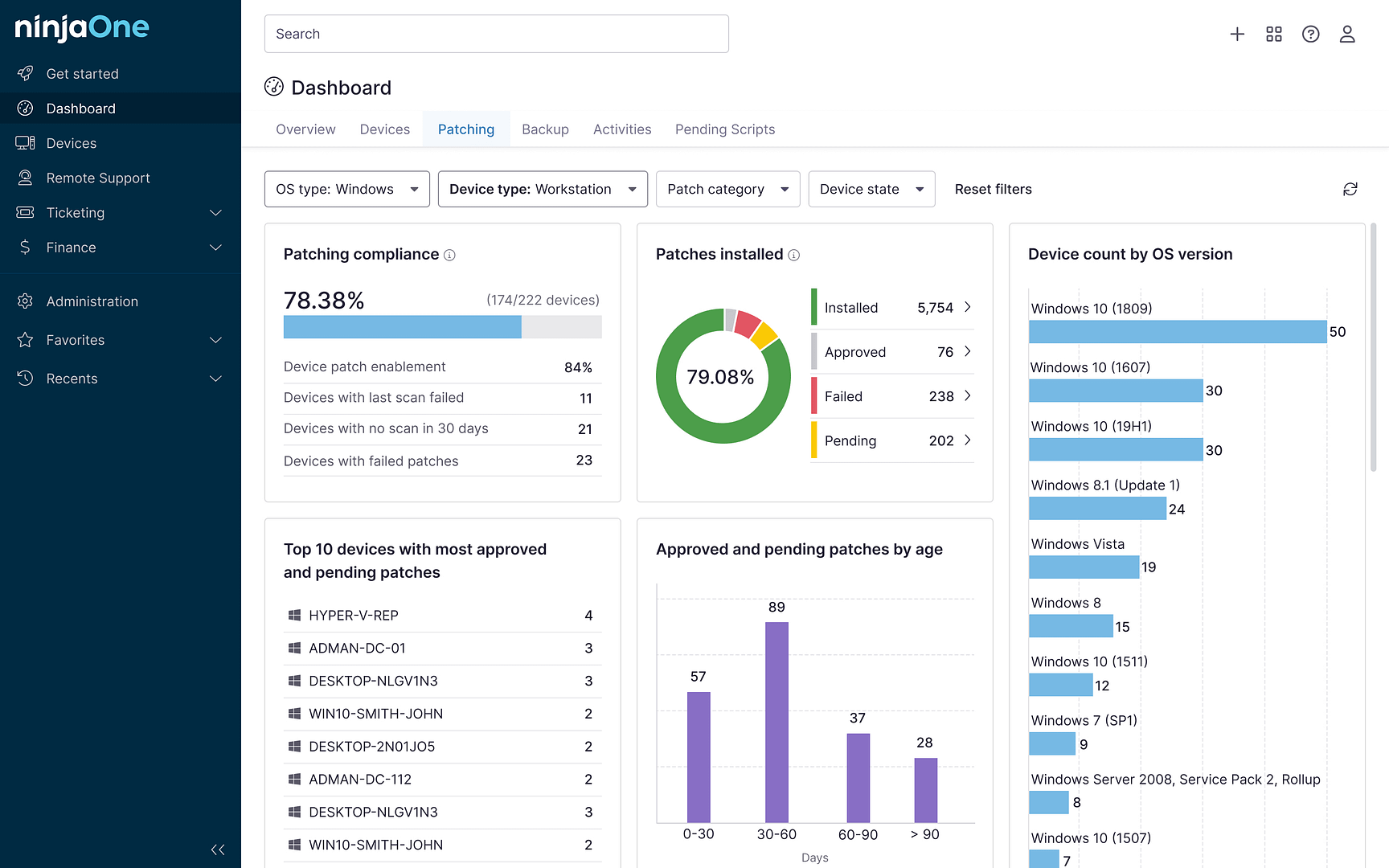
- Track patching, backup, and compliance coverage automatically.
- Trigger tickets when metrics fall below targets.
- Assign remediation tasks directly to owners.
Streamline project handoffs
- Attach runbooks to devices at go-live.
- Maintain documentation links between projects and operations.
- Use ring deployments for controlled rollouts.
Surface data for business reviews
- Integrate scorecards into QBR materials.
- Display real-time SLA performance dashboards.
- Track vulnerability management across environments.
This practical application creates a living MSP scaling framework that grows with your business.
Achieving growth through balanced project maturity vs operational maturity
Picking up the balance between project maturity vs operational maturity transforms your MSP from a reactive service provider into a strategic growth engine.
By implementing the dual scorecard, standardized handoffs, and quarterly rhythm outlined here, you systematically reduce firefighting while creating capacity for profitable expansion.
This disciplined approach ultimately lets you deliver changes faster while maintaining the rock-solid reliability that retains clients and builds a lasting market reputation.
Related topics:
- Using RMM Dashboards and Other Tools to Track Supporting Metrics for SLA Monitoring
- Patch Management Process: A Step-by-Step Guide
- How to Run a Baseline IT Maturity Assessment Without a Consultant
- How to Measure Your IT Automation Maturity Level
- Why Revenue is Not the Most Important MSP Growth Metric: 4 Things to Focus on for Sustainability