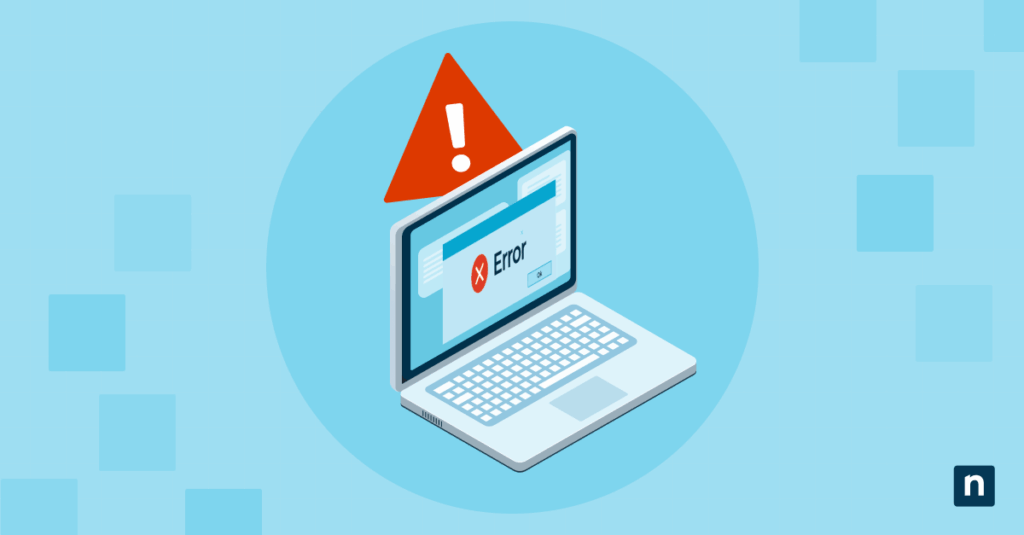
Error 0x80300024 typically appears during Windows installation, with the message “Windows is unable to install to the selected location.” This is a common issue when setting up a dual-boot system, especially when installing Windows 11 on a second drive or partition.
The error is often linked to storage-related conflicts, such as incorrect boot drive priority, mismatched partition styles, or leftover system partitions from a previous installation. It can also occur if the USB installer and the target disk use different partition styles, or if RAID or mixed controller modes are active in BIOS/UEFI.
This guide breaks down the methods to fix error code 0x80300024 and completes your Windows 11 dual-boot installation on a separate drive.
📌 Recommended deployment strategies:
Click to Choose a Method | 💻 Best for Individual Users | 💻💻💻 Best for Enterprises |
| Method 1: Reformat the target drive using Diskpart | ✓ | |
| Method 2: Set the correct drive as first boot device in BIOS | ✓ | ✓ |
| Method 3: Ensure matching partition styles (GPT vs. MBR) | ✓ | ✓ |
| Method 4: Physically disconnect other drives temporarily | ✓ |
How to fix error code 0x80300024 during Windows 11 dual boot setup
To ensure a smooth setup, make sure you have the following in place:
- A bootable Windows 11 USB installer
- Access to BIOS/UEFI settings and administrator privileges
- A full backup of all important data from any affected drives
Method 1: Reformat the target drive using Diskpart
📌 Use Cases: Use this if you’re installing Windows 11 on a drive with old partitions, conflicting formats, or leftover system data.
📌 Prerequisite: The installer must be booted in the correct mode (UEFI or Legacy BIOS, depending on your system).
⚠️ Warning: The clean command erases all data on the selected disk. Be sure to back up any important files beforehand.
- Boot from your Windows 11 USB installer.
- At the partition selection screen, press Shift + F10 to open Command Prompt.
- Enter the following commands one at a time:
- diskpart ← (starts the DiskPart utility)
- list disk ← (lists all available disks within DiskPart)
- select disk X ← (replace X with the target disk number)
- clean ← (this will erase all data on the selected disk)
- convert gpt ← (or use `convert mbr` depending on your BIOS mode)
- exit
- Close Command Prompt, click Refresh, and continue the installation.
Method 2: Set the correct drive as the first boot device in BIOS
📌 Use Cases: Use this if you’re installing on a second drive and the installer isn’t recognizing it as the primary boot device.
📌 Prerequisite: Confirm that both drives are detected in BIOS.
- Restart your PC and enter the BIOS/UEFI settings (usually by pressing Del, F2, F12, or Esc during startup).
- Go to the Boot tab.
- Identify and select the drive on which you intend to install Windows 11. [See #1 in ⚠️ Things to look out for.]
- Move it to the top of the boot priority list using the arrow keys or mouse input (depending on the BIOS version).
- (Optional) Disable or move other drives down the boot priority list.
- Save changes and exit BIOS.
- Boot again into the Windows 11 installer.
This prevents conflicts between boot records on multiple disks.
Method 3: Ensure matching partition style (GPT vs. MBR)
📌 Use Cases: Use this if the installation fails due to a mismatch between firmware mode and the target drive’s partition style.
📌 Prerequisite: The installer must be booted in the correct mode (UEFI or Legacy BIOS, depending on your system).
- In Windows Setup, press Shift + F10 to open Command Prompt.
- Enter the following commands:
- diskpart ← (starts the DiskPart utility)
- list disk ← (lists all available disks within DiskPart)
- Look at the GPT column. An asterisk (*) means the disk is already GPT. If not, it’s MBR. (Read How to Check If a Disk Is MBR or GPT in Windows.)
- Check your firmware mode:
- Press Win + R, type msinfo32, and look for BIOS Mode:
- UEFI – Disk must be GPT.
- Legacy BIOS – Disk must be MBR.
- Press Win + R, type msinfo32, and look for BIOS Mode:
- If mismatched, use Diskpart to convert the disk: [See #3 in ⚠️ Things to look out for.]
- Use convert gpt for UEFI systems.
- Use convert mbr for Legacy BIOS.
- (Refer to Method 1 for full Diskpart usage.)
- Restart and retry the installation. [See #2 in ⚠️ Things to look out for.]
💡 Tip: Read How to Convert GPT Disk to MBR Disk in Windows 10 and Windows 11.
Method 4: Physically disconnect other drives temporarily
📌 Use Cases: Use this if you’re dual-booting and want to avoid Windows from writing boot data to the wrong drive.
📌 Prerequisite: Backup all critical data from affected drives before modifying drive connections.
- Shut down your PC completely.
- Open the case and physically unplug all drives except the one where you’re installing Windows 11.
- Boot using the USB installer and complete the installation.
- Once Windows 11 is installed, shut down your PC again.
- Reconnect the other drives.
- (Optional) Use bcdedit or a boot manager to configure dual-boot options.
This avoids installer confusion caused by multiple bootable partitions.
⚠️ Things to look out for
Risks | Potential Consequences | Reversals |
| Selecting the wrong boot drive in BIOS | Bootloader installed to the wrong drive, causing boot issues or overwriting the existing OS loader. | Re-enter the BIOS to correct the boot order. If needed, repair the bootloader using Windows Recovery Environment or bcdboot. |
| Installing on a GPT disk while in Legacy BIOS mode, or on an MBR disk while in UEFI | Windows Setup will refuse to install, or installation will fail midway. | Reboot the installer in the correct firmware mode or convert the partition style using Diskpart. |
| Converting partition styles without backup | Data loss from the clean and convert commands. | No built-in recovery; use third-party data recovery tools. |
Additional considerations
These settings and checks can prevent or resolve installation issues, especially during dual-boot setups involving separate drives:
USB installer format
If your system uses UEFI (which most systems do), your USB installer must match its expectations:
- Partition scheme: GPT
- File system: FAT32 (required for UEFI boot)
Use Rufus to create a UEFI-compatible Windows 11 installer by selecting GPT as the partition scheme and UEFI (non-CSM) as the target system.
Storage controller mode
Windows Setup may not detect your drive or throw errors if the SATA controller is set to RAID and you don’t have the necessary RAID drivers ready.
To avoid this, enter the BIOS and set the controller mode to AHCI (Advanced Host Controller Interface). This is the recommended and most compatible option for standard SSDs and HDDs.
Drive health
A failing or corrupted drive can trigger install errors like 0x80300024. Use tools like chkdsk or manufacturer diagnostics to verify disk integrity. These tools provide SMART status, bad sector scans, and check overall drive health.
Secure Boot
Secure Boot can block unsigned drivers or modified bootloaders, especially during dual-boot setups or when using custom Windows ISOs. Consider temporarily disabling Secure Boot in your BIOS or UEFI settings if you encounter installation issues.
bcdedit
After a successful installation, Windows may not always add the new OS to the boot menu, particularly in dual-boot configurations. You can manually add entries using: bcdedit /set {current} description “Windows 11”
Fix Windows 11 dual boot error 0x80300024 to finish your setup smoothly
Error 0x80300024 often stems from conflicting partition styles, incorrect disk priority, or boot mode mismatches. These issues can be resolved with a few deliberate steps.
Use Diskpart to clean and reformat the target drive. Make sure the installer is booted in the correct mode (UEFI mode for GPT or Legacy BIOS for MBR). Set the installation drive as the first boot device in BIOS to avoid misplacing the bootloader. Temporarily disconnect other drives during setup to avoid partitioning conflicts. After installation, reconnect the drives and configure the boot menu if needed.
With these precautions, you can eliminate error 0x80300024 and complete your Windows 11 dual-boot setup efficiently and safely.
Related topics: