
Key points
- Most cybersecurity incidents result from operational security gaps such as unpatched vulnerabilities, unmanaged endpoints, configuration drift, and failed recovery processes.
- Fragmented IT environments reduce visibility and create inconsistencies that increase endpoint security risk and complicate remediation efforts.
- Continuous asset discovery and endpoint visibility provide the foundation for effective patch management, configuration enforcement, and security monitoring.
- Vulnerability-aware patch management helps organizations prioritize remediation efforts based on risk and reduce exposure to known threats.
- Configuration control and drift detection help maintain security standards across large endpoint environments and prevent unnoticed deviations.
- Backup and recovery processes should be regularly tested to ensure organizations can recover quickly from outages, ransomware, or other disruptive incidents.
Most security conversations focus on high-profile threats like zero-days, supply chain attacks, or nation-state actors. While these threats are real, they’re not where most breaches actually happen.
- Nearly 60 percent of data breaches are traced back to a known, unpatched vulnerability. Verizon’s 2026 Data Breach Report found that only 26 percent of critical vulnerabilities were fully remediated by organizations in 2025.
- According to ESG research, 90 percent of organizations say they have blind spots in their endpoint management. And 76 percent say they’ve experienced a cyberattack due to exploitation of unknown, unmanaged, or poorly managed internet-facing assets.
- Only about half of IT organizations test their backup and recovery plans monthly or more frequently.
In other words, the biggest security risks in most environments aren’t sophisticated exploits. They’re a missed patch, an untracked endpoint, or an untested backup. If these gaps exist in your environment, they point to an execution problem. Fortunately, execution problems can be fixed.
Disconnected, complex IT environment
Over time, most IT environments accumulate layers that add complexity and compromise security. Tools are added to solve specific problems. Integrations are pieced together to fill service or functionality holes. Then, to make matters worse, processes are built to get around the limitations of these disconnected tools. Although none of the solutions was designed to work in sync with the others, your IT team is expected to operate as though they do.
When visibility, patching, endpoint control, and backup reside on separate systems that don’t talk to each other, the result is:
- Unmanaged endpoints go too long with unresolved issues due to lack of full visibility.
- Configuration drift builds quietly across hundreds of endpoints, going undetected until it becomes difficult to control.
- Patches get deployed without vulnerability context, or they don’t get deployed at all because the risk of disruption is unclear. Over 80 percent of IT leaders have postponed a critical patch for this reason. It’s also not uncommon to discover that a patch believed to be fully deployed had actually missed multiple endpoints.
- Backup workflows that haven’t been tested could compromise your ability to recover when something breaks.
Over time fragmented tools increase your organization’s security risk.
Building foundational security to reduce your security risk
Addressing these security gaps doesn’t require a complete overhaul. To address these risks, your IT team must apply foundational security discipline to the following areas:
- Visibility – Full, continuous asset discovery across every endpoint, whether managed, unmanaged, or remote is the starting point. Without it, patching and configuration enforcement are just guesswork.
- Control – Every endpoint should be consistently configured and centrally managed. Configuration drift is one of the least noticed and most persistent risks in any IT environment. Catching it early, before it spreads, is far cheaper than cleaning it up after the fact.
- Remediation – Patching with vulnerability context lets teams prioritize effectively and act before attackers do.
- Recovery – Backup is only valuable if recovery actually works. Automated, regularly tested backup and recovery with provable results means incidents become recoverable events rather than extended outages.
Closing the execution gap
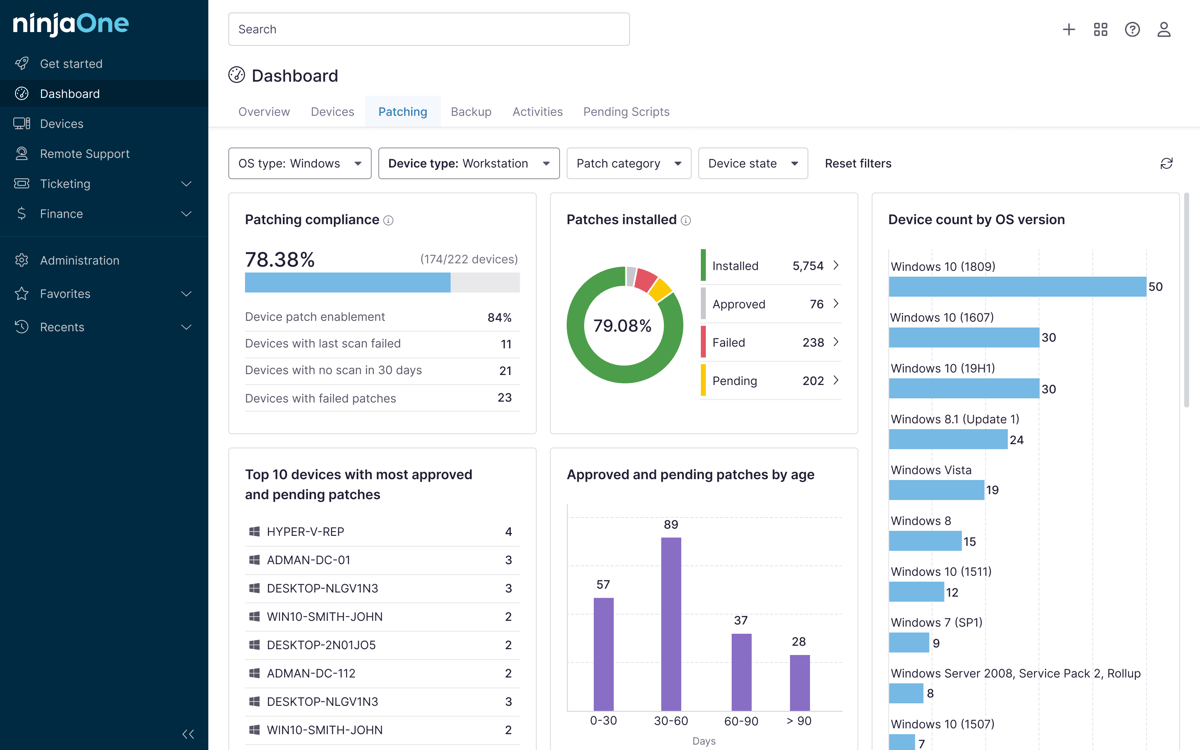
NinjaOne can help close the execution gap. Our unified IT operations platform brings endpoint and patch management, backup, robust automations, remote access, and more into a single platform, giving IT teams and MSPs the visibility, control, and automation to act consistently and at scale. When these capabilities operate together, automated patching happens safely across every device, configuration drift gets caught before it spreads, and backup and recovery are provable before you need them.
The goal isn’t to eliminate every possible threat. It’s to close the gaps that matter most — consistently, automatically, and at the scale modern environments demand.
Take our security assessment to see where you stand. Then, watch a demo or try NinjaOne free to see how it can help you build a solid security foundation.