


Key Points
- Firewalls examine traffic at the packet, session, or application layer and decide whether to allow or deny traffic across a network.
- Firewall placement is as important as configuration, as a misplaced firewall can create blind spots that attackers can exploit.
- Overly permissive rules can cause firewall failure, and outdated rules can silently reactivate or grant unintended access when IPs or ports are reused.
- Internal firewalls and network segmentation help limit lateral movement after a breach by enforcing least privilege across internal zones.
- Continuous maintenance, including regular rule reviews, change management, traffic monitoring, and architectural alignment, helps maximize firewall value over time.
Firewalls contribute to network security by inspecting traffic, enforcing policy, and controlling how different parts of the network can talk to each other, but their real effectiveness depends on where they sit, how they are configured, and how actively they are managed over time. They function as essential gatekeepers within a broader security architecture rather than as a standalone solution.
What do firewalls do in network security?
Firewalls are network security controls that examine traffic and apply rules to decide whether to allow, deny, or log connections. They enforce policy at the packet, session, or application level depending on the technology in use, ranging from basic packet filters to advanced next‑generation firewalls that perform deep inspection of protocol and payload.
At a foundational level, firewalls act as programmable checkpoints that sit along critical network paths and make deterministic decisions about traffic based on defined rules. They evaluate attributes such as source and destination IP address, port, protocol, connection state, and sometimes application identity or user identity, then apply policy to shape which flows are permitted and which are blocked.
Different firewall technologies implement this control in different ways. Traditional packet‑filtering firewalls focus on header information and make decisions per packet, while stateful firewalls track the state of connections over time, allowing them to understand whether a packet legitimately belongs to an established session. Application‑aware firewalls go further by identifying the application generating the traffic and enforcing policies at that layer, even when traffic uses common ports like 80 or 443.
In practice, a firewall’s primary contributions to security are:
- Inspecting network traffic
- Enforcing allow and deny rules
- Controlling access between defined network zones
- Reducing exposure to unauthorized or unnecessary connections
Many firewalls also perform supporting functions such as network address translation (NAT), VPN termination, and detailed logging.
By concentrating these “go” and “no-go” decisions at various control points, firewalls shape the permitted pathways through which systems, users, and applications can communicate. They turn the network from a flat mesh into a set of explicitly authorized flows, acting as programmable choke points that both enforce security requirements and provide visibility into how the environment is actually being used.
Why firewall placement is critical
Where a firewall is placed determines which traffic it can actually see and control, which makes placement as important as the rules themselves. A firewall deployed in the wrong location can be perfectly configured and still fail to prevent critical attacks because relevant traffic never passes through it.
Common placements include the network perimeter between internal and external networks, segmentation points between internal zones such as user VLANs and server networks, and access points for cloud connections, VPNs, and remote access.
Poor or inconsistent placement creates blind spots and alternate paths that allow traffic to bypass inspection entirely, undermining the intended security model.
The role of configuration in firewall security effectiveness
Firewall effectiveness depends heavily on rule configuration, not just on having a device in place. Overly permissive rules, such as broad “any–any” allowances, can quietly erode the value of a firewall by allowing far more access than originally intended.
Over time, unused or outdated rules accumulate, rule conflicts appear, and documentation of rule intent is lost, making it difficult to understand why a given rule exists or what would break if it were removed. For example, when servers or applications are retired but their associated firewall rules remain, those rules can silently “wake up” if the same IPs, subnets, or ports are reused later, granting unintended access paths that were never reviewed for the new context.
Misconfiguration, including accidental exposure of services or failure to restrict high‑risk protocols, is one of the leading causes of firewall‑related security failures and often results from complex, poorly governed rule sets.
Internal firewalls and segmentation
Modern network security assumes that perimeter defenses will occasionally fail and that attackers may gain some level of internal access. Internal firewalls and segmentation address this reality by limiting lateral movement once an initial foothold is established.
By placing firewalls between internal zones — such as user segments, server networks, management networks, and high‑sensitivity systems — organizations can enforce least privilege access between zones. This segmentation protects sensitive systems from internal threats, constrains the blast radius of a compromise, and makes it harder for attackers to pivot freely across the environment.
Operational maintenance and governance
Firewalls are not “set it and forget it” devices; their security value decays without ongoing operational care. Regular rule reviews and cleanup are necessary to remove obsolete entries and align access with current business requirements.
Change management for firewall updates helps ensure that new rules are tested, documented, and approved, reducing the risk of accidental exposure. Continuous monitoring of blocked and allowed traffic patterns reveals misuse, misconfigurations, and evolving application behavior, while alignment with changes in network architecture prevents the firewall from becoming detached from how the environment actually works.
Common firewall related threats
Several common threats undermine firewall effectiveness even when the technology is present. Misconfigured rules can directly create unwanted exposure, while shadow IT and undocumented network paths introduce traffic flows that never pass through official control points.
Encrypted traffic that is not inspected can carry malicious content or command‑and‑control channels through allowed ports, effectively tunneling through the firewall’s policy. Inconsistent policy enforcement across different firewall devices or platforms leads to gaps, where the same type of traffic is blocked in one location but allowed in another, complicating incident response and increasing the likelihood of unnoticed weaknesses.
Limitations and scope considerations
Firewalls operate at the network layer and do not directly protect endpoints from all forms of attack, such as local malware execution or user‑level abuse. They also cannot compensate for weak identity controls, poor authentication practices, or excessive user privileges.
To be effective, firewalls must integrate with other security layers, including endpoint protection, identity and access management, logging, and detection capabilities. They are a critical control within defense in depth, but relying on them as a complete solution often leads to a false sense of security.
Common misconceptions
Several misconceptions reduce the quality of firewall deployments. One is the belief that simply installing a firewall guarantees security, when in reality security depends on thoughtful placement, careful configuration, and continuous oversight.
Another misconception is that firewalls are only perimeter devices, even though internal firewalls and segmentation have become increasingly important for containing breaches and protecting sensitive systems.
A further mistaken assumption is that firewall rules rarely need review, despite the fact that rule sets must evolve right alongside changing networks, applications, and business needs.
NinjaOne integration
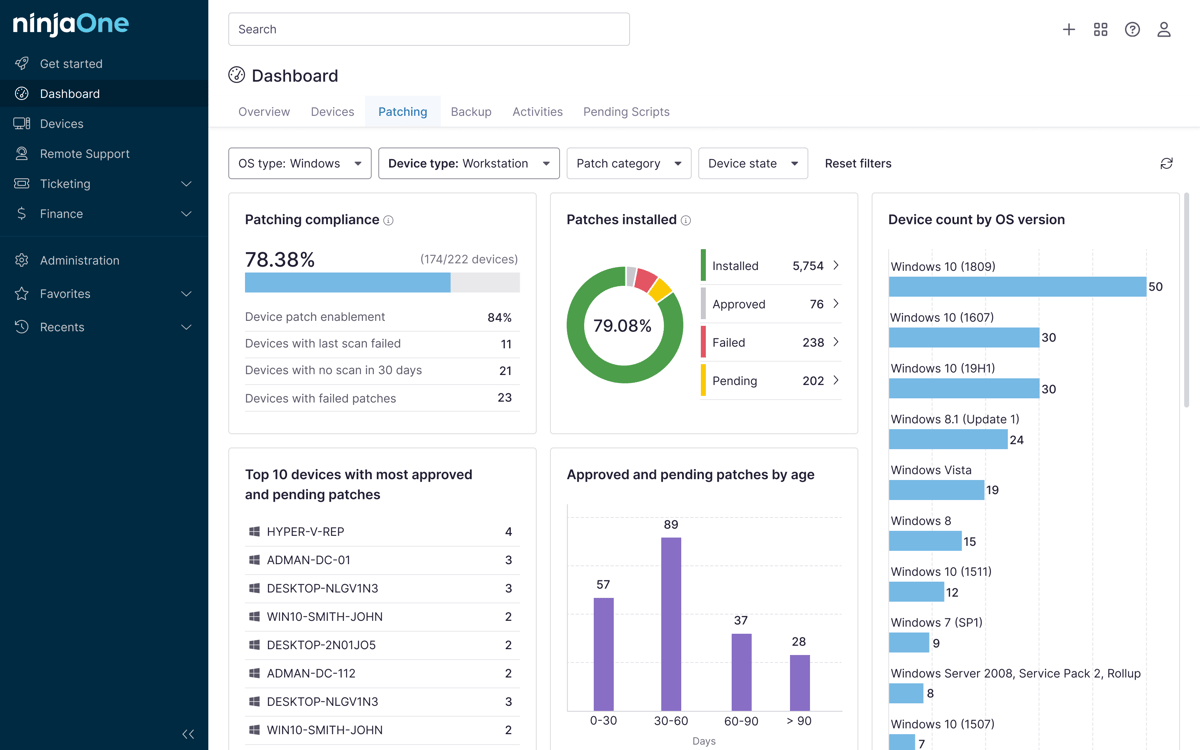
NinjaOne can support network security efforts by providing visibility into endpoint behavior, network activity, and configuration drift across managed devices. This visibility helps teams validate whether firewall policy is behaving as expected from the endpoint perspective and detect anomalies that might indicate gaps in segmentation or misconfigured rules.
By correlating endpoint and network observations, NinjaOne assists in maintaining defense in depth, making it easier to see how firewall controls interact with other layers of security and where operational practices may need adjustment to lock in the intended security program.
In summary
Firewalls remain a cornerstone of network security, but their true effectiveness is determined by how they are deployed and managed rather than by their mere existence in the network. Thoughtful placement, following firewall configuration best practices, and disciplined governance are essential for ensuring firewalls reduce risk instead of providing only the appearance of protection.
Remember that firewalls most often fail due to neglected rule sets and weak operational practices, not missing technology. Poor placement creates blind spots that no amount of rule tuning can fully correct, while internal segmentation largely defines how much damage a successful breach can cause. Firewalls only remain effective when governance keeps pace with ongoing network and application change.