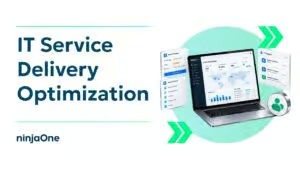
NSP guide: How to achieve IT service delivery optimization. Transform chaotic IT requests through consistent strategic IT service delivery. In this video, you'll learn how to apply a practical framework to define your services, measure what actually matters, and automate your workflows for faster, more reliable IT delivery. Before we begin, be sure to subscribe to NinjaOne's IT Video Hub and our YouTube channel for more tech content like this. How to build an IT service delivery optimization framework. Start by publishing a clear service catalog to standardize request types with clear fields, priorities, and SLAs. Set Olas and escalation paths so handoffs don't stall and use self-service forms with validation to capture the right information upfront. Next, track SLO attainment rates, resolution times, and reopen rates. Monitor queue depth and backlog age. Avoid bottlenecks by applying work in progress limits and sharing real-time dashboards so everyone is working from the same data. Standardize IT service delivery with reusable ticket templates for common requests and changes. Apply guardrails for pre-approved standard changes and keep version control playbooks attached to your service items. Automate IT service delivery with automated runbooks for high-volume requests. Auto-enrich tickets with data pulled from monitoring and inventory systems. Use success-checking scripts to automatically close tickets after successful fulfillment. Integrate with service ops to automatically create tickets from monitoring alerts and connect them to runbooks. You can speed up root cause analysis by correlating incidents with recent changes. Add deployment gates that pause rollouts when error budgets are depleted. To demonstrate the value of your IT services and manage cost to serve, analyze the cost of effort and tools to calculate the true cost per request. Cut out low-value catalog items and consolidate redundant tools where appropriate. You can then reinvest the savings into reliability engineering, and self-service capabilities. Your IT service delivery should adapt to your business's changing needs through regular reviews and process improvements. Review weekly SLO breaches and handoff failures and retire any outdated templates. Assign action items with clear owners and deadlines and implement SLA enforcement mechanisms. Following this step ensures your IT service delivery processes continue to improve. IT service delivery optimization. With this IT service delivery optimization guide, you can clearly define service expectations, deliver consistent IT services, and continually improve processes to achieve efficient and cost-effective service delivery. For more information, check out our official blog post on How to Achieve IT Service Delivery Optimization, linked in the description below.

MSP Guide: How to Achieve IT Service Delivery Optimization

Watch this to learn how to apply a practical IT service delivery optimization framework that covers service catalogs, SLO tracking, standardization, automation, ServiceOps integration, and cost management. peration your business can rely on.

Read the full blog on How to Achieve IT Service Delivery Optimization
Never miss a NinjaOne video!