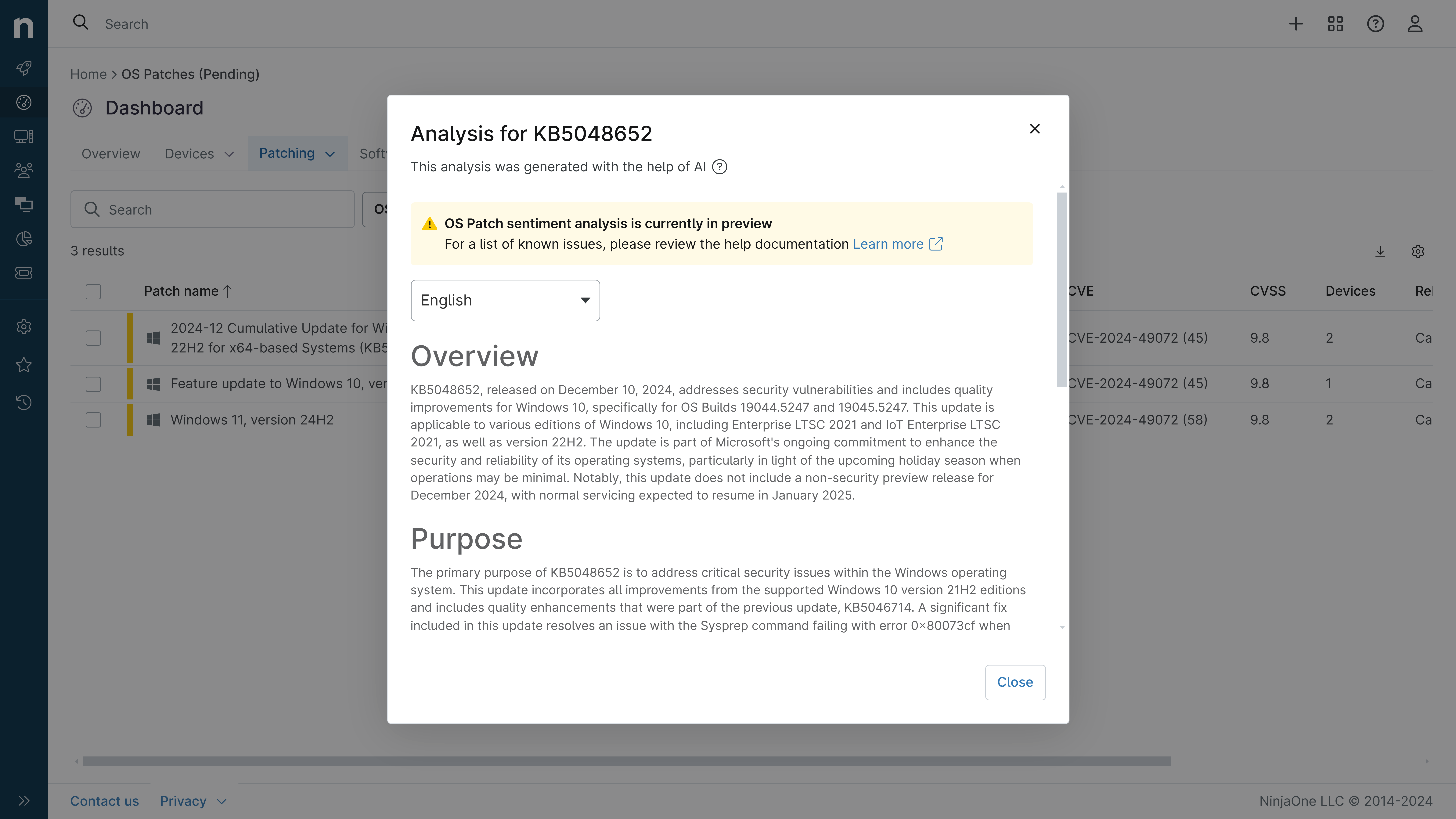
KB5082427: Overview with user sentiment and feedback
Last Updated May 28, 2026
Probability of successful installation and continued operation of the machine
Overview
KB5082427 is an April 2026 cumulative security and reliability update for .NET Framework 3.5 and 4.8 on Windows Server 2022. This patch represents Microsoft's regular monthly maintenance cycle for the .NET Framework, addressing multiple security vulnerabilities and improving overall system stability. The update is distributed through standard Windows Update channels and is designed to be installed as part of routine server maintenance operations.
The patch focuses on critical security enhancements, particularly addressing a remote code execution vulnerability that could allow attackers to execute arbitrary code through .NET Framework processes. Additionally, it resolves several denial-of-service vulnerabilities, a security feature bypass issue, and an information disclosure vulnerability. The update also includes quality improvements to the .NET Runtime, specifically enhancing ClickOnce verification logic to support modern cryptographic hash algorithms.
General Purpose
This cumulative update delivers essential security hardening for .NET Framework environments running on Windows Server 2022. The patch addresses six distinct security vulnerabilities spanning remote code execution, denial-of-service, security feature bypass, and information disclosure categories. The most critical element is the remediation of CVE-2026-32178, a remote code execution vulnerability that poses significant risk to exposed systems. Beyond security fixes, the update enhances the .NET Runtime with improved ClickOnce deployment verification, adding support for SHA384 and SHA512 hash algorithms to align with modern security standards. The update applies to both .NET Framework 3.5 and 4.8 versions, ensuring comprehensive coverage across different application compatibility requirements.
General Sentiment
Community and technical sentiment regarding this patch is overwhelmingly positive, though limited discussion volume exists at this time. The patch addresses genuinely critical security vulnerabilities, particularly the remote code execution flaw, which justifies immediate deployment in most production environments. Microsoft's official documentation indicates no known issues following release, which is a favorable indicator. The update follows standard deployment practices through Windows Update and WSUS, reducing deployment friction. However, administrators should note that the patch requires a system restart when affected .NET Framework files are in use, necessitating planned maintenance windows in production environments. The requirement to exit .NET Framework-based applications before installation suggests potential service disruption, though this is standard practice for framework updates. No negative user feedback or compatibility issues have been reported, suggesting a stable release.
Known Issues
- Microsoft has not identified any known issues associated with this update at the time of release.
Disclaimer: We take measures to ensure that AI-generated content is of the highest possible quality, but we cannot guarantee its accuracy and recommend that users do their own independent research. Generated on 2026-05-28 07:23 PM