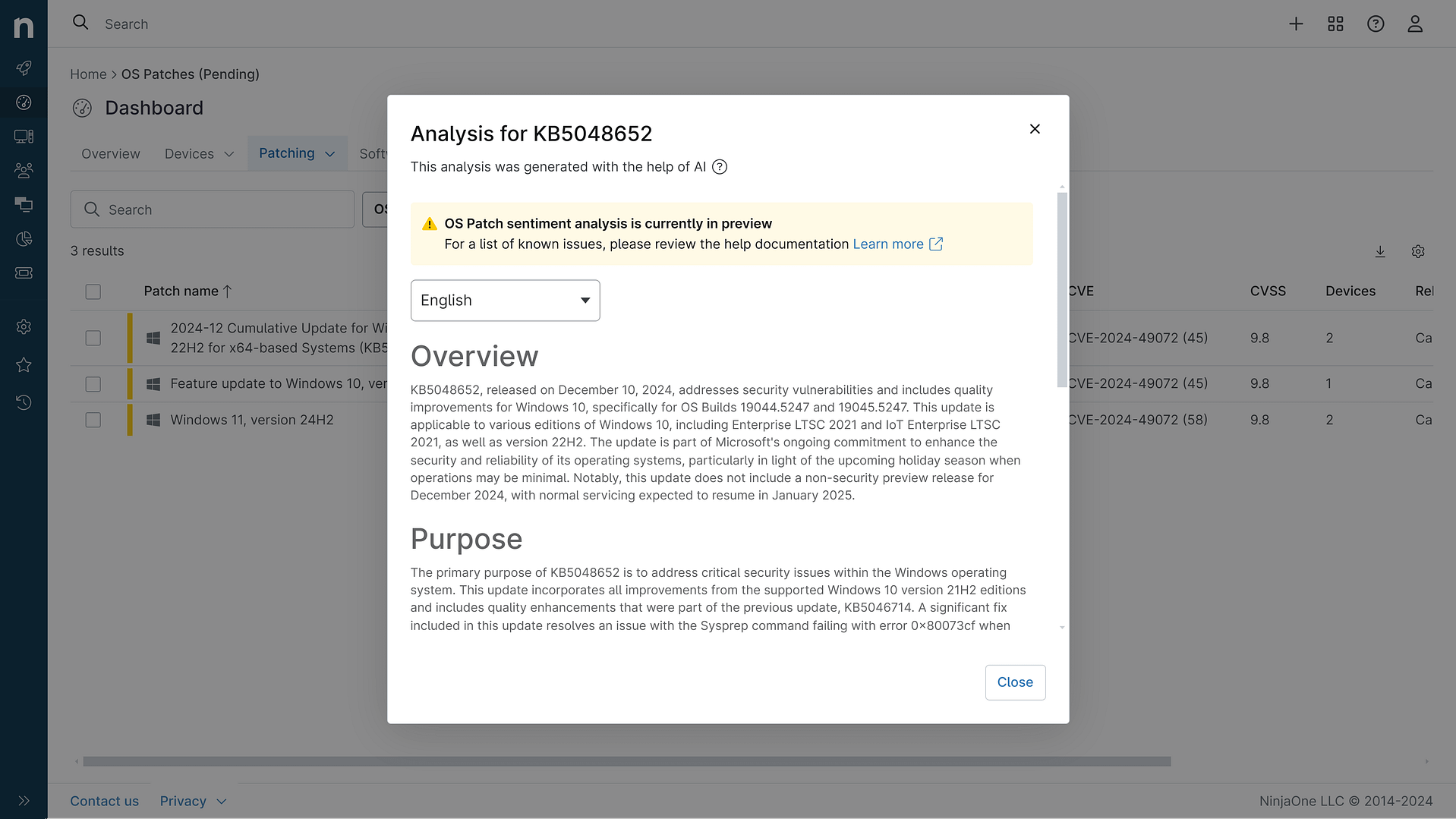
KB5082426: Overview with user sentiment and feedback
Last Updated May 30, 2026
Probability of successful installation and continued operation of the machine
Overview
KB5082426 is a cumulative security and reliability update for .NET Framework 3.5 and 4.8 released on April 14, 2026, designed for Windows 10 Version 21H2 and Windows 10 Version 22H2 systems. This update addresses multiple critical security vulnerabilities and includes quality improvements to enhance the stability and functionality of the .NET Framework runtime environment. The patch was revised on April 22, 2026, to include a known issues section, indicating that Microsoft identified and documented an installation concern that affects specific deployment scenarios.
The update is distributed through multiple channels including Windows Update, Microsoft Update, Windows Update for Business, Microsoft Update Catalog, and Windows Server Update Services (WSUS), making it widely accessible to enterprise and consumer users. Microsoft recommends applying this update as part of regular maintenance routines to ensure systems remain protected against identified threats and benefit from cumulative reliability enhancements.
General Purpose
This cumulative update delivers six critical security fixes addressing remote code execution, denial-of-service, security feature bypass, and information disclosure vulnerabilities within the .NET Framework. The most significant security improvement addresses CVE-2026-32178, a remote code execution vulnerability that could allow attackers to execute arbitrary code with elevated privileges. Additional denial-of-service vulnerabilities (CVE-2026-32203, CVE-2026-32226, and CVE-2026-23666) are mitigated to prevent application crashes and service interruptions. The update also resolves a security feature bypass vulnerability (CVE-2026-26171) and an information disclosure vulnerability (CVE-2026-33116). Beyond security enhancements, the patch includes quality improvements to the .NET Runtime, specifically adding verification logic for ClickOnce deployments to support SHA384 and SHA512 cryptographic algorithms, improving compatibility with modern security standards.
General Sentiment
The overall sentiment toward KB5082426 is moderately positive, as it addresses significant security vulnerabilities that could pose substantial risk to systems running .NET Framework applications. The inclusion of a remote code execution fix demonstrates Microsoft's responsiveness to critical threats. However, the revision history and addition of a known issues section on April 22, 2026—eight days after initial release—raises concerns about the thoroughness of pre-release testing. The documented installation failure when applying the update through DISM to offline Windows 10 IoT Enterprise LTSC 21H2 images suggests that certain deployment methodologies were not adequately validated before release. While the security improvements are compelling and necessary, the post-release discovery of installation issues tempers enthusiasm. Organizations using standard Windows Update channels should experience smoother deployments, but those managing offline or IoT deployments may face complications. The fact that a resolution is still pending indicates this remains an active issue requiring workarounds or delayed deployment for affected environments.
Known Issues
- Installation failure when applied through DISM to offline Windows 10 IoT Enterprise LTSC 21H2 images; Microsoft is working on a resolution with a fix planned for a future .NET Framework update
- Requires .NET Framework 3.5 or 4.8 to be pre-installed; systems lacking these prerequisites cannot receive the update
- Computer restart required after installation if affected files are in use; users must close all .NET Framework-based applications before applying the patch to minimize disruption
Disclaimer: We take measures to ensure that AI-generated content is of the highest possible quality, but we cannot guarantee its accuracy and recommend that users do their own independent research. Generated on 2026-05-30 07:54 PM