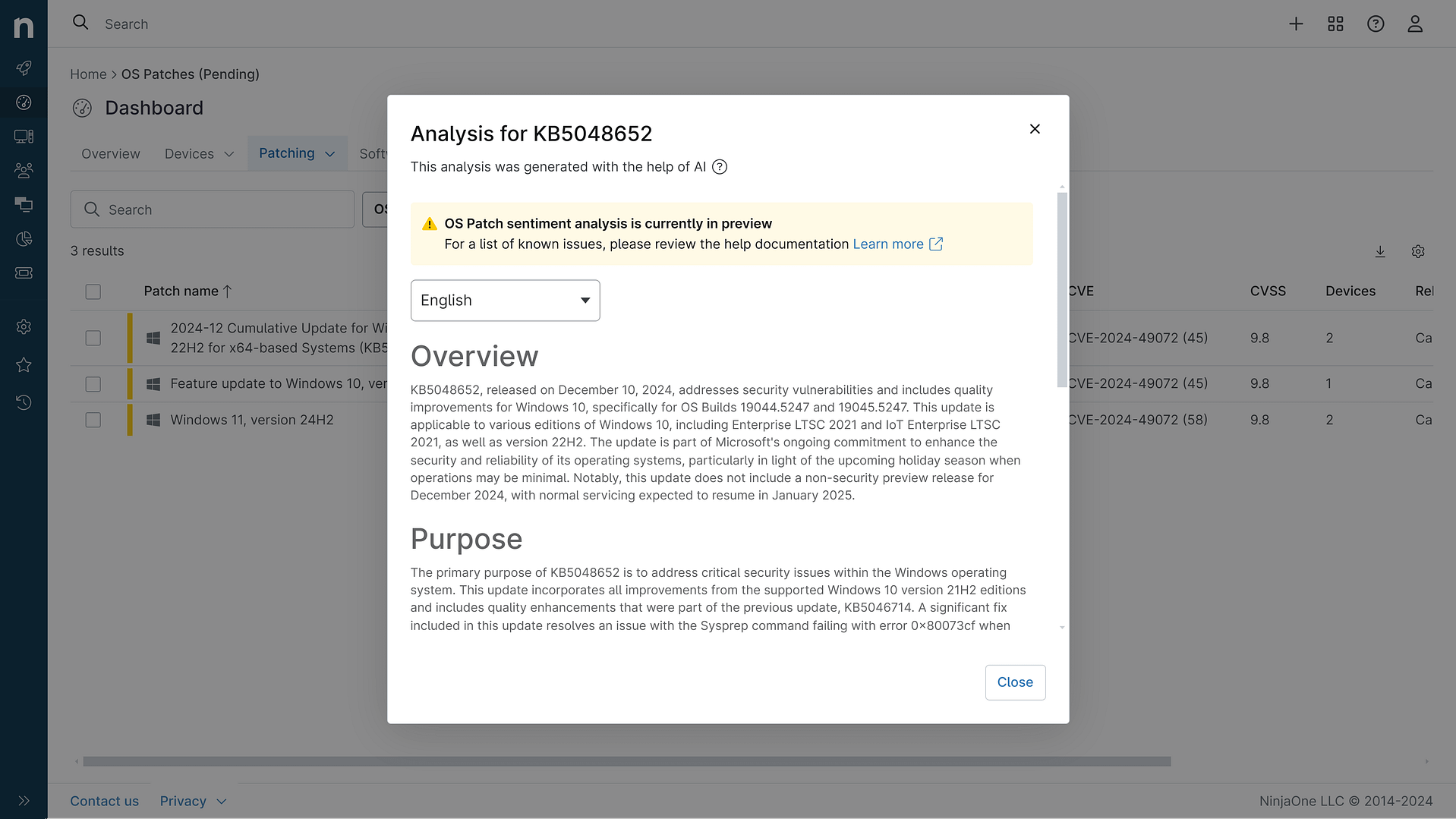
KB5082400: Overview with user sentiment and feedback
Last Updated May 30, 2026
Probability of successful installation and continued operation of the machine
Overview
KB5082400 is an April 2026 security and quality rollup update designed for .NET Framework versions 4.6.2, 4.7, 4.7.1, and 4.7.2 running on Windows Server 2012. This update is part of Microsoft's Extended Security Updates (ESU) program, which provides continued security coverage for systems that have reached end-of-support status. Windows Server 2012 reached its standard end-of-support date on October 10, 2023, and ESUs are available through October 13, 2026, on a renewable annual basis.
The update addresses multiple critical security vulnerabilities affecting the .NET Framework runtime environment, including remote code execution risks and denial-of-service vectors. Additionally, it incorporates quality improvements to enhance system reliability and compatibility. Organizations running legacy .NET Framework versions on Windows Server 2012 should evaluate this update as part of their security maintenance strategy, particularly if they have not yet migrated to newer Windows Server versions.
General Purpose
This cumulative security and quality rollup targets six distinct security vulnerabilities within .NET Framework implementations. The most critical fix addresses CVE-2026-32178, which represents a remote code execution vulnerability that could allow attackers to execute arbitrary code with elevated privileges. The update also mitigates four denial-of-service vulnerabilities (CVE-2026-32203, CVE-2026-32226, CVE-2026-23666) that could be exploited to disrupt application availability. A security feature bypass vulnerability (CVE-2026-26171) and an information disclosure vulnerability (CVE-2026-33116) are also resolved.
Beyond security fixes, the rollup includes a quality improvement to the .NET Runtime that adds verification logic for ClickOnce deployments, enabling support for SHA384 and SHA512 hash algorithms. This enhancement improves compatibility with modern cryptographic standards and deployment scenarios. The update requires installation of a prerequisite servicing stack update (KB5044413) to ensure reliable deployment and proper application of security patches. Users must have .NET Framework 4.6.2, 4.7, 4.7.1, or 4.7.2 already installed to apply this update.
General Sentiment
Overall sentiment toward KB5082400 is cautiously positive from a security perspective, as it addresses significant vulnerabilities in legacy .NET Framework versions. However, there are important contextual considerations. The update applies specifically to Windows Server 2012, an operating system that reached end-of-support over two years ago, which suggests organizations should view this as a transitional measure rather than a long-term solution. Microsoft explicitly recommends upgrading to a later version of Windows Server, indicating this ESU is intended to provide a bridge period for organizations unable to immediately migrate.
A notable concern exists regarding Azure Arc-enabled deployments, where installation failures have been documented. The documentation indicates that specific network endpoint requirements must be met for successful installation on Azure Arc devices, which could complicate deployment in hybrid or cloud-connected environments. This limitation may create friction for organizations attempting to patch systems in modern infrastructure scenarios. The requirement to reinstall the update if language packs are subsequently added represents an additional operational consideration. Despite these caveats, the absence of reported post-installation issues in the official documentation and the straightforward deployment through Windows Update channels suggest the update itself is technically sound for standard deployments.
Known Issues
- Installation may fail on Azure Arc-enabled devices running Windows Server 2012 unless specific network endpoints for Extended Security Updates are accessible as defined in Connected Machine agent network requirements
- If a language pack is installed after applying this update, the update must be reinstalled to maintain proper functionality
- All .NET Framework-based applications should be closed prior to installation to avoid potential file-in-use conflicts during the update process
- Computer restart may be required after applying the update if affected system files are currently in use by running processes
Disclaimer: We take measures to ensure that AI-generated content is of the highest possible quality, but we cannot guarantee its accuracy and recommend that users do their own independent research. Generated on 2026-05-30 07:52 PM