Windows 11 Management with NinjaOne Windows Management
NinjaOne Windows Management NinjaOne Windows Management applies endpoint management to Windows 11 devices, covering inventory, patching, remote administration, and policy control in one console.
NinjaOne Windows Management NinjaOne Windows Management applies endpoint management to Windows 11 devices, covering inventory, patching, remote administration, and policy control in one console.
The following table outlines common challenges IT teams and MSPs face when managing Windows 11 devices and how NinjaOne Windows Management addresses them.
Problem | How NinjaOne resolves it |
IT lacks consistent visibility into hardware, software, and operational status across distributed Windows 11 devices. | NinjaOne collects hardware and software inventory and monitors endpoint status for managed Windows 11 devices from a centralized console. |
Keeping Windows 11 devices current with OS and third-party patches requires ongoing manual scheduling and approval. | NinjaOne provides policy-based patch management that lets administrators configure scan schedules, approval rules, deployment timing, and compliance monitoring for Windows OS and supported third-party updates. |
Troubleshooting Windows 11 devices across distributed or remote users often requires physical access or delays. | NinjaOne provides remote administration tools, including remote access and script execution, so administrators can investigate and resolve issues without physical access to the device. |
Deploying and standardizing software across Windows 11 devices becomes inconsistent when done manually or on different schedules. | NinjaOne supports software deployment through manual, scheduled, or policy-based workflows, helping standardize application management across managed Windows 11 devices. |
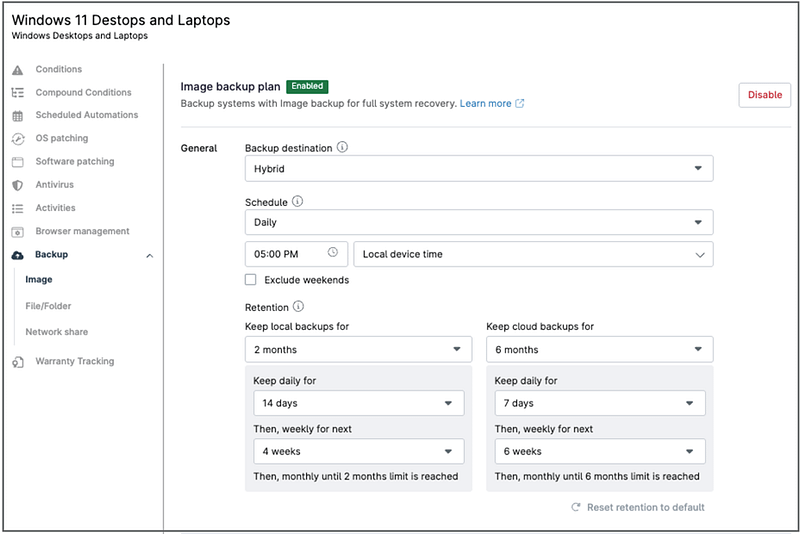
Rebuilding a Windows 11 device after OS corruption or failure takes too long when relying on manual reinstallation. | NinjaOne Image Backup captures complete OS, application, and file data at the volume level, allowing administrators to restore a corrupted Windows 11 device to its prior state, including bare metal recovery to new hardware when needed. |
Managing Windows 11 with NinjaOne Windows Management helps IT teams improve operational visibility, reduce manual administration, and maintain more consistent endpoint management across their environments. Key benefits include:
Image Backup and bare metal recovery let administrators restore a Windows 11 device to its prior state without lengthy manual rebuilds.
CVSS-based vulnerability reporting and policy-driven patch management give administrators visibility into risk and confidence that updates are applied consistently across managed devices.
Technicians can launch NinjaOne Remote, the remote registry editor, remote terminal (PowerShell and CMD), and the remote service and task managers directly from a ticket, letting administrators resolve issues on distributed Windows 11 devices without switching tools or requiring physical presence.
Built-in AD user management and discovery let administrators manage domain-joined Windows 11 devices and users alongside other endpoint workflows from the same console.
Standardized, policy-based configuration reduces variation in day-to-day administration across managed Windows 11 devices while preserving flexibility for groups with different requirements.
saved time on manual tasks through automation
reduced ticket volumes and resolution times
replaced 3-4 tools with NinjaOne

NinjaOne collects hardware and software inventory from managed Windows 11 devices, including system specifications, installed applications, processor information, memory, storage, and network details. Administrators can review this information from a management console when monitoring managed endpoints.

Administrators can configure policies for Windows OS updates, including scan schedules, approval rules, deployment timing, and compliance monitoring. NinjaOne also provides CVSS-based vulnerability reporting and dedicated patch reporting for Windows devices, along with WinGet support for updating supported third-party applications.

Administrators can remotely access Windows 11 endpoints using NinjaOne Remote to troubleshoot issues and execute scripts without physical access to the device. Remote tools include file browser and transfer, remote terminal, remote task manager, and remote service manager.

Administrators can remotely view and modify the Windows registry on managed Windows 11 devices, supporting advanced troubleshooting and configuration tasks that require direct system-level access.

NinjaOne can report on disk encryption status for managed Windows 11 devices and retrieve BitLocker recovery keys, helping administrators verify encryption compliance and support device recovery when needed.

NinjaOne supports Active Directory user management and AD-based discovery and deployment, allowing administrators to manage domain-joined Windows 11 devices and users alongside other endpoint management workflows.

NinjaOne supports deployment of supported Windows application packages through manual, scheduled, or policy-based workflows, including one-click software uninstall, helping administrators standardize application management across managed devices.
Managing Windows 11 with NinjaOne Windows Management follows four high-level phases, from initial configuration through ongoing administration and maintenance.
Administrators set up patch, encryption, and software policies, along with organization and location assignments, before enrollment, so devices are placed and governed correctly from the moment they connect.
Administrators install the NinjaOne agent on Windows 11 devices, or use Active Directory-based discovery and deployment to enroll domain-joined devices at scale, applying the pre-configured policies and organization/location assignments automatically at enrollment time.
Monitor endpoint health, deploy OS and third party application updates, launch remote administration tools, execute scripts, and respond to alerts from the NinjaOne console. Technicians can also initiate remote actions directly from generated tickets when integrated service management workflows are in use.
Review patch compliance, update policies as operational requirements change, and use automation to support ongoing Windows 11 administration. Continuous monitoring and policy-based management help maintain consistent system configurations across managed environments.
CrowdStrike Falcon is an endpoint protection platform (EPP) that provides antivirus, endpoint detection and response (EDR), and threat intelligence capabilities for managed devices.
NinjaOne integrates with CrowdStrike to help administrators deploy the CrowdStrike agent using policies, view threat alerts detected by CrowdStrike directly in the NinjaOne console and go to the corresponding device in the CrowdStrike console for further investigation or remediation.

SentinelOne is an AI-driven endpoint protection platform (EPP) that provides antivirus, endpoint detection and response (EDR), and extended detection and response (XDR) capabilities for managed devices.
NinjaOne integrates with SentinelOne to help administrators deploy the SentinelOne agent, monitor endpoint protection status, view detected threats, and launch supported security actions for managed Windows 11 endpoints from the NinjaOne management interface.
Bitdefender GravityZone is an endpoint protection platform (EPP) that provides antivirus and threat detection capabilities for managed devices.
NinjaOne integrates with Bitdefender to help administrators deploy and manage the Bitdefender agent and view detected threats for managed Windows 11 endpoints from the NinjaOne management interface.
Microsoft Intune is Microsoft’s cloud-based device management and MDM platform.
NinjaOne integrates with Microsoft Intune to support co-managed environments, allowing organizations already using Intune for Windows 11 device management to incorporate NinjaOne’s monitoring, patching, and remote administration capabilities alongside it.
Duo is a multi-factor authentication (MFA) and identity security platform.
NinjaOne integrates with Duo to help administrators enforce MFA for technician and end-user access to managed Windows 11 devices as part of a broader identity security strategy.
"Before NinjaOne, we spent weeks scheduling time with our busy teachers to patch devices,"
said Robert Barcomb, network and systems technician at Beekmantown Central School District.
In this blog, we’ll look at how this shift helps IT and security teams move from reactive, scheduled scans to continuous, up-to-date vulnerability visibility.

Easily manage all of your Windows endpoints: workstations, laptops, virtual machines, and servers 100% remotely.
NinjaOne Windows 11 Management refers to the capabilities within NinjaOne Windows Management that allow administrators to monitor, patch, deploy software to, and remotely administer Windows 11 devices from a centralized console, including Windows-specific tools such as Active Directory integration, the remote registry editor, and BitLocker encryption reporting.
NinjaOne supports endpoint management for Windows, macOS, and Linux devices, allowing administrators to manage mixed environments from a single console.
No. Active Directory integration is optional. Administrators can enroll and manage standalone or Azure AD/Entra-joined Windows 11 devices using the NinjaOne agent without an on-premises AD environment.
NinjaOne can report on disk encryption status and retrieve BitLocker recovery keys for managed Windows 11 devices, helping administrators verify encryption compliance and support recovery scenarios.
No. NinjaOne integrates with dedicated endpoint security platforms such as CrowdStrike, SentinelOne, and Bitdefender rather than replacing them, giving administrators visibility into threat detection alongside NinjaOne’s own management and patching capabilities.
Yes. NinjaOne includes a remote registry editor for managed Windows 11 devices, allowing administrators to view and modify registry settings without physical access to the device.
NinjaOne Image Backup captures complete OS, application, and file data at the volume level, allowing administrators to restore a device to a prior state or perform bare metal recovery to new hardware.