Key Points
- Paid search or PPC is a digitalis digital advertising strategy where businesses pay to have their ads appear at the top of search engine results when users search for specific keywords.
- PPC is one of the most measurable, manageable, and therefore efficient marketing channels – making it a good option for MSPs.
- To start a paid search campaign, MSPs should:
- Create an optimized landing page
- Identify relevant and high-value keywords
- Set a maximum bid budget for chosen keywords, keeping the CAC:LTV (customer acquisition cost vs average customer lifetime value) ratio as a guideline
You’ve already built a lead-generating website, priced your services strategically, and launched referral and direct mail campaigns—but what if you could reach potential clients at the exact moment they’re searching for solutions like yours? Enter paid search for MSPs.
In this guide, you’ll learn how paid search marketing works, what makes it a powerful growth channel for MSPs, how to estimate costs, and the practical steps to get started.
What is paid search and how does it work? Paid search is a type of digital marketing in which search engines, such as Google, Bing, and Yahoo, allow businesses to display advertisements on their search engine results pages (SERPs). It is also known as “pay-per-click” (PPC) because businesses only pay when a person clicks on their ad.
With PPC, a business chooses the highest price (or maximum bid) it is willing to spend on a click for search terms (or keywords) related to its services. For MSPs, these keywords typically look like “IT service provider,” “MSP services,” or even “how to set up a server.”
When a person searches for one of those keywords, most search engines will display related ads based on the bid amount and ad relevance. Here’s an example of what that looks like in practice:
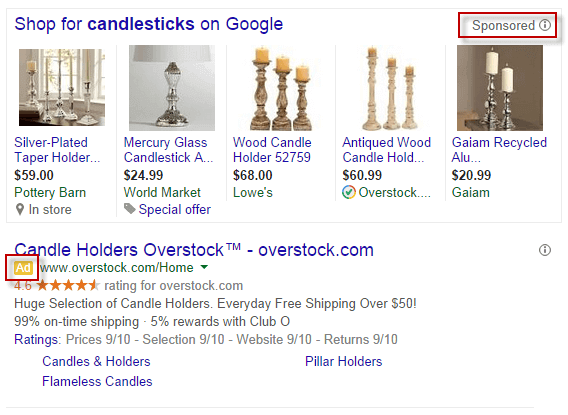
In the previous example from WordStream, a person searched for “candlesticks” on Google. The top ads shown are examples of ads that strike a balance between maximum bid and relevant, high-quality content.
Should you try marketing your MSP with paid search ads?
The short answer is that it depends on your goals and needs.
The long answer is slightly more nuanced. MSPs may have other marketing efforts and may dismiss PPC because of the associated costs. However, paid search offers measurable, manageable, efficient, and effective marketing that can benefit you more than expected.
Investing in paid search is by no means a silver bullet, but we recommend giving it a try if:
- You have the capability of creating landing pages on your MSP website that are optimized for conversion, but those pages aren’t getting enough traction from SEO alone
- You have a sales process that can reliably convert leads into customers
- You want to expand your business quickly and have some money to spend on growth (we’ll get into how much money below)
- You need fast results and want data about what appeals most to your customers by region, product, or feature
- You want to test whether a new location, new demographic, new service, etc. would work or is working for your business
The benefit of using paid search ads as an MSP
Paid search is one of the most measurable, manageable, and therefore efficient marketing channels.
That’s because once you’ve set your bids and created the corresponding ads, the search engine advertising platforms handle the rest (for the most part).
Plus, when it comes to conversions, paid search can be even more impactful than search engine optimization (SEO) methods that aim to draw traffic to a website organically (read: without paying), because it takes leads directly to a landing page that’s been optimized for conversions. Paid search can even supplement organic traffic by making casual searchers aware of your business offerings and inspiring them to continue their own research.
How much is paid search marketing going to cost me?
There’s always the big deciding factor every business must consider before diving into any new marketing channel: price.
While there are numerous variables and nuances that can affect cost-per-click, in general, businesses in the IT services industry should set aside a minimum of $2,000 to give paid search ads a fair initial test. Even that initial amount can be used quickly, as some of the most competitive IT keywords can cost $100 a click.
A good consideration to keep things in check is your customer acquisition cost compared to your average customer lifetime value, or your CAC:LTV ratio. Generally, it’s advised that this ratio should be at least 1:3; that means you should be earning back at least three times the amount you’re paying to acquire each new customer.
With that benchmark in mind, you can consider the cost of keywords and the additional costs related to closing a sale. From there, you can determine what’s an acceptable amount to spend and what isn’t.
Note that the effectiveness of your sales follow-up and closing ability will have major implications on how cost-effective any lead generation effort is (or isn’t) going to be. Before you spend a dime on paid search it’s a good idea to make sure you have a proven, repeatable sales process.
Of course, there’s also the question of outsourcing. You can hire an agency or specialist to launch and manage paid search ad campaigns for you, but keep in mind they typically charge a high hourly rate or even a percentage of your advertising budget. That makes them an expensive option better suited for MSPs who are short on time but have a longer budget.
For a visual walkthrough of a paid search campaign, please view this brief video: ‘The Ultimate Guide to Paid Search Ads for MSPs’.
How to get started with paid search
Whether you’re just getting your paid search campaign off the ground, looking to level up with experimentation, or paid search is already paying off and you’re ready for some advanced strategies—this guide has everything you need.
Step 1: Optimizing your landing page
First things first, you’ve got to have a website or at least a landing page to which your ad directs traffic. The page should be optimized with a clear CTA, such as a form, that captures key information needed to turn a cold lead into a prospect with whom you can continue communication.
For tips on landing page optimization, see this handy guide from the fine folks at Unbounce.
Step 2: Finding your keywords
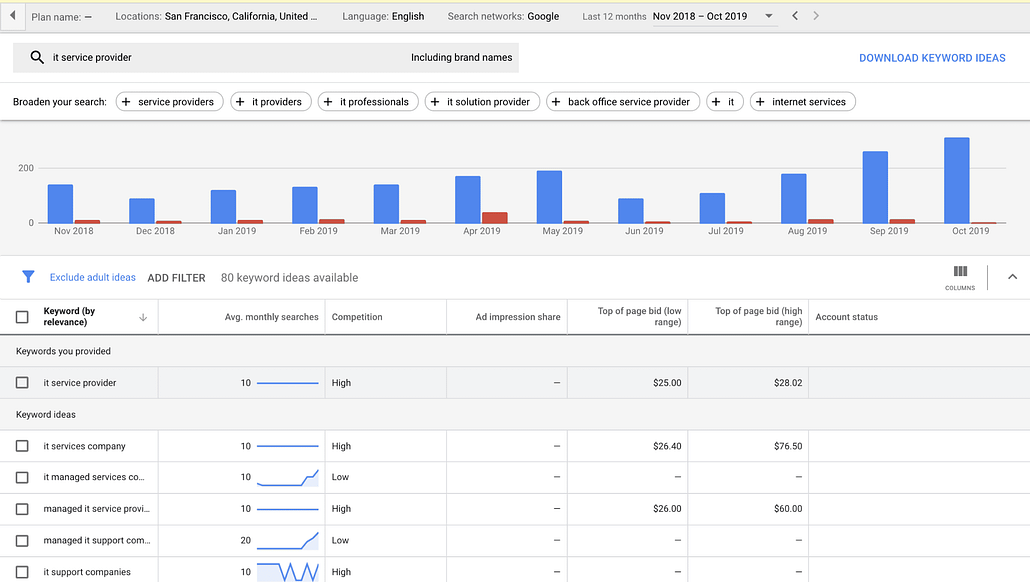
Next, prepare a list of the keywords you want to bid on. The best way to start is by brainstorming common phrases that your potential customers may be searching for. A keyword research tool, such as Google’s Keyword Planner, can help generate ideas and provide estimates for the cost of clicks in your target geographical area.
The following image shows our results when we used Keyword Planner to find keywords related to “IT Service Provider” in the San Francisco area.
Step 3: Bid on your keywords
After selecting your keywords, the final step is to set your bid per keyword, per day. A good rule of thumb is to keep the ideal CAC:LTV ratio of 1:3 in mind to determine the worth of each keyword, especially if you have a limited budget.
Here are other tips to keep in mind so you can maximize your budget:
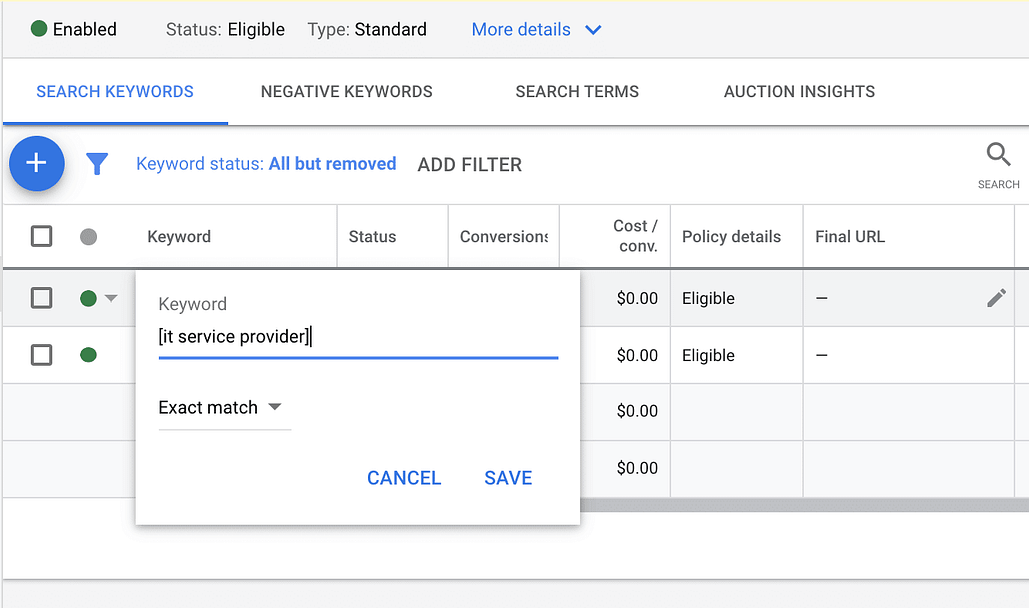
- Bid for “exact match.” This means that your ads will only be displayed during searches that are the exact same or extremely similar to the keywords on which you’ve bid. While this tactic will generate less traffic overall, each click is sure to be from someone who’s actively looking for the services you provide—and therefore more likely to convert.
- Make your bids location-based. Feel free to target your location or simply locations you like to serve. You can even get as specific as a zip code to ensure you’re advertising to your ideal audience and getting the most bang for your buck.
If you’re ready to implement these tactics to set up an affordable paid search campaign, we recommend starting with Google Ads to take advantage of the ad credits they provide for new users.
Tips for organizing and experimenting with your paid search strategy
With your paid search program up and running, you’ve earned the flexibility to take a little more time and spend a little more money to learn more about your audience and boost your results.
That means it’s time to experiment! Here are some tips to consider:
Try out different match types
Trying out different match types helps you expand your reach and potential traffic. Understanding how each match type works is crucial when testing out this strategy.
- Exact match ads will only be displayed when a search matches exact or near-exact keywords. This ensures relevant traffic, but it can be too restrictive and limit the scalability of your campaign.
- Phrase match ads are shown when a search matches a keyword or loose variations of a keyword, even if there are additional words before or after. This brings a larger volume of clicks, which you can use as insights into users’ search habits.
Bid less on irrelevant keywords
We recommend bidding less on keywords as they become less relevant to your business. However, if you have the budget, never totally rule them out because they may help you tap into customers who are looking for your services without even realizing it.
However, while you’re experimenting with match types, we recommend avoiding broad match altogether. Broad match is the default match type and will display ads for searches that include everything from misspelled words, synonyms, and more. There’s just no way to limit irrelevant clicks—each of which you’ll be paying for!
And while you’re running experiments on your match types, keep a close eye on your campaign every day for the first two weeks to ensure you’re not spending unnecessarily.
Use ad extensions
Next, if your search engine advertising platform allows for ad extensions — use them!
Learn every possible extension you can tack onto your ad and experiment with different combinations to see what searches respond to.
The following example shows a Google ad for an MSP business that features various extensions. including a phone number to location. These extensions increase the real estate your ad occupies on the page and creates valuable context for searchers.

Clean up your campaign structure
Refining your campaign structure is a good way to streamline your work and save costs, making it a valuable next step.
Group your keywords into ad groups and gather these ad groups into campaigns. Best practice suggests creating two ad groups:
1. An ad group that consists of 4-7 high volume phrase match keywords that are closely related.
2. An ad group that consists of 15-20 exact match keywords.
Next, group both ad groups into a single campaign and set the daily budget.
Once your paid search campaigns are organized in this way, you’ll be able to see how well each is performing and more effectively control your spending.
What comes next: other paid search tips and considerations
Up until now, we’ve been advertising to cold leads. But what happens after a lead clicks on your ad? Is that the end of their journey? Paired with the right marketing strategy, paid search can be a good starting point to a customer’s interaction with you.
Remarketing
Remarketing, also known as retargeting, enables businesses to show ads to search engine users who have already visited their website or landing page. It enables businesses to become familiar with their audiences, which intrinsically builds trust.
And, it works.
Search engine users who have been remarketed to are two to three times more likely to click on an ad than cold leads are.
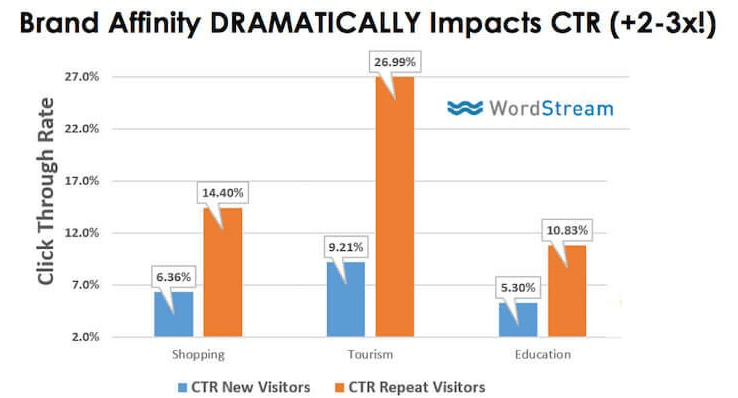
Source: WordStream
Remarketing ads can either double down on brand awareness or feature something special for the viewer—such as information about a product they may be interested in, a unique discount code, etc.
The only downside is that remarketing usually requires technical know-how and time to set up. You can choose to figure it out on your own or hire one of the many agencies that can help.
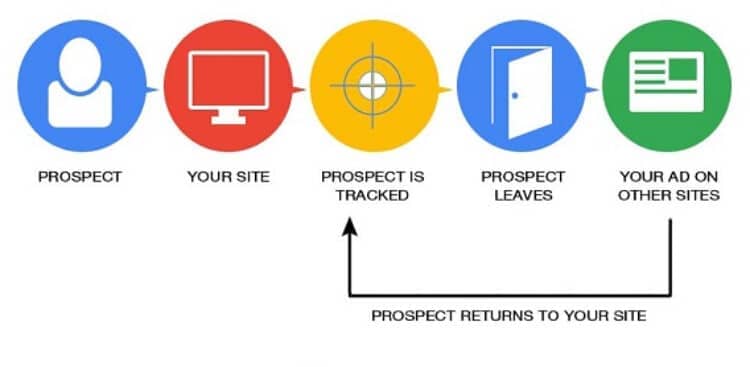
Source: PPC Protect
A/B testing
In addition to remarketing, A/B or “split” testing is a great way to further advance a paid search campaign that’s already running smoothly.
At its core, A/B testing is the practice of comparing any two versions of something to determine which one performs better. When it comes to paid search for MSPs, you could compare different audiences, different keywords, different landing pages, and so on. A/B testing should measure just one change at a time and should be conducted on a regular basis to take full advantage of its full potential.
As more and more MSPs continue to invest in paid search, it is inevitable that it will become more expensive and competitive. On top of that, audiences change—perhaps more quickly now than ever before. A/B testing gives you a way to ensure you’re getting the best return on your PPC investment.
In the following example, you’ll see how Google Ads provides a “Drafts & experiments” feature that makes it easy to allocate a percentage of your budget toward testing out different campaigns.
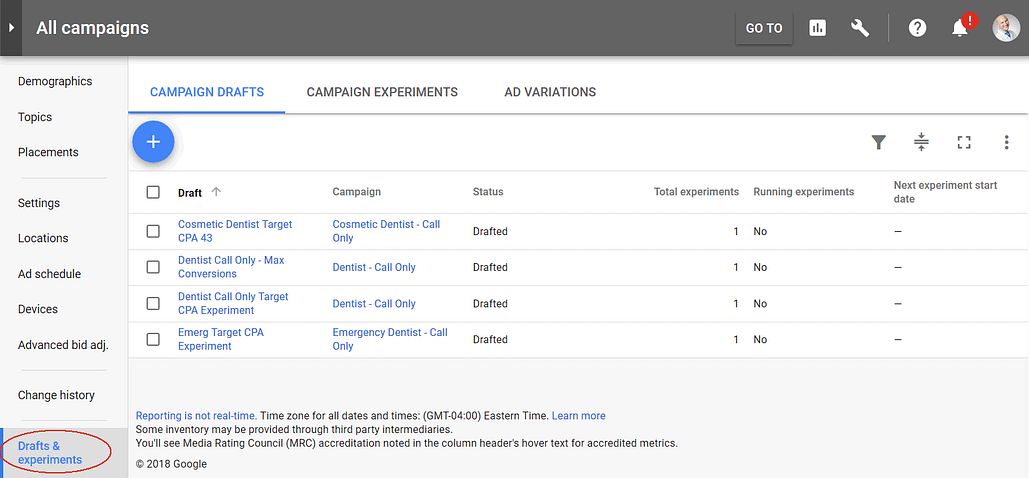
Source: WebsiteOptimization.com
Realistically, even the smartest MSP business won’t be able to come up with cutting-edge marketing ideas and every campaign won’t grow by leaps and bounds every single day. That’s why A/B testing is so important. It provides a way to automatically and incrementally improve the effectiveness of your paid search campaign without wasting a significant amount of money or salary dollars.
Can’t find the time to pursue paid search for your MSP?
While we can make you a kick-ass guide to creating a successful paid search campaign for your MSP, we can’t make you allocate the time you need to pursue this and other effective marketing strategies.
If you’re way too busy working in your business instead of on it, let us make your life easier with NinjaOne, the #1-rated RMM on G2 Crowd. Try us for free today!
Learn more in our NinjaOne RMM FAQ page to see how remote monitoring and management can help MSPs save time and scale efficiently.