Real-time browser visibility and extension risk control
Extend client endpoint management into the browser. See every extension, score risk, and enforce URL and domain policies across Chrome, Edge, and Firefox.
Continuous visibility, no manual audits client by client
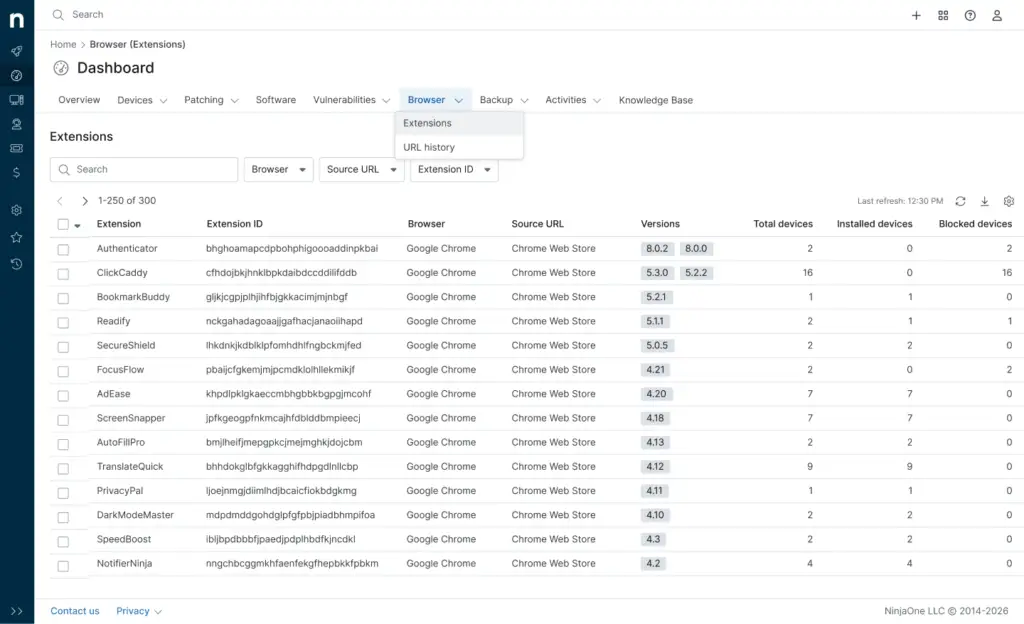
Automatically discover every extension installed across every managed device, for every client, in real time. No scripts, no spreadsheets, no chasing down device owners across a dozen different environments.
Built to enforce policy, not just report on it
Extension risk scores and web access controls connect directly into policy enforcement for one client or 50. Technicians can block, allow, or quarantine extensions without a separate follow-up step.
Native to the platform you already run
NinjaOne Browser Management runs inside the same NinjaOne agent you already use across your entire client base. No separate console, no new agent, no added infrastructure, and nothing new for your technicians to learn.
Browser Management Features
Browser extension inventory
Automatically discover every extension installed across managed devices, for every client you support. Get a full, real-time view of what’s running in the browser across all client environments without manual audits or scripting.
Extension risk scoring
Every discovered extension gets a risk score, so you can quickly spot high-risk extensions across any client, prioritize risks and make informed decisions on what to allow or block, without reviewing every extension manually.
Extension policies: deploy, block, default-deny
Push approved extensions out to a client’s fleet, block specific extensions or use default-deny so only pre-approved extensions run. Apply the same policy across all client environments or tailor policies client-by-client.
Website and domain blocking
Block access to specific websites, domains, or categories across managed devices. Enforce a consistent acceptable-use standard for any client, to reduce exposure to phishing, malware, and unapproved SaaS or AI tools.
Browser activity history
Pull browsing history from managed devices to support incident response, compliance audits, and service desk troubleshooting for any client, without deploying extra network-level tooling per site.
Multi-browser policy management
Manage Chrome, Edge, and Firefox from one workflow within the unified NinjaOne platform. Apply the same policies everywhere so standards hold no matter which browser a client’s users pick, or how many clients you’re managing at once.
Custom end-user block messages
When someone hits a blocked site or extension, show them a message that explains why. You’ll have fewer help desk tickets, more transparency, and less back-and-forth with your service desk, across every client you support.
NinjaOne Browser Management makes your life easier. You don’t have to go in manually and check for rogue extensions. A few clicks and you’re done. It’s all right in one spot. That alone is a massive selling point.”
Extend the power of NinjaOne with deep integrations that sync data, automate workflows, and streamline device, security, and service operations in one platform.
It extends the endpoint management you already deliver into the browser, giving you visibility, policy control, and risk reduction across Chrome, Microsoft Edge, and Firefox for every client you manage. It’s built directly into the NinjaOne platform, so you manage the browser the same way you already manage endpoints, with no new tool or client onboarding process required.
Why does the browser need to be managed like an endpoint?
The browser is where work happens now. SaaS apps, identity providers, AI tools, and sensitive client data all flow through it. Most of your clients are still managing that layer with scripts, GPOs, or nothing at all, and that gap is where risk builds up, client by client.
Can I apply different policies to different clients?
Yes. Extension and web access policies are applied at the level you choose. Standardize a baseline across your whole book of business, then layer in client-specific rules where a client’s risk tolerance or regulatory requirements call for it.
Do I need a separate agent, console, or infrastructure per client?
No. Browser Management is embedded in the NinjaOne platform and delivered through the existing endpoint agent your clients already run. There’s no separate infrastructure to stand up, no new tool for your technicians to learn, and no extra agent to deploy across your client base.
How does extension risk scoring help my technicians work faster?
Every discovered extension is scored and evaluates permissions, web store data, and other signals. Instead of reviewing every extension by hand across every client, your technicians can triage by risk score and focus their time on what actually needs attention.
What is a default-deny extension policy, and when should I use it for clients?
A default-deny policy blocks every extension except the ones you’ve explicitly approved. It’s the most secure posture for extension governance and fits well for clients in regulated industries, security-conscious accounts, or any client where you want to shut down extension sprawl without a lot of ongoing maintenance on your end.
How is this different from the GPOs or scripts we use today?
GPOs and scripts are static and reactive. They need manual updates per client, drift out of date, and can’t give you continuous visibility into what’s happening in the browser across your book of business. Browser Management enforces policy continuously and gives you real-time activity data inside the workflows you already use.
How does this help with AI tool governance for clients?
Most AI tool use happens in the browser. NinjaOne Browser Management lets you see which AI tools are being accessed on a client’s devices and apply extension and web access policies to control what’s allowed. This is often the first real visibility a client has into their own AI usage.
How does this help me grow my revenue?
Browser visibility, extension governance, and web access control become a service you can package and sell, not just a feature you enable for free. Smaller MSPs get an easy entry point using workflows they already know. Larger MSPs and MSSPs can standardize policy enforcement and reporting across every client, and price it as a distinct security tier.
How hard is it to roll out across our existing clients?
NinjaOne Browser Management is built to be operationally simple. Because it’s embedded in NinjaOne, there’s no new infrastructure, no scripting, and no specialized browser management expertise needed. You can start gaining visibility and enforcing basic policy for a single client right away, then extend it across the rest of your book on your own timeline.